

Catalogue des publications
Les achats en ligne sont suspendus, sauf pour les fichiers. Veuillez contactez : ventes@ifao.egnet.net. J'ai un code promotionnel.
On line orders are suspended, except for files. Please contact : ventes@ifao.egnet.net. I have a promotional code.
Cahiers des Annales islamologiques (CAI)
Les Cahiers des Annales islamologiques (CAI) s’inscrivent aussi bien dans la tradition savante du monde arabo-musulman que dans les approches des disciplines plus contemporaines.
La série "Sources" propose des éditions scientifiques de textes, en arabe comme dans les autres langues de culture pratiquées dans le monde arabo-musulman aux époques médiévale, moderne et contemporaine.
La série "Monographies" met en valeur les sujets les plus variés, de l’étude érudite à l’essai novateur sur des thèmes transversaux.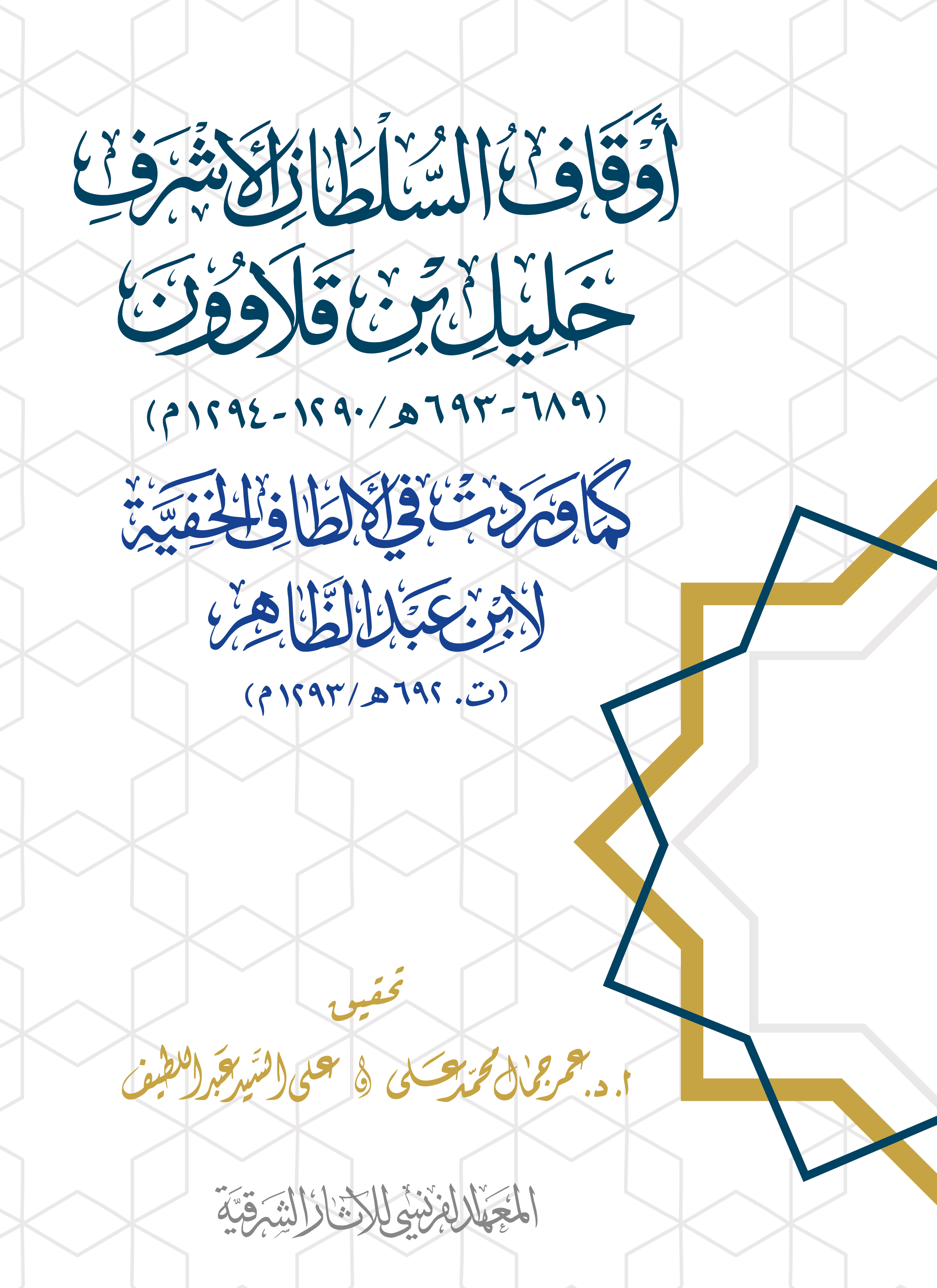
Omar Jamal Mohamed Ali, Ali al-Sayyid Abdelatif
أوقاف السُّلْطان الأشْرف خليل بن قَلاوون كما وردت في الألطاف الخفيّة من السِّيرة الشَريفة السُّلطانيّة المَلَكيّة الأشرفيّة لمُحيي الدّين بن عبد الظّاهر ويليه:
النَّقش الكتابي للقُبّة الأَشْرفية مرسومان للسُّلْطان الأشرف إلى رُهبان دير سانت كاترين وثيقة ثبوت أوقاف السُّلْطان الأَشرف خليل في العَصر العثماني
يُقدم هذا الكتاب النصّ الكامل لأوقاف السُّلْطان الأشرف خليل بن قَلاوون (689-693 هـ/1290-1294 م) على مدرسته المعروفة بالمدرسة الأشرفية بالقاهرة وعلى مصالح القُبَّة المَنصورية التي أنشأها والده السُّلْطان المَنصور قَلاوون. وقد حفظ لنا هذا النصّ المؤرخ مُحيي الدِّين عبد الله بن عبد الظَّاهر (620-692 هـ/1223-1293 م) في كتابه الألطاف الخفيَّة من السِّيرة الشَّريفة السُّلْطانية المَلَكيّة الأشرفية.
وبالإضافة إلى نصوص أربعة أوقاف ومقدمة عن حياة هذا السُّلْطان المملوكي وناظر وقفه شَمس الدِّين ابن السَّلعُوس والمؤرخ مُحيي الدِّين عبد الله بن عبد الظَّاهر، يقدم الكتاب للقارئ ملاحق مهمة منها وثيقة ثبوت أوقاف السُّلْطان الأَشرف في العَصر العثماني (٩٥٤ هـ)، ومرسومان يتعلقان بحماية رهبان دير سانت كاترين بسيناء من المظالم والمغارم.
ويرسم الكِتَاب بفضل نصوص الأوقاف المنشورة صورة طبوغرافية لبعض الأماكن بمدينة القاهرة في نهاية القرن السابع الهجري/الثالث عشر الميلادي، فضلا عن وصفه القرى التي أوقفها الأشرف خليل بن قَلاوون في ساحل صور وعَكَّا بعد تحريرهما من أيدي الصَّليبيين.
Cet ouvrage présente les textes intégraux des waqf-s du sultan al-Ašraf Ḫalīl ibn Qalāwūn (689-693 H/1290-1294 J.-C.) au bénéfice de son école connue sous le nom d'al-Madrasa al-ašrafiyya, au Caire, et des services d’al-Qubba al-Manṣūriyya, fondée par son père, le sultan al-Manṣūr Qalāwūn. Ces textes ont été conservés par l'historien Muḥyī al-Dīn ʿAbdallāh ibn ʿAbd al-Zāhir (620-692 H/1223-1293 J.-C.) dans son ouvrage al-Alṭāf al-ḫafiyya min al-sīra al-šarīfa al sulṭāniyya al-malakiyya al-ašrafiyya.
Outre les textes de ces quatre waqf-s et une introduction sur la vie de ce sultan mamelouk, de l’administrateur de son waqf, Šams al-Dīn ibn al-Salʿūs, et de l'historien Muḥyī al-Dīn ʿAbdallāh ibn ʿAbd al-Zāhir, le livre comporte d’importantes annexes, dont un document datant de 954 H/1547 J.-C., attestant les waqf-s d’al-Ašraf Ḫalīl ibn Qalāwūn à l'époque ottomane, et deux décrets relatifs à la protection des moines du monastère Sainte-Catherine (Sinaï) contre les injustices.
Les textes des waqf-s publiés dans ce livre permettent de dresser une image topographique de certains lieux du Caire de la fin du VIIe siècle/XIIIe siècle. Il contient également une description de villages situés sur la côte de Tyr et d'Acre qu’al-Ašraf Ḫalil ibn Qalāwūn a donnés en waqf après l’expulsion des croisés de ces deux villes.
This work presents the complete texts of the waqf-s of Sultan al-Ašraf Ḫalīl ibn Qalāwūn (689-693 AH/1290-1294 AD) for the benefit of his school known as al-Madrasa al-ašrafiyya, in Cairo, and of the services of al-Qubba al-Manṣūriyya, founded by his father, Sultan al-Manṣūr Qalāwūn. These texts were preserved by the historian Muḥyī al-Dīn ʿAbdallāh ibn ʿAbd al-Zāhir (620-692 AH/1223-1293 AD) in his work al-Alṭāf al-ḫafiyya min al-sīra al-šarīfa al sulṭāniyya al-malakiyya al-ašrafiyya. Besides the texts of these four waqf-s and an introduction on the life of this Mamluk sultan, the administrator of his waqf, Šams al-Dīn ibn al-Salʿūs, and the historian Muḥyī al-Dīn ʿAbdallāh ibn ʿAbd al-Zāhir, the book includes important appendices, including a document dating from 954 AH/1547 AD, attesting to the waqf-s of al-Ašraf Ḫalīl ibn Qalāwūn in the Ottoman period, and two decrees relating to the protection of the monks of the Monastery of Saint Catherine (Sinai) against injustices.
The waqf-s texts published in this book allow us to create a topographical picture of certain places in Cairo at the end of the 7th/13th century. It also contains a description of villages located on the coast of Tyre and Acre that al-Ašraf Ḫalil ibn Qalāwūn donated as waqf after the expulsion of the crusaders from these two cities.
- Omar Jamal Mohamed Ali
عمر جمال محمد علي إبراهيم أستاذ التاريخ والحضارة الإسلامية بكلية الآداب بجامعة سوهاج بجمهورية مصر العربية، وأستاذ مشارك بكلية الآداب والعلوم الإنسانية بالجامعة القاسمية بدولة الإمارات العربية المتحدة، وهو متخصص في دراسة ونشر وتحقيق المجموعات الوثائقية الأرشيفية الخاصة بعصري سلاطين الأيوبيين والمماليك. - Ali al-Sayyid Abdelatif
علي السيد عبد اللطيف، باحث ومحقق في التراث الإسلامي، حاصل على ماجستير من معهد البحوث والدراسات العربية بالقاهرة، وله عدة دراسات في الفقه والتاريخ الإسلاميين.
- Vous pouvez acquérir ce(s) fichier(s) PDF issu(s) de cet ouvrage en cliquant sur le nom du fichier puis 'Ajouter au panier'.
- You can buy theses PDF files extracted from this book by clicking on the file name then 'Add to cart'.
ISBN 9782724711257
2025 IFAO
Collection: CAI 37
Langue(s): français
1 vol. 148 p.
16 € (842 EGP)
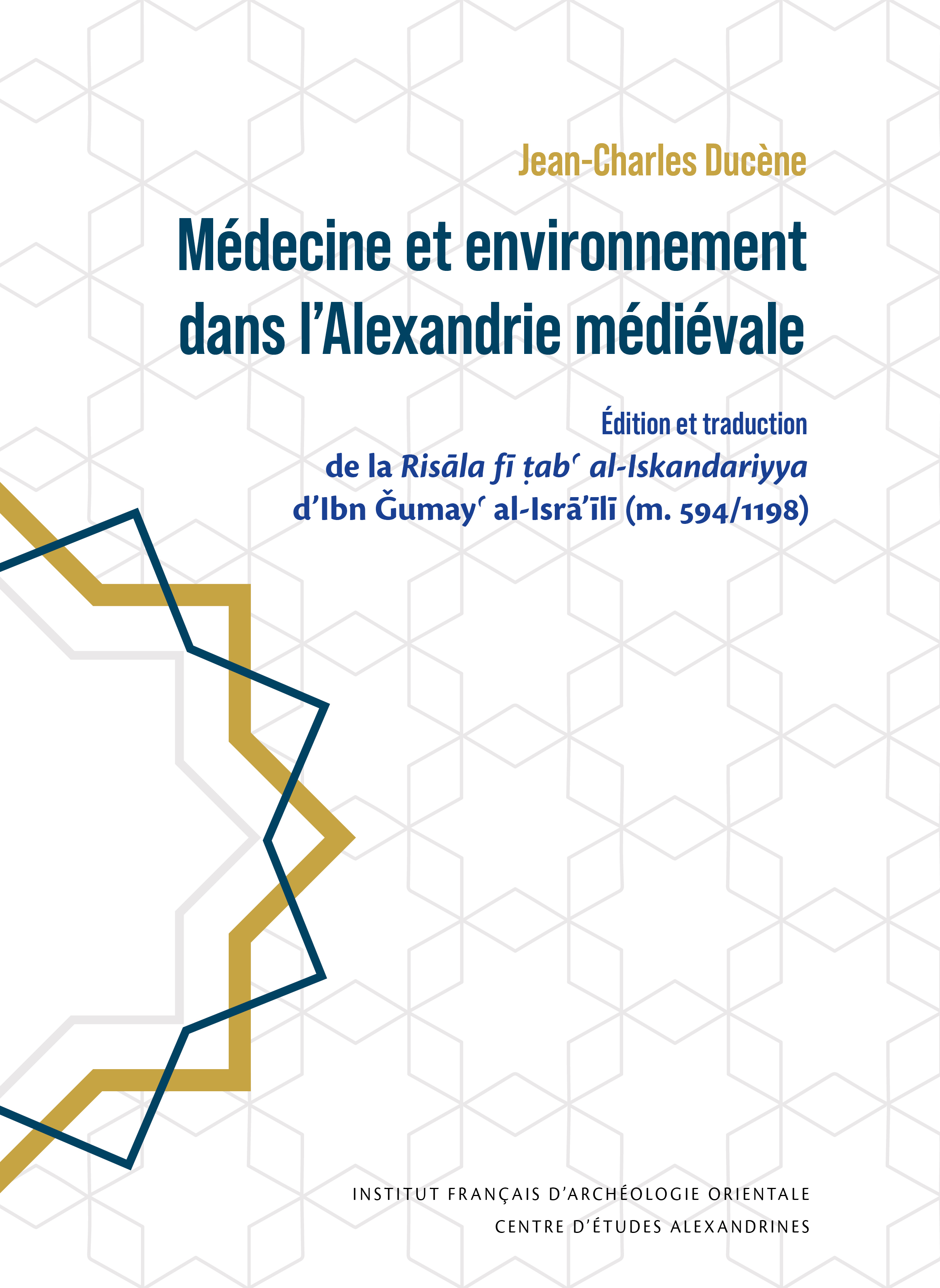
Jean-Charles Ducène
Médecine et environnement dans l'Alexandrie médiévale
Édition et traduction de la Risāla fī ṭabʿ al-Iskandariyya d’Ibn Ǧumayʿ al-Isrā’īlī (m. 594/1198)
Alors que tout au long de l’époque médiévale, Alexandrie a joué, grâce à son port, un rôle prépondérant dans l’ouverture de l’Égypte sur la Méditerranée, peu de monographies lui ont été consacrées par des auteurs égyptiens.
À côté du Kitāb al-ilmām d’al-Nuwayrī al-Iskandarānī (viiie/xive siècle), il y a cette Épître sur la nature d’Alexandrie du médecin juif Hibat Allāh ibn Ǧumayʿ (m. 594/1198), qui travailla au Caire, dans l’entourage de Saladin.
Avec pour paradigmes les critères de la médecine hippocratique et après un séjour de six mois dans cette ville, l’auteur décrit sa situation sanitaire en précisant sa topographie et son exposition aux éléments naturels. Il s’arrête sur le régime alimentaire et le mode de vie de ses habitants au vie/xiie siècle, donnant un aperçu des boissons et aliments qu’ils consommaient et mettant en lumière en quoi ce régime convenait ou pas à son environnement car, selon la médecine médiévale, l’inadéquation entre climat et alimentation était à l’origine de déséquilibres humoraux, sources de maladies. Cette riche description se clôt par des recommandations diététiques et thérapeutiques en accord avec la science médicale de époque.
Témoignage rare sur la vie alexandrine au Moyen-âge, ce livre est également un aperçu des applications environnementales de la médecine hippocratique.
Although Alexandria, thanks to its port, played a leading role throughout the Middle Ages in opening up Egypt to the Mediterranean, few monographs by Egyptian authors have been devoted to it. Besides the Kitāb al-ilmām by al-Nuwayrī al-Iskandarānī (fl. 770/1360), there is this Epistle on the Nature of Alexandria by the Jewish physician Hibat Allāh ibn Ǧumayʿ (d. 594/1198), who worked in Cairo in Saladin's entourage. Using the criteria of Hippocratic medicine as his paradigms, and after a six-month stay in the city, the author describes its health situation, specifying its topography and its exposure to the natural elements. He examines the diet and lifestyle of the city's inhabitants in the 6th/12th century, giving an overview of the food and drink they consumed and highlighting the ways in which this diet was or was not adapted to its environment, since, according to medieval medicine, the mismatch between climate and diet was the cause of humoral imbalances, which were a source of disease. This rich description concludes with dietary and therapeutic recommendations in line with the medical science of the time. A rare glimpse into life in medieval Alexandria, this book also offers an insight into the environmental applications of Hippocratic medicine.
على الرغم من أن مدينة وميناء الإسكندرية لَعِبَا دورًا رئيسيًا طوال العصر الوسيط في انفتاح مصر على البحر المتوسط، إلا أن الكُتاب المصريين لم يفردوا لها مؤلَّفًا، باستثناء "كتاب الإلمام" للنويري الإسكندراني. بيد أن هذه الفجوة يرأبها كتاب "رسالة في طبع الإسكندرية" للطبيب اليهودي هبة الله – أي نثنائيل – ابن جُمَيْع (ت ٥٩٤هـ/ ١١٩٨م) الذي كان يعمل في بلاط صلاح الدين بالقاهرة. فوفق نموذج يقوم على معايير طب أبقراط وقواعده، وبعد إقامته في المدينة لمدة ستة شهور، يصف لنا المؤلف الوضع الصحي للمدينة وطوبوغرافيتها وتعرضها لعناصر الطبيعة. وفي نحو عشرة فصول، يتوقف الكاتب عند النظام الغذائي لأهل المدينة وأسلوب حياتهم بغية تسليط الضوء على ما يتوافق فيه وما يتعارض منه مع ما تحث عليه البيئة حسب رأيه، إذ تُسبِّب حالات عدم التلاؤم في هذا اختلالًا في المزاج، يكون بدوره مصدرًا للمرض. هكذا صنّف ابن جُمَيع قائمة مفصّلة للمشروبات والمأكولات المستهلكة من قبل سكان المدينة في القرن الثاني عشر الميلادي، قبل أن يُقَدِّم بعض النصائح حول النظام الغذائي والعلاج والطب الوقائي بما يتفق مع علوم عصره.
- Jean-Charles Ducène (
 : 079163564)
Jean-Charles Ducène est directeur d’études à l’École pratique des hautes études/PSL. Son enseignement porte sur les sciences naturelles et la géographie arabes médiévales. Il a notamment édité L’Afrique dans le Uns al-muhaǧ d’al-Idrīsī (Louvain, 2010) et a coédité le Dictionnaire géographique de l’Afrique médiévale (Paris, 2023).
- Vous pouvez acquérir ce(s) fichier(s) PDF issu(s) de cet ouvrage en cliquant sur le nom du fichier puis 'Ajouter au panier'.
- You can buy theses PDF files extracted from this book by clicking on the file name then 'Add to cart'.
ISBN 9782724709766
2023 IFAO
Collection: CAI 36
Langue(s): français
1 vol. 248 p.
23 € (1211 EGP)
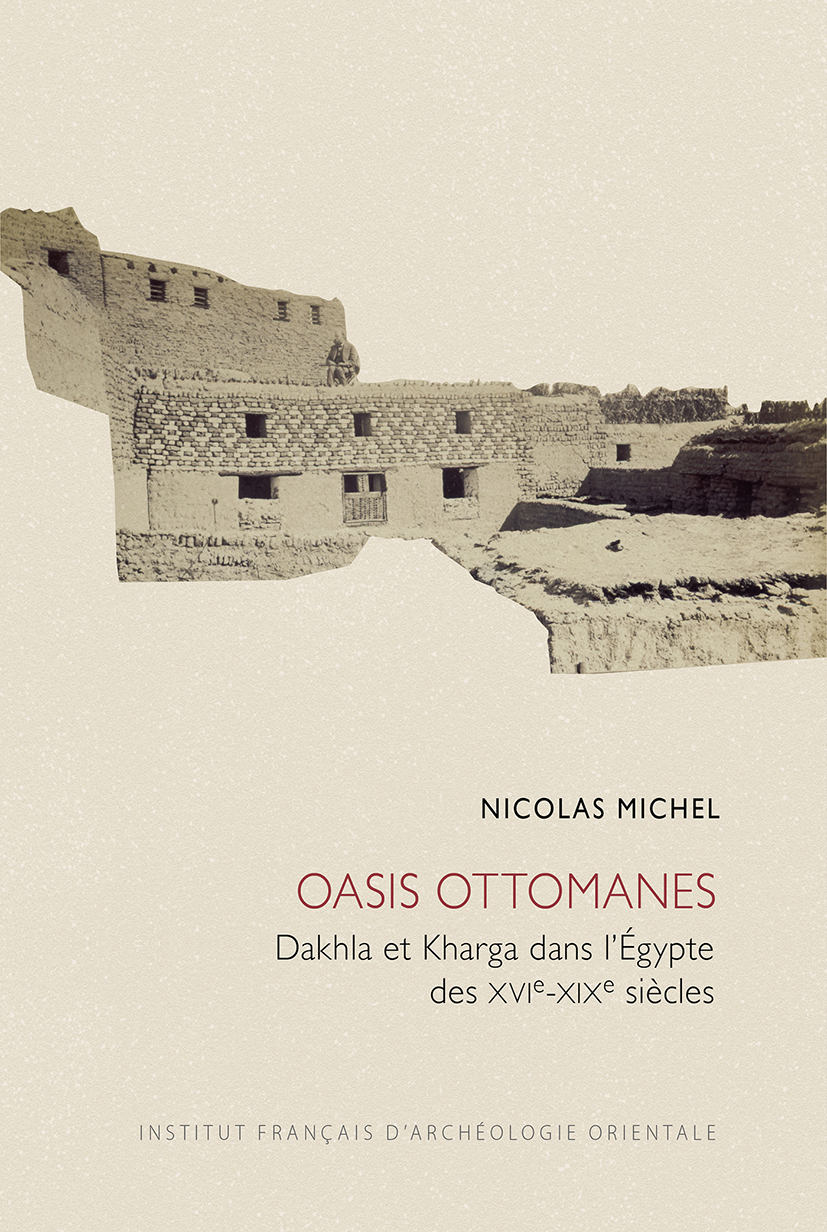
Nicolas Michel
Oasis ottomanes
Dakhla et Kharga dans l’Égypte des XVIe-XIXe siècles
Ce livre explore la place des oasis de Dakhla et Kharga dans l’Égypte et l’empire ottomans. Il entend contribuer à la réflexion sur les caractéristiques et les limites de la notion d’ottomanité, vue par les habitants de cette région qui, du Caire, paraissait lointaine et isolée. Il s’appuie sur plusieurs ensembles d’archives privées, en grande partie inédits, complétés par les récits de voyageurs et la documentation de l’époque contemporaine. En dépit de leur éloignement de la Vallée du Nil et de leur milieu naturel très spécifique, les Oasis étaient encadrées sur les plans administratif et judiciaire de la même manière que le reste de l’Égypte. Leur fiscalité était spécifique, comme l’étaient leurs ressources, avant tout agricoles. En raison de la menace de raids bédouins, elles abritaient une importante garnison. Le livre étudie les effets de cette présence militaire sur la société oasienne des XVIe-XVIIIe siècles, et montre l’effacement graduel des spécificités ottomanes, puis de leur mémoire, au cours du XIXe siècle.
This book explores the position of the Dakhla and Kharga oases within Ottoman Egypt as well as the whole empire. It intends to contribute to the reflection on the characteristics and limits of Ottomanity as seen by the inhabitants of a region which, from Cairo, seemed remote and isolated. It is based on several sets of private archives, largely unpublished, supplemented by travelogues and by modern literature. Despite their remoteness from the Nile Valley and a unique environment, the Oases were integrated in the same administrative and judicial frame as the rest of Egypt. Taxation was specific as were the primarily agricultural resources. Because of the threat of Beduin raids, the Oases housed a large garrison. The book studies the impact of this military presence upon the Oasian society from the sixteenth to the eighteenth century, and the gradual erasure of Ottoman peculiarities, then of their memory during the nineteenth century.
- Nicolas Michel ( : 15681594X)
Nicolas Michel, historien, arabisant, ancien directeur des études à l’Ifao, est professeur d’histoire contemporaine à Aix-Marseille Université. Il travaille sur l’histoire des sociétés rurales du monde arabe pré-moderne. Après une thèse sur l’économie rurale du Maroc au XIXe siècle (publiée sous le titre Une économie de subsistances. Le Maroc précolonial, Ifao, 1997), il a porté ses recherches sur l’Égypte ottomane, publiant notamment L’Égypte des villages autour du seizième siècle, Peeters, 2018 et, en co-direction avec Benjamin Lellouch, Conquête ottomane de l’Égypte (1517). Arrière-plan, impacts, échos, Brill, 2013.
- Vous pouvez acquérir ce(s) fichier(s) PDF issu(s) de cet ouvrage en cliquant sur le nom du fichier puis 'Ajouter au panier'.
- You can buy theses PDF files extracted from this book by clicking on the file name then 'Add to cart'.
ISBN 9782724707496
2021 IFAO
Collection: CAI 35
Langue(s): anglais
1 vol. 192 p.
28 € (1474 EGP)
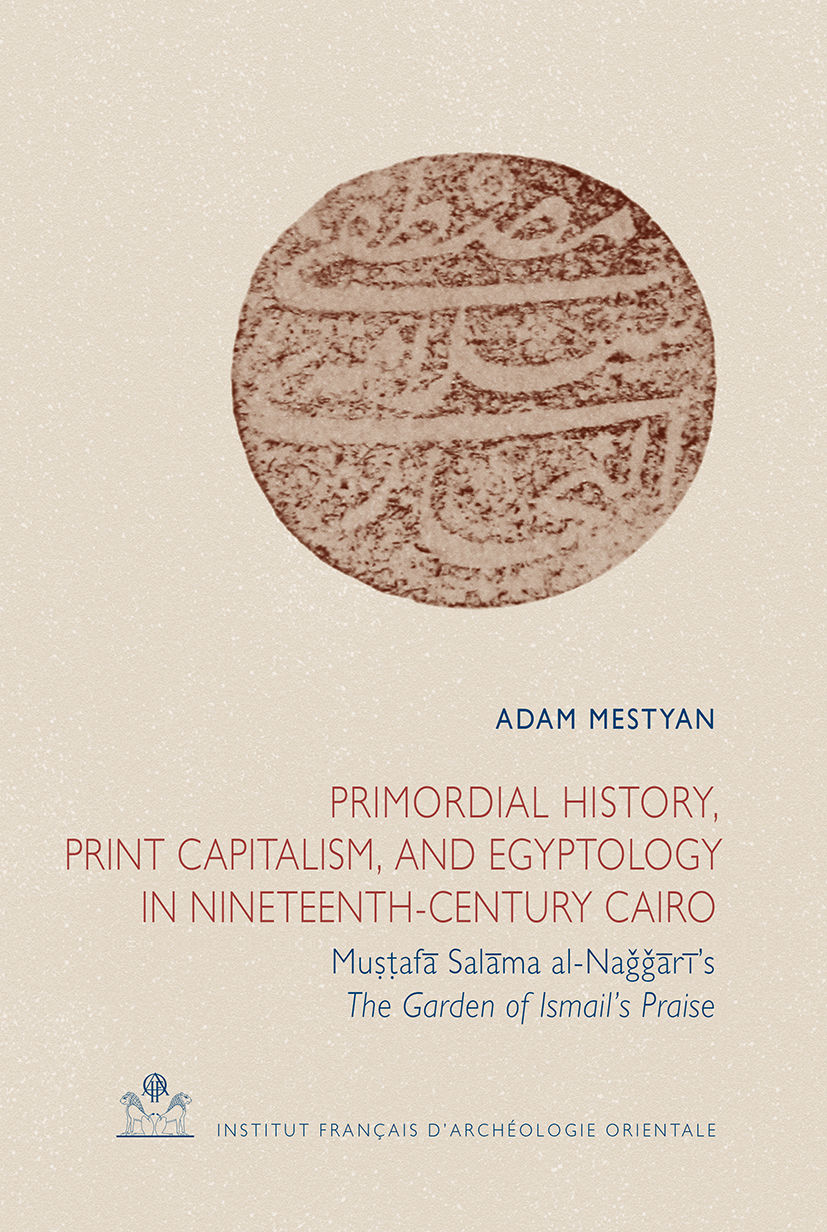
Adam Mestyan
Primordial History, Print Capitalism, and Egyptology in Nineteenth-Century Cairo
Muṣṭafā Salāma al-Naǧǧārī’s. The Garden of Ismail’s Praise
How old is the world? This question was a central problem for Muslims, Christians, and Jews in the face of the new scientific discoveries in the nineteenth century. This book introduces the answer from a Muslim point of view, outside of official institutions. The extended introduction – a microhistory in the Middle East – explores the life and œuvre of a forgotten Egyptian intellectual and poet, Muṣṭafā Salāma al-Naǧǧārī (d. 1870). Next, A. Mestyan provides the English translation and Arabic transcription of the surviving fragments of al-Naǧǧārīʼs manuscript, The Garden of Ismail’s Praise. This is a universal history of Egypt, written while the Suez Canal was under construction to praise the governor Khedive Ismail (r. 1863-1879). The author advocates a unique solution to computing the period of primordial history, before the Deluge, in the age of steam and print. Al-Naǧǧārī's alternative Nahḍa voice is available for the first time in this edition.
- Adam Mestyan ( : 201666359)
Adam Mestyan is Assistant Professor at the History Department of Duke University. His first monograph was Arab Patriotism – The Ideology and Culture of Power in Late Ottoman Egypt (Princeton University Press, 2017).
- Vous pouvez acquérir ce(s) fichier(s) PDF issu(s) de cet ouvrage en cliquant sur le nom du fichier puis 'Ajouter au panier'.
- You can buy theses PDF files extracted from this book by clicking on the file name then 'Add to cart'.
ISBN 9782724707182
2018 IFAO
Collection: CAI 34
Langue(s): français
1 vol. 168 p.
24 € (1263 EGP)
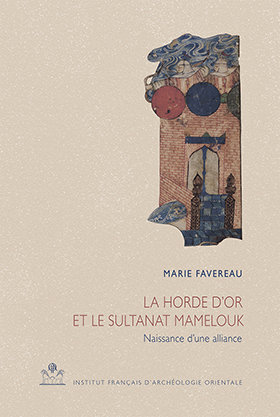
Marie Favereau
La Horde d'or et le sultanat mamelouk
Naissance d'une alliance (660/1261-662/1264)
En 1260, l’empire mongol est au faîte de sa puissance. Mais les descendants de Gengis Khan sont profondément divisés sur le choix du Grand Khan. Ces divisions profitent au sultanat mamelouk en guerre contre les Mongols. Le sultan Baybars parvient alors à se rapprocher d’une des branches les plus puissantes de l’empire mongol, la Horde d’Or, qui est en voie d’islamisation et vise l’indépendance. Cette alliance permet aux Mamelouks de repousser leurs adversaires, d’accroître leur puissance et de sauver le dār al-islām.
À partir d’une reconstitution inédite des premiers échanges diplomatiques entre le sultan mamelouk et le khan de la Horde d’Or, ce livre retrace la rencontre improbable de deux puissances aux cultures radicalement différentes, séparées par des distances immenses pour l’époque, et dont l’alliance aura des effets géopolitiques à long terme au Proche-Orient, en Russie et en Asie Centrale.
In 1260, the Mongol empire was at the heyday of its power. Yet, Chinggis Khan’s descendants could not agree among themselves on the choice of the Great Khan. At war with the Mongols, the Mamluk sultanate took advantage of their divisions. Sultan Baybars managed to create an alliance with the Golden Horde, one of the most powerful branches of the Mongol empire, which was on the path of islamization and seeking for independence. This alliance would allow the Mamluks to repel their adversaries, increase the sultanate’s power, and save the dār al-islām.
By revealing the untold story of the first diplomatic exchanges between the Mamluk sultan and the khan of the Golden Horde, this book uncovers the improbable encounter of two powers with great cultural and physical distances between them. Their alliance would have long-term geopolitical impacts on the Near East, Russia, and Central Asia.
- Marie Favereau ( : 09465929X)
Marie Favereau est docteur en Histoire de l’université de La Sorbonne-Paris IV et de l’università degli Studi di San Marino. Après avoir été membre scientifique de l’Institut français d’archéologie orientale du Caire, elle a travaillé comme chercheur à l’Institut des études avancées de Princeton et à l’université de Leyde. Depuis 2014, elle est membre du projet ERC Nomadic Empires et Research Associate à l’université d’Oxford où elle poursuit ses travaux sur les Mongols, les Mamelouks et l’histoire comparée des empires nomades.
ISBN 9782724706819
2016 IFAO
Collection: CAI 33
Langue(s): français
1 vol. 112 p.
19 € (1000 EGP)
Yūsuf Rāġib
Transmission de biens, mariage et répudiation à Uqlūl, village du Fayyoum, au Ve/XIe siècle
La papyrologie arabe s’attache à publier des documents dispersés dans les collections d’Orient et d’Occident qui éclairent souvent le quotidien de simples gens oubliés des sources narratives. Revenus au jour au hasard de fouilles officielles ou clandestines, ils doivent être patiemment déchiffrés et longuement commentés. Yūsuf Rāġib, papyrologue réputé, édite, traduit et commente ici huit papiers et parchemins rédigés au cours du XIe siècle dans un village obscur du sud du Fayyoum. Découverts à la fin du XIXe siècle, six gagnèrent Londres et deux Berlin. Les cinq premiers sont des actes provenant des archives d’une famille musulmane, les Banū Barmūda ; les trois derniers, des contrats de mariage dont le second fut dissous deux ans plus tard. Le contrat le plus important, écrit sur le plus grand parchemin arabe connu à ce jour, révèle l’opulence d’un émir bédouin qui imposait aux villageois une protection rémunérée : l’année même où le calife al-Mustanṣir survivait dans son palais lors d’une famine sans fin qui régnait dans le pays, il offrait à son épouse une dot considérable et lui promettait nombre de présents somptueux.
Arabic papyrology seeks to publish documents, scattered in the collections of East and West, that often illuminate the daily life of simple people forgotten by narrative sources. Brought to light by official or clandestine excavations, these documents need to be patiently deciphered and commented at length. Yūsuf Rāġib, papyrologist of renown, edits, translates and comments here eight documents on paper and parchment written in the eleventh century in an obscure village in southern Fayyoum. Discovered in the late nineteenth century, six of these documents found their way to London and two to Berlin. The first five belong to the archives of a Muslim family, the Banū Barmuda; the last three are marriage contracts, one dissolved two years after its conclusion. The most important contract, which happens to be the largest Arabic document on parchment known to date, reveals the opulence of a Bedouin emir who imposed a paid protection on the villagers. The year in which Caliph al-Mustanṣir survived in his palace a famine that would not end, the emir offered his wife a rich dowry while promising many more sumptuous presents.
- Yūsuf Rāġib ( : 028277457)
ISBN 9782724705782
2011 IFAO
Collection: CAI 32
Langue(s): français
1 vol. 140 p.
15 € (789 EGP)
Henri Bresc, Yūsuf Rāġib
Le sultan mérinide Abû l-Hassan ‘Alî et Jacques III de Majorque. Du traité de paix au pacte secret
À la différence des Archives du monde arabe, les chancelleries européennes ont conservé de nombreux traités de paix et de commerce passés au Moyen Âge avec les États musulmans. La Bibliothèque nationale de Paris renferme en particulier un document particulièrement riche et éclairant, le traité de paix passé le 15 avril 1339 à Tlemcen entre le souverain mérinide Abū l-Ḥasan ‘Alī, alors au faîte de sa puissance militaire, et les ambassadeurs de Jacques III, roi de Majorque.
Le traité jette une vive lumière sur les relations politiques et économiques entre les États riverains de la Méditerranée occidentale et sur le discours diplomatique qui les traduit. Le Maroc mérinide constituait pour le roi de Majorque un recours et un allié contre son suzerain, son parent et ennemi Pierre IV d’Aragon. L’alliance projetée ne sera pas conclue, et le royaume de Majorque annexé en 1343 à l’Aragon.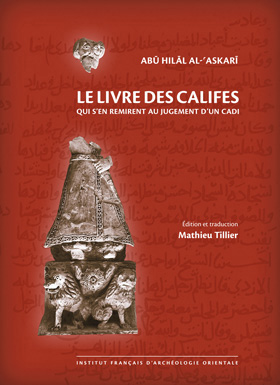
ISBN 9782724705546
2011 IFAO
Collection: CAI 30
Langue(s): arabe, français
1 vol. 103 p.
20 € (1053 EGP)
Abû Hilâl Al-‘Askarî, Mathieu Tillier (éd.)
Le livre des califes qui s’en remirent au jugement d’un cadi . . . .أبو هلال العسكري، كتاب ما احتكم به الخلفاء إلى القضا ة
Ce court ouvrage d'adab, écrit par Abū Hilāl al-ʿAskarī (m. vers 400/1010), marque une étape essentielle dans l’histoire des relations entre les pouvoirs politique et judiciaire. À travers une série de récits pseudo-historiques, l’auteur entend démontrer que le souverain, avant même d’agir en justicier, doit accepter de se soumettre au jugement des hommes. Ce bref miroir des princes d’époque būyide vient couronner une longue évolution doctrinale issue des tensions entre le sommet de l’État et la judicature : en plaçant les califes sous l’autorité judiciaire des cadis, Abū Hilāl contribue à la désacralisation de l’institution califale et à la promotion d’une magistrature indépendante.
Mathieu Tillier, chercheur à l’Institut français du Proche-Orient (Ifpo), propose ici l’édition du texte arabe, précédée d’une introduction et accompagnée d’une traduction française.
This short adab treatise by Abū Hilāl al-ʿAskarī (d. c. 400/1010) marks an important turning point in the relationship between political power and the judiciary in Islam. Written in the Būyid period as a concise mirror for princes, the work sanctions a doctrinal evolution that is the outcome of long-standing tension between the judiciary and the highest levels of the state. Using a series of pseudo-historical narratives, Abū Hilāl suggests that rulers should be prepared to submit to the adjudication of ordinary men. By presenting caliphs as being under the judicial authority of qāḍī-s, the author contributes to the de-sacralisation of the caliphate and to the promotion of an independent judiciary.
Mathieu Tillier, researcher at the Institut français du Proche-Orient (Ifpo), presents a critical edition of the text with an introduction and a translation into French.
تلخيص: يمثّل كتاب أبي هلال العسكري (المتوفّى في حوالي عام 400 ه/1010 مـ) الذي بين أيدينا مرحلة هامّة في تاريخ العلاقات بين السلطات السياسية والقضائية. فإنّ المؤلّف يبيّن عبر تسلسل من الأخبار أنّ السلطان العادل لا يمكنه تجسّد السلطة القضائية إلّا بعد أن خضع لأحكام قضاته. فهذا الكتاب، المؤلَّف في العصر البويهي والمنتمي إلى جنس آداب الملوك، يتوّج تطوّراً نظريّاً هامّاً نجم عن توتّر العلاقات بين القضاة والدولة العبّاسية. فمن خلال وصفه للعديد من الخلفاء المستسلمين لأحكام القضاة، يسهم أبو هلال في إزالة هالة القدسيّة عن الخلافة والدفاع عن مؤسّسة قضائيّة مستقلّة.
قام ماتيو تيليه، وهو باحث في المعهد الفرنسي للشرق الأدنى، بتقديم الكتاب وتحقيقه قبل ترجمته إلى الفرنسية.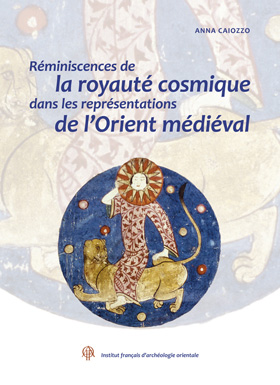
Anna Caiozzo
Réminiscences de la royauté cosmique dans les représentations de l’Orient médiéval
Dans l’Orient ancien, les cieux investissent les rois lors de leur avènement. Le roi est alors, comme dans l’Iran préislamique, promu frère des astres, doté de prérogatives qui lui permettent de faire régner sur Terre l’ordre cosmique. Le corps du roi est garant de cette stabilité. Le monde musulman hérite de cette dimension qui assure la promotion du calife ou de l’imam selon les doctrines du pouvoir, comme étant « l’ombre de Dieu sur Terre ». Cet aspect essentiel de l’idéologie politico-religieuse trouve un écho dans la culture visuelle de l’Orient médiéval où, hormis les voûtes palatiales, les monnaies, les métaux, le rituel de cour à partir des Abbassides, les manuscrits enluminés issus de différents corpus, pseudo-scientifique comme la cosmographie, littéraire comme la poésie ou l’épopée, pérennisent à leur tour le souvenir des liens étroits entre les rois et les cieux. En effet, l’une des dimensions de la royauté cosmique repose sur la représentation anthropomorphique des astres, les luminaires en particulier, promus par l’astrologie hellénistique qui symbolisent bien les pouvoirs temporels par le biais des analogies hermétiques tout comme le montrent les thèmes des métaux du XIIᵉ au XVᵉ siècle.
Cet ouvrage invite également le lecteur à découvrir les rêves d’envol et de voyages dans l’au-delà, transposition d’un thème issu des anciennes hiérogamies, désormais abouti dans le Mi‘rāj, le Voyage céleste du Prophète Muḥammad.The kings of the Eastern Ancient world were invested by Heaven. As in the pre-Islamic Iran, they were thus promoted brothers of the heavenly bodies, and that status allowed them to bring on earth the cosmic order. The king’s body was the guarantor of this stability. The Muslim world inherits the dimension that promotes a caliph or an imam as “the Shadow of God on earth” according to governing doctrines. This main aspect of the religious and political ideology is present in the visual culture of medieval East where, beneath palace architecture, coins, metallic objects and court rituals from the Abbasids, illuminated manuscripts from different corpora – pseudo-scientific for cosmography, literature for poetry and epics – perpetuate the memory of the tight links between kings and heavens. A dimension of cosmic kingship lies on the anthropomorphic representation of the heavenly bodies, especially the luminaries, promoted by the Hellenistic astrology, and well symbolizing temporal powers by the mean of hermetic analogies, as shown on metallic artefacts from the 12th to the 15th c.
The reader is invited to discover the celestial journeys, transposition of the hierogamies of the Ancient world, which the best example is the Mi‘rāj of Prophet Muḥammad.
The kings of the Eastern Ancient world were invested by Heaven. As in the pre-Islamic Iran, they were thus promoted brothers of the heavenly bodies, and that status allowed them to bring on earth the cosmic order. The king’s body was the guarantor of this stability. The Muslim world inherits the dimension that promotes a caliph or an imam as “the Shadow of God on Earth” according to governing doctrines. This main aspect of the religious and political ideology is present in the visual culture of medieval East where, beneath palace architecture, coins, metallic objects and court rituals from the Abbasids, illuminated manuscripts from different corpora – pseudo-scientific for cosmography, literature for poetry and epics – perpetuate the memory of the tight links between kings and heavens. A dimension of cosmic kingship lies on the anthropomorphic representation of the heavenly bodies, especially the luminaries, promoted by the Hellenistic astrology, and well symbolizing temporal powers by the mean of hermetic analogies, as shown on metallic artefacts from the 12th to the 15th c.
The reader is invited to discover the celestial journeys, transposition of the hierogamies of the Ancient world, which the best example is the Mi‘rāj of Prophet Muḥammad.- Anna Caiozzo ( : 070706832)
ISBN 9782724705485
2010 IFAO
Collection: CAI 29
Langue(s): français, anglais, arabe
1 vol. 442 p.
40 € (2105 EGP)
Rachida Chih (éd.), Catherine Mayeur-Jaouen (éd.)
Le soufisme à l’époque ottomane – Sufism in the Ottoman Era
Quelles furent les conséquences de l’intégration des provinces arabes dans l’Empire ottoman sur le soufisme? Le nouvel espace impérial permet le renouveau des voyages, depuis le Maghreb, l’Inde ou l’Asie du Sud-Est jusqu’aux Lieux saints. La Mecque et Médine, Le Caire, Damas, Zabîd, Istanbul, font figure de carrefours intellectuels. Solidement campé dans ses assises d’époque mamelouke, le soufisme égyptien entre en dialogue avec le soufisme turco-persan, s’installe dans les Villes saintes, essaime jusque dans l’océan Indien. Une littérature soufie florissante fait partie intégrante de la culture générale (adab) de « l’honnête homme » ottoman.
Ce livre explore différents auteurs et genres de littérature soufie et dévotionnelle de l’époque ottomane. À travers ces textes, apparaît le soufisme vécu et transmis de l’investiture (khirqa) à la voie (tarîqa) : le rattachement au cheikh, les chaînes et certificats de transmission (isnâds, ijâzas), les rituels du dhikr, du concert spirituel (samâ‘), de la retraite (khalwa) et des visites pieuses (ziyârât). Les confréries soufies deviennent un phénomène de masse. Dans les âpres débats doctrinaux du soufisme ottoman domine l’influence sans précédent des idées d’Ibn ‘Arabî. La crise du XVIIᵉ siècle, animée par les Qadizadeli, montre l’existence de contestations anti-soufies : elle montre aussi, a contrario, la domination quasiment sans partage du soufisme sur l’islam ottoman.
Seize contributions, une introduction historiographique, un index et une bibliographie générale font de ce livre une référence et un outil de travail.As Arab lands were integrated into the Ottoman Empire, what were the effects on the Sufi tradition? This vast new empire encouraged travel between the furthest reaches of the Muslim world; the Maghrib, India, and South-East Asia, were once again connected to the Holy Sites of Arabia. Cairo, Damascus, Mecca and Medina, Zabid, and Istanbul, figured prominently as intellectual centres in this well connected web. In many aspects Egyptian Sufism was transformed, being brought into dialogue with its Turco-Persian counterparts, assuming a higher profile in Mecca and Medina, and also spreading out to the shores of the Indian Ocean. These developments were facilitated by an explosion of Sufi literature, which became progressively integrated into the cultural life (adab) of every Ottoman gentleman.
This book explores a number of Ottoman-period Sufi writers along with the literature they produced. These studies reveal Sufism as practiced through spiritual investiture (khirqa) into the Sufi path (tarîqa): the connection to ones shaykh, certificates of training (ijâzas) and their transmission (isnâds), the rituals of dhikr and spiritual concerts (samâ‘), ascetic retreat (khalwa), and pilgrimage (ziyâra). In this period the Sufi orders also became widespread mass institutions, and the controversial teachings of Ibn ‘Arabi rose to new prominence. The 17th century crisis provoked by the Qadizadelis made clear one strong anti-Sufi position, at the same time illustrating how deeply Sufism had integrated itself into Ottoman-period Islam.
This volume brings together sixteen contributions, along with a thematic introduction, index and bibliography, offering the reader both a work of reference and new avenues for further research.