

Manifestations scientifiques
Abonnez-vous à la … Subscribe to the Mailing list :
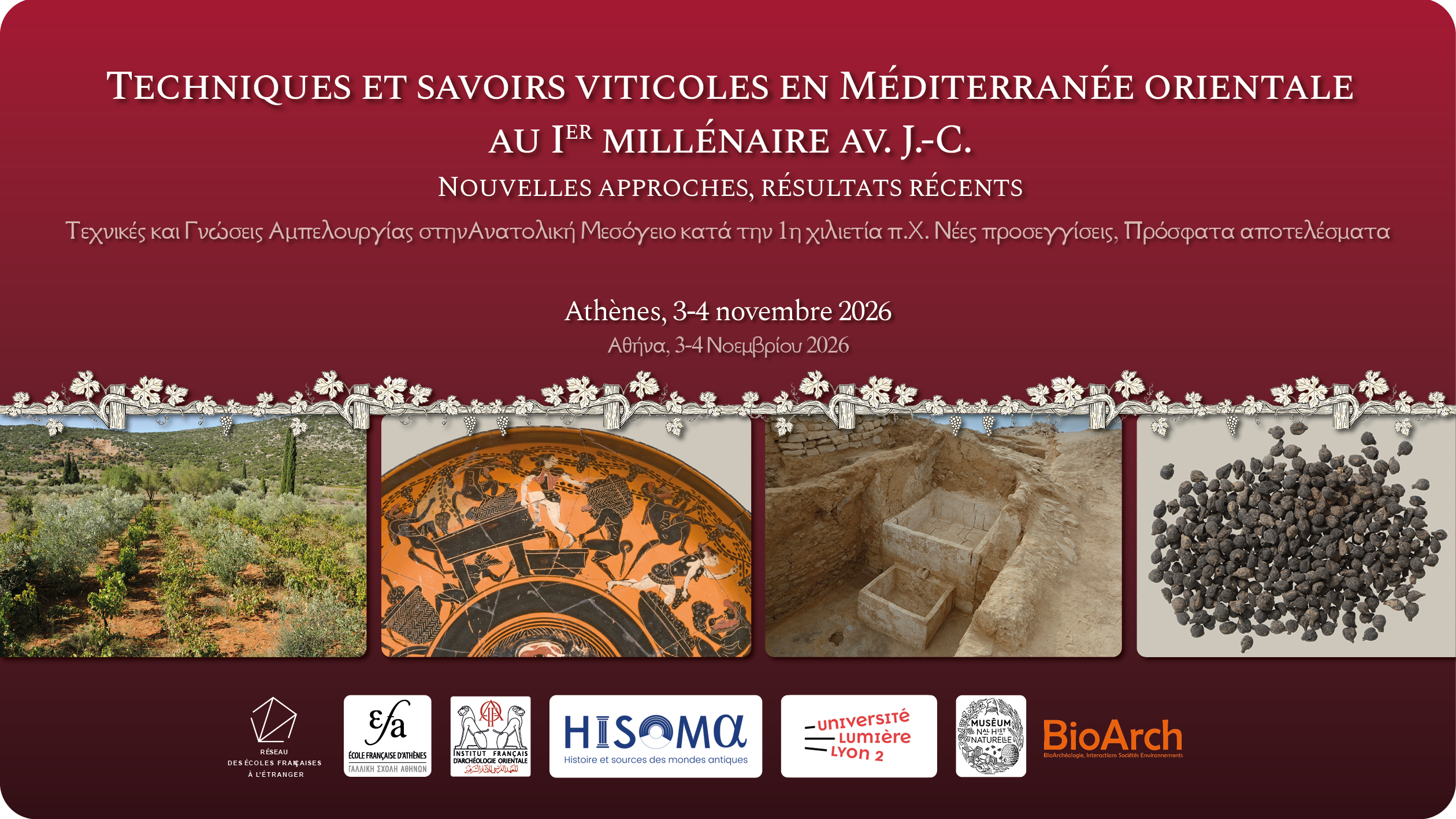
Colloque international
Du mardi 3 novembre 2026 au mercredi 4 novembre 2026 à 8h00 (heure du Caire), EFA 
Techniques et savoirs viticoles en Méditerranée orientale au Ier millénaire av. J.-C.
Nouvelles approches, résultats récents
Clémence Pagnoux & Bérangère Redon
Partenaire(s) de l’Ifao : EfA, HISOMA, Muséum national d’Histoire naturelle, BioArch, Université de Lyon 2
 |
 |
 |
 |
Le Colloque, Athènes, les 3 et 4 novembre 2026
Le thème du vin en Méditerranée durant l’antiquité semble déjà largement traité voire rebattu. Si l’on s’en tient aux 40 dernières années, les travaux sur le sujet incluant la Grèce, l’Égypte et la Turquie ont d’abord mobilisé les sources littéraires, épigraphiques et iconographiques (Amouretti 1988, Brunet 1993, Salviat 1993, Meeks 1993, Tallet 1998), tandis que la documentation papyrologique a été prise en considération plus tard (Dzierzbicka 2018).
Les sources textuelles ont assez rapidement été confrontées aux données archéologiques, installations de presses, récipients de stockage et de transport (Amouretti et Brun 1993, Brun 2004, Rodziewicz 1998). Plus récemment, l’archéobotanique et les analyses chimiques de résidus organiques ont apporté des données nouvelles sur les origines de la production de vin dans le monde égéen (Valamoti et al. 2007, Garnier et Valamoti 2016), la domestication de la vigne et la diversification de la vigne cultivée (Margaritis et al. 2021, Pagnoux et al. 2021, Valamoti et al. 2020). Enfin, les travaux pionniers en archéogénétique ont permis de proposer une première approche pour étudier la présence de vin dans des contenants en céramique (Guash-Jané et al. 2004).
L’association des sources écrites et de la télédétection a permis de travailler sur la spatialisation des vignobles d’Asie Mineure, démontrant par la même occasion la richesse d’une approche croisée inédite (Boulay et Vaudour 2015). En 2015, un colloque avait réuni de nombreuses communications sur la viticulture en Méditerranée orientale, montrant la diversité des approches désormais mobilisées et le dynamisme des recherches actuelles (Diler et al. 2015). Un article récent a permis de faire la synthèse de ces avancées, avec un spectre plus large sur le plan géographique et chronologique (Dodd, Van Limbergen 2025).
En dépit de ce foisonnement de données, des zones d’ombre demeurent notamment à propos du Ier millénaire av. J.-C. Angle mort de la recherche, c’est pourtant une période-clé de rencontres culturelles et d’amplification des liens économiques au sein du monde égéen mais aussi entre les rives de la Méditerranée.
Le programme VitiOrient, « Vigne et vin en Égypte, en Grèce et en Asie Mineure au Ier millénaire av. J.-C. : échanges biotechnologiques et transferts culturels en Méditerranée orientale » (projet commun EfA-IFAO-ResEFE, 2022-2026), avait pour objectif de commencer à combler les lacunes, en réunissant une dizaine de chercheurs travaillant actuellement sur les terrains grecs, turcs et égyptiens. Partant de cas concrets (Labraunda en Turquie, Terpni en Grèce, Plinthine en Égypte), il s’est agi de mettre en place des outils d’analyse et d’enregistrement communs destinés à étudier la viticulture de manière globale, de la culture de la vigne à la fabrication du vin. Prônant le croisement des méthodes pour renouveler les approches, il a mêlé travaux de terrain, inventaire des structures de production, examen lexical de sources textuelles, analyses archéobotaniques et morphométriques des restes de vigne, analyses géomorphologique et agronomique et par télédétection de terroirs.
L’objectif du colloque d’Athènes est, au terme de ce programme, de présenter les résultats de ces travaux mais surtout, en invitant le reste de la communauté « archéo-oenologique », à élargir les perspectives et confronter les méthodes. Le thème central de cette rencontre concernera la reconstitution de la chaîne opératoire de production du vin, de la plantation de la vigne à la vinification et l’on insistera tout particulièrement sur les savoirs et techniques mis en jeu à toutes les étapes. L’accent sera mis sur les travaux interdisciplinaires, afin de mettre évidence le renouvellement des connaissances produit par le croisement des sources.
Les thèmes abordés seront les suivants :
- L’étude des terroirs ;
- L’étude des pratiques de culture (cultures associées, pratiques d’irrigation et d’amendement, traces de plantations, culture en terrasse) ;
- La diffusion, la sélection et l’adaptation de la vigne cultivée ;
- Les installations de production : fouloirs, pressoirs, articulation des espaces de production et de consommation, échelle de production ;
- Les pratiques de vinification : stockage, conservation, recettes de préparation de vin, récipients, structures, sources écrites ;
- La diffusion des techniques, des savoirs et des cépages.
Comité d’organisation
- Clémence Pagnoux, maîtresse de conférence au Museum nationale d’histoire naturelle, laboratoire BioArch, Paris.
- Bérangère Redon, directrice de recherche au laboratoire HiSoMA (Maison de l’Orient et de la Méditerranée, CNRS).
Comité scientifique
- Laurent Bouby, CNRS, Institut des Sciences de l’Évolution – Montpellier (ISEM)
- Véronique Chankowski, directrice de l’École française d’Athènes
- Emlyn Dodd, Senior Lecturer in Classical Studies at the Institute of Classical Studies, University of London
- Olivier Henry, Professeur d’archéologie grecque à l’université de Lyon 2
- Evi Margaritis, Associate Professor at the Science and Technology in Archaeology and Culture Research Center, Cyprus Institute
- Pierre Tallet, directeur de l’Institut français d’archéologie orientale
Informations pratiques
Le colloque aura lieu à l’École française d’Athènes les 3 et 4 novembre 2026.
Plus d’informations sur le projet VitiOrient :
https://www.efa.gr/section-categorie/programme-vitiorient/
https://www.ifao.egnet.net/recherche/operations/op22231/
https://www.resefe.fr/fr/node/5829
*** Références bibliographiques ci-dessous
__________________________________________
Τεχνικές και Γνώσεις Αμπελουργίας στηνΑνατολική Μεσόγειο κατά την 1η χιλιετία π.Χ. Νέες προσεγγίσεις, Πρόσφατα αποτελέσματα
Το θέμα του κρασιού στη Μεσόγειο κατά την αρχαιότητα φαίνεται να έχει ήδη μελετηθεί εκτενώς. Αν περιοριστούμε στα τελευταία 40 χρόνια, οι σχετικές μελέτες της 1η χιλιετίας π.χ που περιλαμβάνουν την Ελλάδα, την Αίγυπτο και την Τουρκία, εστίασαν αρχικά στις γραπτές πηγές και την εικονογραφία (Amouretti 1988, Brunet 1993, Salviat 1993, Meeks 1993, Tallet 1998), ενώ η παπυρολογική τεκμηρίωση λήφθηκε υπόψη αργότερα (Dzierzbicka 2018). Οι γραπτές πηγές ήρθαν γρήγορα σε παραλληλισμό με τα αρχαιολογικά δεδομένα, όπως οι ληνοί, και τα αποθηκευτικά και μεταφορικά σκεύη (Amouretti και Brun 1993, Brun 2004, Rodziewicz 1998). Πιο πρόσφατα, οι αρχαιοβοτανικές μελέτες και οι χημικές αναλύσεις οργανικών καταλοίπων στα αγγεια πρόσφεραν νέες πληροφορίες για τις απαρχές της παραγωγής κρασιού στον Αιγιακό χώρο (Valamoti et al. 2007, Garnier και Valamoti 2016), την εξημέρωση της αμπέλου και την ποικιλομορφία της καλλιεργούμενης αμπέλου (Margaritis et al. 2021, Pagnoux et al. 2021, Valamoti et al. 2020). Τέλος, οι πρωτοποριακές αρχαιογενετικές μελέτες συνέβαλαν στην ανάπτυξη μιας πρώτης προσέγγισης για την μελέτη της αποθήκευσης κρασιού σε κεραμικά αγγεία (Guash-Jané et al. 2004). Η συνδυαστική χρήση των γραπτών πηγών και της τηλεπισκόπησης επέτρεψε τη μελέτη της τοποθεσίας των αμπελώνων της Μικράς Ασίας, αποδεικνύοντας έτσι τον πλούτο των πληροφοριών που αποκομίζονται μέσω μιας καινοτόμου διεπιστημονικής προσέγγισης (Boulay και Vaudour 2015). Το 2015, ένα συνέδριο συγκέντρωσε πολλές ανακοινώσεις για την αμπελουργία στην ανατολική Μεσόγειο, δείχνοντας το εύρος των προσεγγίσεων που χρησιμοποιούνται και τη δυναμική των πρόσφατων ερευνών (Diler et al. 2015). Επίσης, σε πρόσφατο άρθρο παρουσιάστηκς σύνθεση αυτών των εξελίξεων με μια ευρύτερη γεωγραφική και χρονολογική θεώρηση (Dodd, Van Limbergen 2025).
Παρά την πληθώρα των δεδομένων, υπάρχουν πτυχές που παραμένουν άγνωστες, ιδιαίτερα όσον αφορά την 1η χιλιετία π.Χ. Αν και σχεδόν άγνωστη, πρόκειται ωστόσο για μια καθοριστική περίοδο πολιτιστικών ανταλλαγών και ενίσχυσης των οικονομικών δεσμών στον Αιγιακό κόσμο, αλλά και μεταξύ των ακτών της Μεσογείου. Το πρόγραμμα VitiOrient, «Αμπέλι και κρασί στην Αίγυπτο, στην Ελλάδα και στη Μικρά Ασία κατά τον 1η χιλιετία π.Χ.: βιοτεχνολογικές ανταλλαγές και πολιτισμικές μεταφορές στην ανατολική Μεσόγειο» (κοινό ερευνητικό πρόγραμμα EfA-IFAO-ResEFE, 2022-2026), είχε ως στόχο να καλύψει σταδιακά τα κενά της έρευνας, συγκεντρώνοντας περίπου δέκα ερευνητές που εργάζονται αυτή τη στιγμή σε ελληνικές, τουρκικές και αιγυπτιακές θέσεις. Με αφετηρία συγκεκριμένες περιπτώσεις (Labraunda στην Τουρκία, Τερπνή στην Ελλάδα, Plinthine στην Αίγυπτο), ο στόχος ήταν να δημιουργηθούν κοινά εργαλεία ανάλυσης και καταγραφής για τη μελέτη της αμπελουργίας συνολικά, από την καλλιέργεια της αμπέλου μέχρι την παραγωγή του κρασιού. Προωθώντας τη χρήση διαφόρων μεθόδων για μια νέα, ανανεωμένη προσέγγιση των δεδομένων, το ερευνητικό πρόγραμμα συνδύασε διάφορα ερευνητικά πεδία όπως την καταγραφή των δομών παραγωγής, την εξέταση γραπτών πηγών, τις αρχαιοβοτανικές και μορφομετρικές αναλύσεις κατάλοιπων αμπελιού, τις γεωμορφολογικές και αργονομικές αναλύσεις και την τηλεπισκόπηση εδαφών. Ο στόχος του συνεδρίου στην Αθήνα είναι να παρουσιαστούν τα αποτελέσματα αυτών των ερευνών με τη λήξη του προγράμματος, αλλά και να διευρυνθούν μελλοντικές ερευνητικές και μεθοδολογικές προσεγγίσεις, συμπεριλαμβάνοντας και την υπόλοιπη «αρχαιοοινολογική» κοινότητα. Το κεντρικό θέμα αυτής της συνάντησης θα είναι η ανασύσταση της παραγωγικής αλυσίδας του κρασιού, από τη φύτευση της αμπέλου μέχρι την οινοποίηση, με ιδιαίτερη έμφαση στις γνώσεις και τις τεχνικές που εμπλέκονται σε κάθε στάδιο. Έμφαση θα δοθεί στις διεπιστημονικές έρευνες προκειμένου να αναδειχθεί η πολύπλευρη γνώση ως αποτέλεσμα του συνδυασμού των πληροφοριών από διαφορετικές πηγές.
Τα θέματα που θα συζητηθούν είναι τα εξής:
- Μελέτη των εδαφών και των αμπελουργικών περιοχών.
- Μελέτη των πρακτικών καλλιέργειας (συνεκτικές καλλιέργειες, πρακτικές άρδευσης και ενίσχυσης, ίχνη φυτεύσεων, καλλιέργεια σε αναβαθμίδες).
- Η διάδοση, η επιλογή και η προσαρμογή της καλλιεργούμενης αμπέλου.
- Οι εγκαταστάσεις παραγωγής: πατητήρια, πιεστήρια, σύνδεση των χώρων παραγωγής και κατανάλωσης, κλίμακα παραγωγής.
- Οι πρακτικές οινοποίησης: αποθήκευση, συντήρηση, συνταγές παρασκευής κρασιού, σκεύη, γραπτές πηγές.
- Η διάδοση των τεχνικών, των γνώσεων και των ποικιλιών αμπέλου.
Oργανωτική επιτροπή
- Clémence Pagnoux, maîtresse de conférence au Museum nationale d’histoire naturelle, laboratoire BioArch, Paris.
- Bérangère Redon, directrice de recherche au laboratoire HiSoMA (Maison de l’Orient et de la Méditerranée, CNRS)
Επιστημονική επιτροπή
- Laurent Bouby, CNRS, Institut des Sciences de l’Évolution – Montpellier (ISEM)
- Véronique Chankowski, directrice de l’École française d’Athènes
- Emlyn Dodd, Senior Lecturer in Classical Studies at the Institute of Classical Studies, University of London
- Olivier Henry, Professeur d’archéologie grecque à l’université de Lyon 2
- Evi Margaritis, Associate Professor at the Science and Technology in Archaeology and Culture Research Center, Cyprus Institute
- Pierre Tallet, directeur de l’Institut français d’archéologie orientale
Πρακτικές πληροφορίες
Το συμπόσιο θα πραγματοποιηθεί στη Γαλλική Αρχαιολογική Σχολή Αθηνών.
Περισσοτέρες πληροφορίες για στο πρόγραμμα VitiOrient:
https://www.efa.gr/section-categorie/programme-vitiorient/
https://www.ifao.egnet.net/recherche/operations/op22231/
https://www.resefe.fr/fr/node/5829
__________________________________________
Vine-growing and Wine-making Techniques and Knowledge in the Eastern Mediterranean during the 1st millenium BCE - New Approaches, Recent Results
Conference, Athens, 3-4 November 2026
The topic of wine in the Mediterranean during antiquity may appear, at first glance, to be largely exhausted or even overworked. Over the past forty years, studies concerning Greece, Egypt, and Turkey have initially drawn on literary, epigraphic, and iconographic sources (Amouretti 1988; Brunet 1993; Salviat 1993; Meeks 1993; Tallet 1998), while papyrological evidence was integrated later (Dzierzbicka 2018). Textual sources were rapidly confronted with archaeological data, press installations, storage and transport containers (Amouretti and Brun 1993; Brun 2004; Rodziewicz 1998). More recently, archaeobotany and chemical analyses of organic residues have provided new insights into the origins of wine production in the Aegean world (Valamoti et al. 2007; Garnier and Valamoti 2016), the domestication of the grapevine, and the diversification of cultivated grape varieties (Margaritis et al. 2021; Pagnoux et al. 2021; Valamoti et al. 2020). Finally, pioneering work in archaeogenetics has opened the way for an initial approach to detecting wine in ceramic vessels (Guash-Jané et al. 2004). The combination of written sources and remote sensing has also enabled the study of vineyard spatialisation in Asia Minor, demonstrating the value of a new cross-disciplinary approach (Boulay and Vaudour 2015). In 2015, a conference brought together numerous contributions on viticulture in the Eastern Mediterranean, illustrating the diversity of current approaches and the dynamism of recent research (Diler et al. 2015). A short article summarized these advances with a broader geographical and chronological scope (Dodd and Van Limbergen 2025).
Despite the abundance of available data, significant gaps remain, particularly for the first millennium BCE. This period, long neglected, was nevertheless crucial for cultural encounters and the intensification of economic ties within the Aegean world and across the Eastern Mediterranean.
The VitiOrient program, “Grapevine and Wine in Egypt, Greece and Asia Minor in the First Millennium BCE: Biotechnological Exchanges and Cultural Transfers in the Eastern Mediterranean” (EfA-IFAO-ResEFE joint project, 2022-2026), aimed to begin addressing these gaps by bringing together scholars working in Greece, Turkey, and Egypt. Drawing on case studies (Labraunda in Turkey, Terpni in Greece, Plinthine in Egypt), the project sought to establish shared analytical and recording tools for the comprehensive study of viticulture, from grapevine cultivation to wine production. Advocating the use of different methods to renew approaches, it combined fieldwork, inventories of production structures, lexical examination of textual sources, archaeobotanical and morphometric analyses of grapevine remains, as well as geomorphological, agronomic, and remote-sensing studies of terroirs.
The Athens conference, organised at the conclusion of this program, aims to present these results while also inviting the wider “archeo-oenological” research community to broaden perspectives and compare methods. The central theme of the meeting will concern the reconstruction of the chaîne opératoire of wine production – from vine planting to vinification – with particular emphasis on the knowledge and techniques employed at each stage. Interdisciplinary research will be favored, to show how the combination of different types of evidence contributes to renewed understanding.
The topics to be addressed include:
- The study of terroirs;
- The study of cultivation practices (associated crops, irrigation and manuring, planting traces, terrace cultivation);
- The diffusion, selection, and adaptation of cultivated grapevines;
- Production installations: treading floors, presses, organisation of production and consumption spaces, production scales;
- Winemaking practices: storage, preservation, wine preparation recipes, containers, structures, written sources;
- The diffusion of techniques, knowledge, and grape varieties.
Organising Committee
- Clémence Pagnoux, Associate Professor, Muséum national d’Histoire naturelle, BioArch laboratory, Paris;
- Bérangère Redon, Research director at the CNRS, HiSoMA, Maison de l’Orient et de la Méditerranée, Lyon.
Provisional Scientific Committee
- Laurent Bouby, CNRS, Institute of Evolutionary Sciences - Montpellier (ISEM)
- Véronique Chankowski, Director of the French School at Athens
- Emlyn Dodd, Senior Lecturer in Classical Studies, Institute of Classical Studies, University of London
- Olivier Henry, Professor of Greek Archaeology, University of Lyon 2
- Evi Margaritis, Associate Professor, Science and Technology in Archaeology and Culture Research Center, Cyprus Institute
- Pierre Tallet, Director of the French Institute of Oriental Research (Cairo)
Practical Information
The conference will be held at the French School at Athens.
More information on the VitiOrient project:
https://www.efa.gr/section-categorie/programme-vitiorient/
https://www.ifao.egnet.net/recherche/operations/op22231/
https://www.resefe.fr/fr/node/5829
** Bibliographical references below
__________________________________________
تقنيات ومعارف زراعة الكروم وصناعة النبيذ في شرق البحر المتوسط خلال الألفية الأولى قبل الميلاد, مقاربات منهجية جديدة ونتائج بحثية حديثة
الملتقى العلمي، أثينا، ٣-٤ نوفمبر ٢٠٢٦
قد يبدو، للوهلة الأولى، أن موضوع النبيذ في حوض البحر المتوسط خلال العصور القديمة قد استنفد بحثًا وتكرر تناوله على نطاق واسع. غير أن استعراضنا نقديا للأعمال المنجزة خلال العقود الأربعة الأخيرة، ولا سيما تلك التي تناولت اليونان ومصر وآسيا الصغرى، يُبيّن أن لدراسات الأولى أنصبت أساسا على المصادر الأدبية، والنقوش، والمواد الإثنوغرافية ( Amouretti 1998؛ 1993 Brunet Salviat ؛ 1993 Meeks ؛ Tallet ، 1998). في حين لم تدرج الوثائق البردية ضمن هذا الحقل البحثي إلا في مرحلة لاحقة نسبيا (Dzierżbicka 2018) وسرعان ما خضعت المصادر النصية لمقارنة منهجية مع البيانات الأثرية، ولا سيما منشآت العصر المخصصة للعصر والكين، وأواني التخزين والنقل .Amouretti و Brun 1993 ؛Rodziewicz 1998؛ Brun 2004 وفى مرحلة أحدث، أسهم كل من علم الآثار النباتي والتحاليل الكيميائية لبقايا المواد العضوية في توفير بيانات جديدة حول نشأة إنتاج النبيذ في العالم الأرجي، (Garnier et al 2007 ، Valamoti et al 2016) وكذلك حول عمليات "استئناس" الكروم وتطور تنوع الأصناف المزروعة منها .(.Valamoti et al. 2021 ، Pagnoux et al. 2021 ، Margaritis et al 2020). وأخيرًا، أفضت الدراسات الرائدة في علم الآثار الجيني إلى اقتراح أولى المقاربات العلمية لدراسة وجود النبيذ وآثاره داخل الأوعية الخزفية .(Guash-Jané et al. 2004) كما أتاح الجمع بين المصادر المكتوبة وتقنيات الاستشعار عن بعد دراسة التوزيع المكاني لكروم العنب في آسيا الصغرى، مبرزا في الوقت ذاته ثراء المقاربات المتقاطعة (2015 Vaudour ،Boulay ) وفي عام ٢٠١٥، مؤتمر العديد من المداخلات حول زراعة الكروم في شرق البحر ,المتوسط، مبينا تنوع المناهج المعتمدة وديناميكية الأبحاث الحديثة ( Diler et al 2015). وقد أتاح مقال حديث تقديم خلاصة لهذه التقدمات، مع تغطية أوسع على الصعيدين الجغرافي والزمني (2025 Dodd ، Van Limbergen)
وعلى الرغم من الوفرة في المعطيات المتاحة، لا تزال هناك مجالات غير معروفة، ولا سيما فيما يتعلق بالألفية الأولى ق.م. فهذه المرحلة، التي ظلت إلى حد بعيد خارج بورة الاهتمام البحثي، تُعد في الواقع فترة مفصلية تميزت بتكثف التفاعلات الثقافية واتساع الشبكات الاقتصادية، سواء داخل المجال الإيجي أو بين ضفاف البحر المتوسط. وعلى الرغم من الوفرة الكبيرة في المعطيات المتاحة، لا تزال هناك مجالات غير معروفة، ولا سيما فيما يتعلق بالألفية الأولى ق.م. فهذه المرحلة، التي ظلت إلى حد بعيد خارج بورة الاهتمام البحثي، تُعد في الواقع فترة مفصلية تميزت بتكثف التفاعلات الثقافية واتساع الشبكات الاقتصادية، سواء داخل المجال الإيجي أو بين ضفاف البحر المتوسط. وقد أطلق برنامج VitiOrient، تحت عنوان «الكرم والنبيد في مصر واليونان وآسيا الصغرى خلال الألفية الأولى ق.م.: تبادلات التكنولوجيا الحيوية وانتقالات ثقافية في شرق البحر المتوسط» وهو مشروع مشترك بين (المدرسة الفرنسية بأثينا EfA والمعهد الفرنسي للآثار الشرقية Ifao، ومجموعة المدارس الفرنسية في الخارج ResEFE، ٢٠٢٢-٢٠٢٦)، بهدف الإسهام في سد هذه الفجوات المعرفية، من خلال تجميع العشرات من الباحثين العاملين حاليا في الميادين اليونانية والتركية والمصرية. وانطلاقا من دراسات حالة محددة (في لابراوندا بتركيا، وتربني باليونان، وبلنتين في مصر)، سعى البرنامج إلى بلورة أدوات تحليل وتوثيق مشتركة تتيح دراسة زراعة الكرمة وصناعة النبيذ ضمن مقاربة شمولية، تمتد من استزراع الكرمة إلى عمليات تصنيع النبيذ. واعتمد المشروع مناهج متعددة لتحديد المقاربات، جمع بين العمل الميداني، وجرد هياكل الإنتاج، والدراسة المعممة للمصادر التنمية، والتحليلات النباتية القديمة والمورفومترية ل بقايا الكروم، إلى جانب التحليلات الجيمورفولوجية والزراعية، والتحليلات عن بعد للمناطق الزراعية.
ويتمثل الهدف من عقد ندوة أنبنها، في عرض نتائج الأعمال، وبشكل خاص في توسيع دائرة النقاش حول إشراك مجتمع الباحثين في مجال الآثار المرتبطة بالنبيد، بما يتيح مقارنة المناهج المختلفة. وسوف يرتكز المحور الرئيسي لهذه الندوة على إعادة بناء السلسلة التشغيلية لإنتاج النبيذ، من غرس الكرمة إلى مراحل التحمير والتصنيع، مع تركيز خاص على المعارف والتقنيات الموظفة في مختلف مراحل هذه السلسلة. كما سيخصص اهتمام كبير للأعمال متعددة التخصصات، بوصفها إطاراً أساسياً لإبراز التجديد المعرفي الناتج عن تقاطع المصادر.
وستتناول المداخلات المحاور الآتية:
• دراسة البيئة الزراعية
• دراسة ممارسات الزراعة، بما يشمل الزراعات المصاحبة، وتقنيات الري والتسميد، وآثار الغرس، والزراعة المدرجة؛
• انتشار الكروم المزروع، وآليات انتقائه، وتكييفه مع البيئات المختلفة؛
• منشآت الإنتاج، بما في ذلك المعاصر والمكابس، وتنظيم أماكن الإنتاج والاستهلاك، ومقاييس الإنتاج؛
• ممارسات صناعة النبيذ، من تخزين وحفظ ووصفات إعداد النبيذ، إضافة إلى الأوعية والمنشآت والمصادر المكتوبة؛
• انتقال التقنيات والمعارف وأصناف العنب.
اللجنة المنظمة
- Clémence Pagnoux, Associate Professor, Museum national d’Histoire naturelle, BioArch laboratory, Paris.
- Bérangère Redon, Research director at the CNRS, HiSoMA, Maison de l’Orient et de la Méditerranée, Lyon.
اللجنة العلمية
- Laurent Bouby, CNRS, Institute of Evolutionary Sciences - Montpellier (ISEM)
- Véronique Chankowski, Director of the French School at Athens
- Emlyn Dodd, Senior Lecturer in Classical Studies, Institute of Classical Studies, University of London
- Olivier Henry, Professor of Greek Archaeology, University of Lyon 2
- Evi Margaritis, Associate Professor, Science and Technology in Archaeology and Culture Research Center, Cyprus Institute
- Pierre Tallet, Director of the French Institute of Oriental Research (Cairo)
معلومات عملية
سيعقد المؤتمر في المدرسة الفرنسية في أثينا
للمزيد من المعلومات حول المشروع
https://www.efa.gr/section-categorie/programme-vitiorient/
https://www.ifao.egnet.net/recherche/operations/op22231/
https://www.resefe.fr/fr/node/5829
__________________________________________________
Références bibliographiques - Bibliographical references - المراجع
M.-C. Amouretti, . La viticulture antique : contraintes et choix techniques ., Revue des Etudes Anciennes, XC, 1/2 (1988), p. 5‑17.
M.-C. Amouretti et J.-P. Brun (.d.), La production du vin et de l’huile en Méditerranée, Bulletin de Correspondance Hell.nique, suppl.ment 26, Paris (1993).
T. Boulay et E. Vaudour, . Conduite de la vigne, densit.s de plantation et terroirs dans les baux d’Amos ., Studi Ellenistici, 29 (2015), p. 215‑232.
J.-P. Brun, Archéologie du vin et de l’huile. De la préhistoire à l’époque hellénistique, Paris (2004).
M. Brunet, . Vin local et vin de cru. Les exemples de D.los et Thasos ., dans M.-C. Amouretti, J.- P. Brun (.d.), La production du vin et de l’huile en Méditerranée, BCH Suppl. 26 (1993), p. 201‑212.
A. Diler, K. Şenol et .. Aydınoğlu (.d.), Olive Oil and Wine Production in Eastern Mediterranean during Antiquity, Izmir (2015).
E. Dodd, D. Van Limbergen, . Advancement and innovation in ancient wine research ., Current Opinion in Food Sciences 64 (2025), p. 101330.
D. Dzierzbicka, OINOS: Production and Import of Wine in Graeco-Roman Egypt, Journal of Juristic Papyrology. Supplement 31, Varsovie (2018).
N. Garnier et S.M. Valamoti, . Prehistoric wine making at Dikili Tash (Northern Greece): integrating residue analysis and archaeobotany ., J Arch Sci, 74 (2016), p. 195‑206.
M.R. Guash-Jan., M. Ibern-Gomez, C. Andres-Lacu.va, O. Jauregui et M.R. Lamuela-Raventos, . Liquid chromatography with mass spectrometry in tandem mode applied for the identification of wine markers in residues from ancient Egyptian vessels ., Anal Chem, 76, 6 (2004), p. 1672‑1677.
E. Margaritis, C. Pagnoux, L. Bouby, V. Bonhomme, S. Ivorra et K. Tsirtsi, . Hellenistic grape and olive diversity: a case study from rural estates in Greece ., Journal of Archaeological Science: reports, 38 (2021), p. 102842.
D. Meeks, . Ol.iculture et viticulture dans l’.gypte pharaonique ., dans M.-C. Amouretti, J.-P. Brun (.d.), La production du vin et de l’huile en Méditerranée, BCH Suppl. 26 (1993), p. 3-38.
C. Pagnoux, L. Bouby, S.M. Valamoti, V. Bonhomme, S. Ivorra, E. Gkatzogia, A. Karathanou, D. Kotschristou et H. Kroll, . Local domestication or diffusion? Insights into viticulture in Greece from Neolithic to Archaic times, using geometric morphometric analyses of archaeological grape seeds ., Journal of Archaeological Science, 125 (2021), p. 105263.
M. Rodziewicz, . Classification of Wineries from Mareotis ., dans J.-Y. Empereur .d.), Commerce et artisanat dans l’Alexandrie hellénistique et romaine, BCH Suppl. 33 (1998), p. 27-36.
F. Salviat, . Le vin de Thasos. Amphores, vin et sources écrites ., in J.-Y. Empereur and Y. Garlan (.d.), Recherches sur les amphores grecques, BCH Suppl. 10 (1986), p. 145-196.
S.M. Valamoti, M. Mangafa, C. Koukouli-Chrysanthaki et D. Malamidou, . Grape-pressings from northern Greece: the earliest wine in the Aegean ? ., Antiquity, 81 (2007), p. 54‑61.
S.M. Valamoti, C. Pagnoux, M. Ntinou, L. Bouby, V. Bonhomme et J.-F. Terral, . More than meet the eye: new archaeobotanical evidence on Bronze Age viticulture and wine making in the Peloponnese, Greece ., Veget Hist Arch, 29, 1 (2020), p. 35‑50.
P. Tallet, Le vin en Égypte à l’époque pharaonique, th.se de doctorat, Universit. Sorbonne-Paris IV (1998).
Crédits photos : 1 : BnF ; 2 et 4 : Ga.l Pollin (Ifao) ; 3 : Sarah Ivorra (CNRS/ISEM).