

Catalogue des publications
Les achats en ligne sont suspendus, sauf pour les fichiers. Veuillez contactez : ventes@ifao.egnet.net. J'ai un code promotionnel.
On line orders are suspended, except for files. Please contact : ventes@ifao.egnet.net. I have a promotional code.
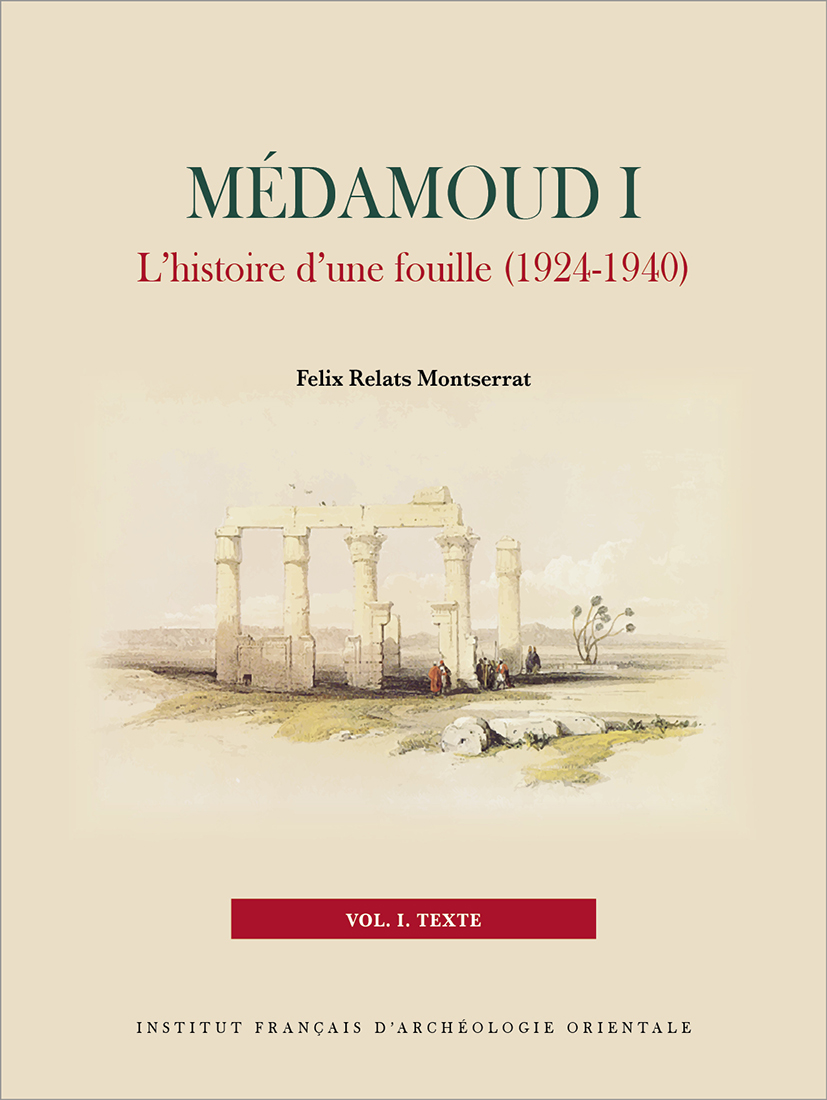
Felix Relats Montserrat
Médamoud I
L'histoire d'une fouille (1924-1940)
Les fouilles françaises de Médamoud se sont déroulées entre 1924 et 1939 sous la direction de F. Bisson de la Roque (1924-1932) et de Cl. Robichon (1933-1939). Elles mirent au jour de nombreux monuments s’échelonnant de la XIe dynastie jusqu’à l’époque byzantine. L’ensemble de cette documentation constitue un corpus riche mais hétérogène dont il a fallu restituer le contexte de découverte, d’autant que les fouilles ont été inégalement publiées. Dans cette optique, il s’est avéré nécessaire, en premier lieu, d’inventorier les vestiges afin de préciser leur datation, leur interprétation et la manière dont ils furent dégagés au début du XXe siècle. Or, l’analyse de l’exploration d’un site, si elle documente les découvertes archéologiques réalisées, livre tout autant d’informations sur le contexte de l’époque où elles ont eu lieu, à la fois sur le plan intellectuel, technique et politique. De là découle le second objectif de l’ouvrage, Médamoud offrant un cas d’étude pour comprendre la manière dont était organisée une mission archéologique, aussi bien du point de vue pratique, que sous l’angle administratif, au début du XXe siècle. Le présent ouvrage est donc organisé en deux parties, présentant d’abord un historique de l’exploration du site, puis un inventaire des structures découvertes.
The French excavations at Medamud took place between 1924 and 1939 under the direction of F. Bisson de la Roque (1924-1932) and Cl. Robichon (1933-1939). They uncovered numerous monuments ranging in date from the 11th Dynasty to the Byzantine period. All of the documentation constitutes a rich but heterogeneous corpus. However, since the publication of the excavations was uneven, it has been necessary to recreate the process of discovery. In order to understand the context in which the architectural remains were found at the beginning of the 20th century, they were inventoried while verifying their dating and interpretation. Since the analysis of the exploration of a site that documents the archaeological discoveries also yields information about the intellectual, technical, and political context of the period in which it took place, this book also presents Medamud as a case study for understanding how an archaeological mission was organized, both practically and administratively, at the beginning of the 20th century. The present work is thus organized in two parts, first presenting a history of the exploration of the site, then an inventory of the structures discovered.
جرت الحفائر الفرنسيَّة في مدامود في الفترة من ١٩٢٤م وحتى ١٩٣٩م تحت إشراف F. Bisson de la Roque (١٩٢٤-١٩٣٢م) وCl. Robichon(١٩٣٣-١٩٣٩م) حيث تم اكتشاف العديدَ مِنَ الآثارِ التي تتراوح من عصر الأسرة الحادية عشرة إلى العصر البيزنطي. تُشكّل كل هذه المكتشفات مجموعةً ثرية، ولكن غير مُتجانسة، فكان لا بد من العودة إلى الظروف التي اكتشفت فيها، خاصة أن عمليات التّنقيب لم يتم نشرها بالتساوٍي. ومن هذا المنطلق، كان لا بد أوَّلًا من القيام بحصر الآثار لتحديد تأريخها وتفسيرها والطريقة التي تم استخراجها بها في بداية القرن العشرين. ومع ذلك، فإن تحليل استكشاف موقع ما، إذا كان يوثّق الاكتشافات الأثريَّة التي تمّت، يوفّر نفسَ القدرِ مِنَ المعلومات حول الفترة التي حدثت فيها، فكريًا وتقنيًا وسياسيًا. ومن هنا ينبع الهدف التالي لهذا الكتاب "مدامود" الذي يقدم نموذج دراسة لفهم كيفية تنظيم البعثة الأثريَّة، عمليًا وإداريًا، في بداية القرن العشرين. ولذلك، تمَّ تنظيم العمل الحالي في جزئين، يقدم الأوَّل منهما تاريخ استكشاف الموقع، ويقدم الثاني جرد للمباني المُكتشفة.
- Felix Relats Montserrat (
 : 196934559)
Agrégé d’histoire, docteur en égyptologie de l’université de Paris-Sorbonne, membre scientifique de l’Institut Français d’Archéologie Orientale du Caire entre 2017 et 2021. Ses recherches portent sur les relations nouées entre le pouvoir royal et les temples, ainsi que sur l’insertion de ces derniers dans leur environnement urbain. Il s’intéresse également à l’artisanat égyptien et tout particulièrement à la production de céramiques. En parallèle, ses recherches doctorales l’ont amené à développer une réflexion sur l’histoire de l’égyptologie au début du XXe siècle. Il dirige la mission Ifao / Sorbonne de Médamoud avec le soutien de la commission des fouilles du MEAE (Louqsor).
- Vous pouvez acquérir ce(s) fichier(s) PDF issu(s) de cet ouvrage en cliquant sur le nom du fichier puis 'Ajouter au panier'.
- You can buy theses PDF files extracted from this book by clicking on the file name then 'Add to cart'.

ISBN 9782724710151
2024 IFAO
Collection: FIFAO 95
Langue(s): français
1 vol. 305 p.
50 € (2632 EGP)
Béatrix Midant-Reynes (éd.), Nathalie Buchez (éd.)
Tell el-Iswid – 2010-2018
Les occupations naqadiennes du secteur 4
Ce second volume des fouilles de Tell el-Iswid est consacré aux vestiges naqadiens du secteur 4. Il s’agit d’un bâti de briques crues, couvrant essentiellement la période Naqada IIIA-B. Trois phases de transformations majeures ont été décelées. La mieux représentée est la phase 2 dont le bâti a été plusieurs fois remanié. Une attention particulière a été accordée aux structures de combustion.
À ces transformations architecturales répondent des changements dans la culture matérielle (céramique, industrie lithique, petit mobilier) en lien avec les données relatives à l’économie de subsistance (faune et micro-restes végétaux).
La céramique, en particulier, a été étudiée selon des approches nouvelles, où les classifications sont fondées prioritairement sur les techniques de fabrication et la restitution des chaînes opératoires, ce qui permet de mieux appréhender les identités culturelles et de dépasser les visées essentiellement chronologiques des classifications morpho-stylistiques traditionnelles.
Les travaux ici présentés prennent place dans le renouvellement des données apportées par les fouilles du site voisin de Tell el-Farkha et par celles de Bouto dans le delta occidental. Ils contribuent à jeter, depuis le Delta, un nouvel éclairage sur les transformations socio-culturelles qui ont affecté l’ensemble de la Vallée du Nil dans le dernier tiers du IVe millénaire.
This second volume of the Tell el-Iswid excavations is devoted to the Naqada period remains in sector 4. It concerns a mud-brick building, dating essentially to the Naqada III A-B period. Three major phases of transformation were detected. The best represented is phase 2, which was reworked several times. Particular attention was paid to the structures which were burned.
These architectural transformations are mirrored by changes in material culture (ceramics, lithic industry, small finds) in connection with data relating to the subsistence economy (fauna and plant micro-remains).
Ceramics have been studied according to new approaches, in which classifications are based primarily on manufacturing techniques and the reconstruction of the « chaîne opératoire », which makes it possible to better understand cultural identities and to go beyond the essentially chronological aims of traditional morpho-stylistic classifications.
The work presented here is part of the review of data from excavations at the neighboring site of Tell el-Farkha and at Bouto in the western Delta. They contribute to shedding new light from the Delta on the socio-cultural transformations that affected the whole Nile valley in the last third of the 4th millennium BC.
يخصص هذا المجلد الثاني من حفائر تل الأسود للبقايا الأثرية لموقع نّقادة في القطاع رقم ٤. ويتعلق بمبنى من الطوب اللبن، يعود تاريخه بشكلٍ أساسي إلى فترة نقادة الثالثة «أ-ب» (IIIA-B). وقد تمَّ الكشف عن ثلاث مراحل رئيسية من التّحوّل. أفضل مرحلة مُمثَّلة هي المرحلة رقم ٢، والتي تمَّ إعادة عملها عِدَّة مرّات. وقد وجه اهتمام خاص بالمباني الخاصة بالحرق.
تتواءم هذه التّحوّلات المعماريَّة مع تّغيُّرات في الثّقافة الماديّة (الفخار، الصِّناعة الحجريَّة، اللُقى الصّغيرة) فيما يتعلق بالبيانات المتعلقة بـ «اقتصاد الكفاف» (البقايا الدّقيقة للحيوانات والنباتات).
وقد تمَّت دراسة الفخار، على وجه الخصوص، وفقًا لمُقاربات جديدة، حيث تعتمد التصنيفات المستخدمة في المقامِ الأوَّل على تقنيات التّصنيع واستعادة سلسلة التّشغيل، مِمَّا يتيح فهم الهويّات الثّقافيَّة بشكلٍ أفضل وتجاوز الأهداف التّأريخية الأساسية للتصنيفات المورفولوجيّة الأسلوبيّة التقليديّة.
يقع العمل المعروض هنا ضمن تحديث البيانات التي أتاحتها أعمال التنقيب في موقع «تل الفرخة» المجاور لموقع تل الأسود، وتلك الموجودة في بوتو في الدلتا الغربيَّة. وتسهم في تسليط ضوءٍ جديد على التَّحوّلات الاجتماعيَّة والثّقافيَّة في الدلتا والتي أثّرت على وادي النيل كله في الثُّلث الأخير من الألفيّة الرابعة قبل الميلاد.
- Béatrix Midant-Reynes ( : 030156963)
Beatrix Midant-Reynes est spécialiste dans l'étude de la préhistoire égyptienne. Elle a dirigé plusieurs chantiers de fouilles en Égypte, tous centrés sur la période prédynastique : Adaïma, en Haute Égypte, Kom el-Khilgan et Tell el-Iswid, dans le Delta oriental. De 2000 à 2015, elle a codirigé le volet préhistoire du programme de prospection du bassin sud de Douch (oasis de Kharga). De 2010 à 2015, elle a été directrice de l'Institut français d'archéologie orientale. Elle est actuellement directrice de recherche émérite au CNRS. La diffusion des connaissances à un plus large public fait partie de ses préoccupations, elle a ainsi publié "Prehistory of Egypt, From the First Egyptians to the First Pharaohs" en 2000 et "Aux origines de l'Égypte. Du Néolithique à l'émergence de l'État" en 2003. - Nathalie Buchez ( : 066514290)
Nathalie Buchez est responsable de recherche archéologique à l’Institut national de recherche en archéologie préventive (Inrap) où elle est plus particulièrement en charge d’opérations de terrain, d’études céramiques et de coordination de projets concernant les âges du Bronze et du premier âge du Fer dans le nord de la France. Docteure en archéologie de l’EHESS, rattachée à l’UMR 5608-TRACES de Toulouse, elle poursuit des recherches sur l’Egypte prédynastique depuis 1989. En 2015, elle a succédé à Béatrix Midant-Reynes comme responsable de la fouille de Tell el-Iswid (Delta oriental) pour l’Ifao et le ministère de l’Europe et des Affaires étrangères.
- Vous pouvez acquérir ce(s) fichier(s) PDF issu(s) de cet ouvrage en cliquant sur le nom du fichier puis 'Ajouter au panier'.
- You can buy theses PDF files extracted from this book by clicking on the file name then 'Add to cart'.

ISBN 9782724710595
2024 IFAO
Collection: BAEFE
Langue(s): français
1 vol.
gratuit - free of charge
Bulletin archéologique des Écoles françaises à l'étranger (BAEFE)
Opérations de terrain Ifao-CEAlex 2023
Le Bulletin archéologique des Écoles françaises à l’étranger propose les contributions de l’École française d’Athènes, de l’École française de Rome, de l’Institut français d’archéologie orientale, du Centre d'études alexandrines, de l’École française d’Extrême-Orient et de la Casa de Velázquez réunis au sein du Réseau des Écoles françaises à l’étranger. C’est ainsi toute l’actualité des recherches archéologiques menées par le réseau des EFE sur tout le pourtour méditerranéen mais aussi dans les Balkans, en Inde et en Asie qui est proposée dans ce Bulletin exclusivement numérique, multilingue et à la publication continue.
Ce numéro est disponible en accès libre sur OpenEdition : https://journals.openedition.org/baefe/10427

ISBN 9782724710205
2024 IFAO
Collection: BiEtud 187
Langue(s): allemand
1 vol. 414 p.
gratuit - free of charge
Christian Leitz (éd.)
Kurzbibliographie zu den übersetzten Tempeltexten der griechisch-römischen Zeit, 7e éd.
Dieses Buch ist eine Fortsetzung des Werks von Jean-Claude Grenier: Temples ptolémaïques et romains. Répertoire bibliographique (Zitierverzeichnis 1955–1974, einschließlich des von N. Sauneron zusammengestellten Zitierverzeichnisses für die Jahre 1939 bis 1954), BiEtud 75, Kairo, 1979. Um Forschern ein aktuelles Nachschlagewerk zur Verfügung zu stellen, ist es nun auf der Website des Ifao (www.ifao.egnet.net) verfügbar und wird unter der Verantwortung von Christian Leitz regelmäßig aktualisiert.
Ce livre fait suite à l’ouvrage de Jean-Claude Grenier : Temples ptolémaïques et romains. Répertoire bibliographique (index des citations 1955-1974, incluant l’index des citations de 1939 à 1954 réunies par N. Sauneron), BiEtud 75, Le Caire, 1979. Afin d'offrir au chercheur un outil d’actualité, il est dorénavant disponible sur le site de l’Ifao (www.ifao.egnet.net) et régulièrement mis à jour sous la responsabilité de Christian Leitz.
This book updates Jean-Claude Grenier’s Temples ptolémaïques et romains. Répertoire bibliographique : Index des citations 1955-1974, incluant l’index des citations de 1939 à 1954 réunies par N. Sauneron, BiEtud 75, Cairo, 1979. In order to provide scholars with an ever-relevant research tool, the bibliography is available on the IFAO website (www.ifao.egnet.net), with regular updates reviewed by Christian Leitz.
- Christian Leitz ( : 070209448)
Christian Leitz est professeur d’égyptologie à Tübingen (depuis 2004). Il a été professeur invité à l’École Pratique des Hautes Études, Paris (2007), au Collège de France (2009), à l’université du Caire (2013).
ISBN 9782724710113
2024 IFAO
Collection: BiGen 75
Langue(s): français
1 vol. 248 p.
33 € (1737 EGP)
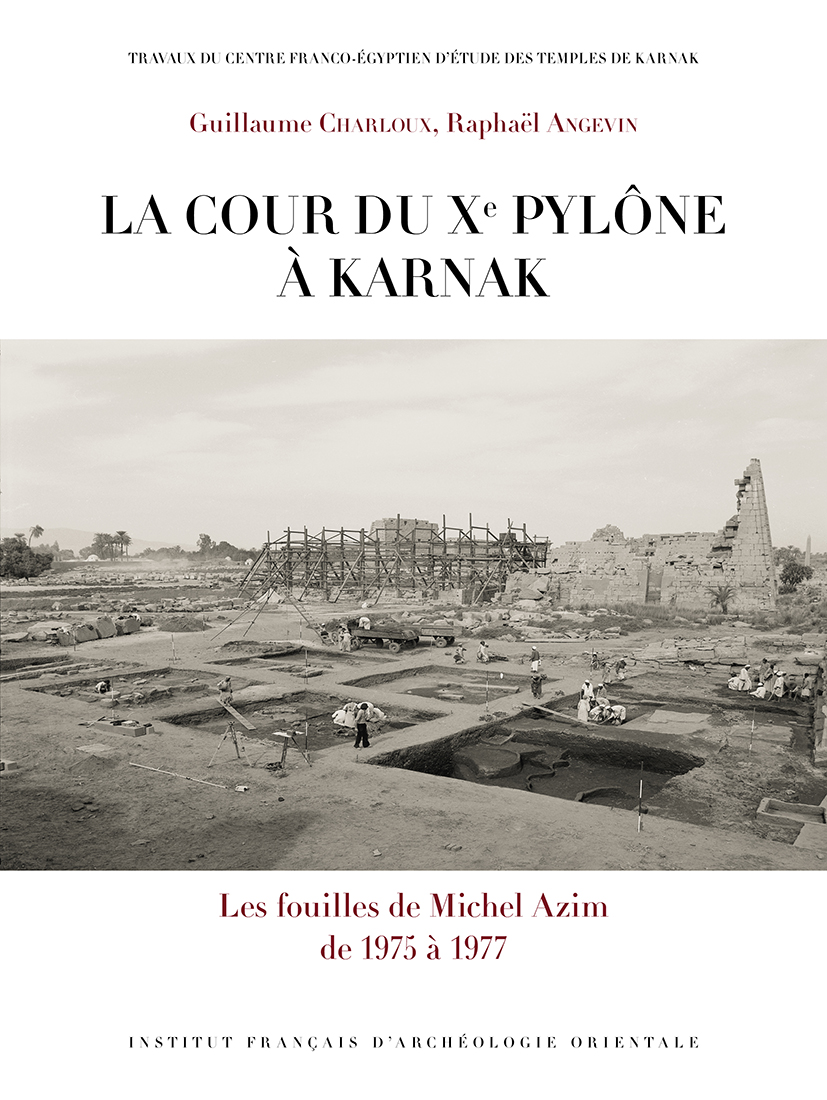
Guillaume Charloux (éd.), Raphaël Angevin (éd.)
La cour du Xe pylône à Karnak
Les fouilles de Michel Azim de 1975 à 1977
Au milieu des années 1970, la fouille engagée par l’architecte Michel Azim dans la cour du Xe pylône constituait l’une des premières explorations archéologiques d’ampleur entreprises à l’emplacement de l’allée processionnelle sud-nord du grand temple d’Amon-Rê depuis les travaux de Georges Legrain au début du xxe siècle. En dépit de son importance, cette opération est demeurée largement inédite et les résultats des travaux réalisés n’ont jusqu’ici fait l’objet que de rares notes liminaires.
Le présent ouvrage vient conclure un ambitieux programme d’inventaire de la documentation de ces fouilles conservée dans plusieurs institutions françaises et égyptiennes. L’ensemble des résultats obtenus à l’issue des campagnes de recherche de 1975-1976 et 1977 est ici réexaminé à la lumière d’un sondage d’évaluation stratigraphique effectué en 2015, dont le mobilier archéologique est analysé par une dizaine de spécialistes.
Bien que la séquence des constructions et des occupations de la cour du Xe pylône reste très proche de celle restituée initialement par le fouilleur, les analyses récentes permettent de réviser en profondeur la chronologie du site, et se révèlent essentielles pour la connaissance de l’histoire urbaine de Thèbes.
In the mid-1970s, Michel Azim, architect at the Franco-Egyptian Center for the Study of the Temples of Karnak, undertook the first large-scale archaeological investigation in the courtyard of the 10th pylon since the work of Georges Legrain at the beginning of the 20th century. Despite its importance, however, this operation has remained largely unpublished and the results of the work carried out have been the subject of only a few preliminary reports and notes.
The present book concludes an ambitious program of inventorying the documentation of these excavations stored in several French and Egyptian institutions. All the results of the research carried out from 1975 to 1977 are re-examined here in the light of a stratigraphic evaluation test-pit undertaken in 2015—the archaeological material from which is analyzed by a dozen specialists.
Although the sequence of constructions and occupations of the 10th pylon courtyard remains very close to the one initially established by the excavator, the recent analyses make it possible to more precisely calibrate the chronology of the site, and will thus prove essential for the study of Ancient Thebes.
تُعد الحفائر التي قام بها المهندس المعماري ميشيل عظيم في منتصف سبعينيات القرن الماضي، في فناء الصرح العاشر هي أوَّلِ حفائر أثريَّة واسعة النّطاق أُجريت في موقع الممر الاحتفالي المتجه جنوب-شمال بمعبد آمون رع الكبير وذلك منذ أعمال Georges Legrain في بداية القرن العشرين. ولكن على الرغم من أهمّيَّة هذه الحفائر، إلا أنها لم تنشر بشكل كامل وأشير إلى نتائج العمل المُنجز بتقارير أولية بسيطة فقط.
الكتاب الحالي ينهي برنامجًٍا طموحًا لجرد توثيق هذه الحفائر المحفوظة في العديدِ من المؤسَّسات الفرنسيَّة والمصريَّة. حيث تتم هنا إعادة فحص جميع نتائج الدراسات التي أُجريت في ١٩٧٥-١٩٧٦م و١٩٧٧م، في ضوء تقييم المسح الأثري للطبقات الذي أُجري في عام ٢٠١٥، والتي قام عشرات من المتخصصين بتحليل البقايا الأثريَّة منها.
وعلى الرغم من أنَّ التتابع الزمني للمنشآت وإشغالات فناء الصّرح العاشر تظلّ قريبة جدًا من تلك التي حدَّدها المُنقِّب في البداية، إلَّا أنَّ التّحاليل الحديثة تتيح مراجعة متعمقة للتّسلسل الزّمني للموقع، وبالتالي تُثبت أنَّها ضرورية لمعرفة تاريخ مدينة طيبة.
- Guillaume Charloux ( : 109153634)
Guillaume Charloux, docteur en archéologie de l’université Paris 1 Panthéon-Sorbonne, diplômé de l’École du Louvre et de l’École biblique et archéologique française de Jérusalem, est actuellement ingénieur de recherche au CNRS (UMR 8167, Orient & Méditerranée, Paris). Il dirige depuis 2010 la mission archéologique et épigraphique Oasis de l’Arabie déserte, regroupant plusieurs sites majeurs d'Arabie : al-Bad', Camel Site, Dûmat al-Jandal, Kharj et Najrân. Il coordonne également plusieurs projets de recherche à Karnak (Égypte), auprès du CFEETK (USR 3172 du CNRS - CSA), notamment la fouille du temple de Ptah en collaboration avec Christophe Thiers (CNRS, UMR5140), et la publication des fouilles archéologiques 1975-1977 de la cour du Xe pylône avec Raphaël Angevin (Ministère de la culture, UMR 7041, Arscan). - Raphaël Angevin ( : 167355201)
Raphaël Angevin est préhistorien et archéologue. Conservateur du patrimoine au Service régional de l’archéologie d’Auvergne-Rhône-Alpes, il est spécialiste des industries lithiques du Chalcolithique et de l’âge du Bronze au Proche-Orient. Ses travaux l’ont notamment conduit à rouvrir le dossier des origines de Karnak et à examiner le mobilier lithique provenant des fouilles anciennes et récentes sur le site. Membre du laboratoire VEPMO de l’UMR 7041-ArScAn et doctorant de l’université de Paris 1 Panthéon-Sorbonne, il consacre sa thèse à l’étude technologique des productions en silex et en obsidienne du site de Mari (Tell Hariri, Syrie) et à leur relation avec les systèmes techniques mésopotamiens des IVe et IIIe millénaires.
- Vous pouvez acquérir ce(s) fichier(s) PDF issu(s) de cet ouvrage en cliquant sur le nom du fichier puis 'Ajouter au panier'.
- You can buy theses PDF files extracted from this book by clicking on the file name then 'Add to cart'.

Version pdf de l’ouvrage :
Bibliothèque générale 75
ISBN 9782724710694
2024 IFAO
Langue(s): français
265 p.
23 € (1211 EGP)
Guillaume Charloux (éd.), Raphaël Angevin (éd.)
La cour du Xe pylône à Karnak
Les fouilles de Michel Azim de 1975 à 1977
Au milieu des années 1970, la fouille engagée par l’architecte Michel Azim dans la cour du Xe pylône constituait l’une des premières explorations archéologiques d’ampleur entreprises à l’emplacement de l’allée processionnelle sud-nord du grand temple d’Amon-Rê depuis les travaux de Georges Legrain au début du xxe siècle. En dépit de son importance, cette opération est demeurée largement inédite et les résultats des travaux réalisés n’ont jusqu’ici fait l’objet que de rares notes liminaires.
Le présent ouvrage vient conclure un ambitieux programme d’inventaire de la documentation de ces fouilles conservée dans plusieurs institutions françaises et égyptiennes. L’ensemble des résultats obtenus à l’issue des campagnes de recherche de 1975-1976 et 1977 est ici réexaminé à la lumière d’un sondage d’évaluation stratigraphique effectué en 2015, dont le mobilier archéologique est analysé par une dizaine de spécialistes.
Bien que la séquence des constructions et des occupations de la cour du Xe pylône reste très proche de celle restituée initialement par le fouilleur, les analyses récentes permettent de réviser en profondeur la chronologie du site, et se révèlent essentielles pour la connaissance de l’histoire urbaine de Thèbes.
In the mid-1970s, Michel Azim, architect at the Franco-Egyptian Center for the Study of the Temples of Karnak, undertook the first large-scale archaeological investigation in the courtyard of the 10th pylon since the work of Georges Legrain at the beginning of the 20th century. Despite its importance, however, this operation has remained largely unpublished and the results of the work carried out have been the subject of only a few preliminary reports and notes.
The present book concludes an ambitious program of inventorying the documentation of these excavations stored in several French and Egyptian institutions. All the results of the research carried out from 1975 to 1977 are re-examined here in the light of a stratigraphic evaluation test-pit undertaken in 2015—the archaeological material from which is analyzed by a dozen specialists.
Although the sequence of constructions and occupations of the 10th pylon courtyard remains very close to the one initially established by the excavator, the recent analyses make it possible to more precisely calibrate the chronology of the site, and will thus prove essential for the study of Ancient Thebes.
- Guillaume Charloux ( : 109153634)
Guillaume Charloux, docteur en archéologie de l’université Paris 1 Panthéon-Sorbonne, diplômé de l’École du Louvre et de l’École biblique et archéologique française de Jérusalem, est actuellement ingénieur de recherche au CNRS (UMR 8167, Orient & Méditerranée, Paris). Il dirige depuis 2010 la mission archéologique et épigraphique Oasis de l’Arabie déserte, regroupant plusieurs sites majeurs d'Arabie : al-Bad', Camel Site, Dûmat al-Jandal, Kharj et Najrân. Il coordonne également plusieurs projets de recherche à Karnak (Égypte), auprès du CFEETK (USR 3172 du CNRS - CSA), notamment la fouille du temple de Ptah en collaboration avec Christophe Thiers (CNRS, UMR5140), et la publication des fouilles archéologiques 1975-1977 de la cour du Xe pylône avec Raphaël Angevin (Ministère de la culture, UMR 7041, Arscan). - Raphaël Angevin ( : 167355201)
Raphaël Angevin est préhistorien et archéologue. Conservateur du patrimoine au Service régional de l’archéologie d’Auvergne-Rhône-Alpes, il est spécialiste des industries lithiques du Chalcolithique et de l’âge du Bronze au Proche-Orient. Ses travaux l’ont notamment conduit à rouvrir le dossier des origines de Karnak et à examiner le mobilier lithique provenant des fouilles anciennes et récentes sur le site. Membre du laboratoire VEPMO de l’UMR 7041-ArScAn et doctorant de l’université de Paris 1 Panthéon-Sorbonne, il consacre sa thèse à l’étude technologique des productions en silex et en obsidienne du site de Mari (Tell Hariri, Syrie) et à leur relation avec les systèmes techniques mésopotamiens des IVe et IIIe millénaires.
Version pdf de l’ouvrage :
Cahiers de la céramique égyptienne 12
ISBN 9782724710830
2024 IFAO
Langue(s): français
228 p.
16 € (842 EGP)
Gwenola Graff
Les vases C-Ware à décor géométrique de Nagada I (Égypte, IVe millénaire)
Les images laissées sur différents supports par la culture prépharaonique de Nagada, en Égypte, au IVe millénaire, sont abondantes et de belle qualité. Pour autant, leur compréhension et leur interprétation ne sont pas toujours aisées.
Les coupes et les vases de Nagada I (3900-3700 av. J.-C.) auxquels cette étude est consacrée sont de couleur rouge sombre et portent un décor peint en blanc, composé uniquement de formes géométriques simples. Depuis longtemps, ces compositions répétitives et monotones rebutent les chercheurs et rendent difficile toute interprétation. On peut même penser n’avoir affaire qu’à une composition ornementale, dépourvue de toute signification.
La présente étude réexamine cet ensemble d’objets si souvent délaissés. Pour ce faire, un vaste corpus d’objets a été rassemblé et analysé. La compréhension de ces décors non figuratifs au premier regard aura supposé de concevoir des méthodes adaptées et des outils conceptuels issus de l’anthropologie comme de la linguistique ou des statistiques. Au final, l’étude offerte au lecteur sort du cadre strict de l’iconographie prédynastique égyptienne pour proposer une archéologie du signe graphique.
The images left on various media by the pre-pharaonic culture of Nagada, Egypt, in the 4th millennium are abundant and of high quality. However, they are not always easy to understand or interpret.
The bowls and vases from Nagada I (3900-3700 BC), to which this study is devoted, are dark red in color and decorated with simple geometric shapes painted in white. For a long time, these repetitive, monotonous compositions have discouraged researchers and made interpretation difficult. It may even be thought that we are dealing with an ornamental composition devoid of any meaning.
The present study re-examines this often neglected group of objects. To this end, a vast corpus of objects was collected and analyzed. To understand these non-figurative decorations, it was first necessary to devise appropriate methods and conceptual tools drawn from anthropology, linguistics and statistics. The completed study goes beyond the strict framework of Egyptian predynastic iconography to propose an archaeology of the graphic sign.
خَلَفَت حضارة نقادة ما قبل الفرعونية في مصر صوَرًا وافرة وذات نوعية جيدة على مختلف الوسائط الأثرية في الألفية الرابعة. ومع ذلك، فإن فهمها وتفسيرها ليس دائمًا بالأمر الهَيِّن.
خُصِّصَت هذه الدراسة لأكواب ومَزهريات نقادة الأولى (٣٩٠٠-٣٧٠٠ ق.م)، ذات اللون الأحمر الداكن والتي تحمل زخرفة ملوَّنة باللون الأبيض، والمكوَّنة فقط من أشكال هندسية بسيطة. هذه التركيبات المتكررة والرتيبة ثَبَّطَت عزم الباحثين لفترة طويلة، وجعلت من الصعب أي تفسير لها؛ بل والاعتقاد أننا نتعامل فقط مع تركيبة زخرفية خالية من أي معنى.
تُعيد هذه الدراسة فحص مجموعة القطع هذه التي غالبًا ما يتم إهمالها؛ حيث تم جمع وتحليل عدد كبير من القطع. ولفهم هذه الزخارف غير التصويرية للوهلة الأولى، سوف يُفترَض أن نَتَخَيَّل أساليبًا مناسبة وأدوات تَصَوُّرِيّة مُستمَدة من الأنثروبولوﭽﻳﺎ وكذلك من اللغويات أو الإحصاءات. وفي نهاية المطاف، تخرج الدراسة المُقدَّمة للقارئ عن النطاق الصارم للمناظر التصويرية المصرية في عصر ما قبل الأسرات، من أجل تقديم علم آثار من العلامة المرسومة.
- Gwenola Graff ( : 067160549)
Gwenola Graff est égyptologue à l'Institut de Recherches pour le Développement. Son travail porte sur l’iconographie prédynastique égyptienne. Elle dirige une mission archéologique franco-égyptienne dans le sud de l’Égypte (région d’Assouan).
Version pdf de l’ouvrage :
Mémoires publiés par les membres de l’Institut français d’archéologie orientale 155
ISBN 9782724710847
2024 IFAO
Langue(s): français
393 p.
29 € (1526 EGP)
Dominique Bénazeth
Catalogue général du Musée copte
Objets en métal 2
Il aura fallu attendre une vingtaine d’année ce deuxième volume du Catalogue général du Musée copte. Objets en métal. Cette longue période a permis à l’auteur d’approfondir ses connaissances dans les domaines concernés par une collection extrêmement diverse et d’améliorer le contenu des 326 notices, qui présentent en tout 449 pièces. L’édition des textes portés par certains objets n’avait pas été systématique dans le premier volume. Grâce à la collaboration d’éminents spécialistes, une nouvelle rubrique « Inscription » donne les textes grec, copte, arabe, guèze, turc, arménien et slavon. Après les objets en rapport avec la lumière et le feu, luminaires et encensoirs, ainsi que des « trésors » d’églises, le nouveau volume contient, dans une première partie, des objets liturgiques ou à fort caractère chrétien : instruments consacrés ou utilisés par le clergé, ornements vestimentaires ecclésiastiques, croix de toutes sortes, mobilier, témoignages de piété personnelle ; une section regroupe des faux produits au début du xxe siècle dans le Fayoum. La seconde partie inclut une centaine d’objets qui entrent dans des typologies semblables aux précédentes tout en étant profanes : couverts,instruments de musique, bassins, pichets, plats et plateaux, ceintures.
The second volume of the Catalogue général du Musée copte. Objets en métal, has been finally completed after twenty years. This long period allowed the author to deepen her knowledge in the fields concerned by an extremely diverse collection and to improve the content of the 326 entries, introducing 449 items. The edition of the texts on certain objects was not systematically included in the first volume. Thanks to the collaboration of eminent specialists, a new heading “Inscription” gives the Greek, Coptic, Arabic, Guezh, Turkish, Armenian and Slavonic texts. Following objects related to light and fire, luminaries and incense burners, as well as church “treasures”, the new volume contains, in the first part, liturgical items or objects with a strong Christian character: instruments consecrated or used by the clergy, ornaments for ecclesiastical vestments, crosses of all kinds, furniture, testimonies of personal piety; a section gathers forgeries produced at the beginning of the twentieth century in the Fayum. The second part includes about a hundred objects that fall into similar typologies to the previous ones but are secular: cutlery, musical instruments, basins, jugs, dishes and trays, belts.
تعين الانتظار نحو عشرين عامًا لصدور «الكتالوج العام للمتحف القبطي. المشغولات المعدنية». وقد أتاحت هذه الفترة الزمنية الطويلة للكاتبة تعميق معارفها في المجالات الخاصة بمجموعة بالغة التنوع كما سمحت بتحسين محتوى الـ ٣٢٦ بطاقة توصيف، التي تقدم ٤٤٩ قطعة في الإجمال. ولم يكن نشر النصوص المنقوشة على بعض القطع يتم بشكل ممنهج في المجلد الأول. وبفضل تعاون عدد من أبرز المتخصصين، تقدم فقرة "كتابات ونقوش" الجديدة النصوص اليونانية والقبطية والعربية والجعزية والتركية والأرمنية والسلاﭬية. وبعد القطع ذات الصلة بالنور والنار، من مصابيح ومباخر، وبعد "كنوز" الكنائس، يتضمن المجلد الجديد، في جزئه الأول، قطعًا طقسية أو ذات طابع مسيحي قوي: أدوات مكرسة أو مستخدمة من قبل رجال الدين، وزخارف للملابس الكهنوتية، صلبان بأنواعها، أثاث، وشواهد لورع الأفراد؛ وهناك قسم مخصص للقطع المقلدة التي أُنتجت في الفيوم في مطلع القرن العشرين. أما الجزء الثاني فيشتمل على نحو مائة قطعة تندرج في صنف مماثل للسابقة ولكنها غير دينية: أدوات مائدة، آلات موسيقية، طشوت، أباريق، أطباق وصواني، أحزمة.
- Dominique Bénazeth ( : 029888212)
Dominique Bénazeth est conservatrice générale honoraire du patrimoine. Sa carrière s’est déroulée au sein de la section copte du département des Antiquités égyptiennes au musée du Louvre, dont elle a rédigé le catalogue des objets en métal. Elle a dirigé les premières fouilles Louvre-Ifao à Baouît et enseigné à l’École du Louvre.
Version pdf de l’ouvrage :
Recherches d’archéologie, de philologie et d’histoire 49
ISBN 9782724710823
2024 IFAO
Langue(s): français
500 p.
10 € (526 EGP)
Annalaura Turiano
Missionnaires italiens et enseignement en Égypte (1890-1970)
De la pastorale migratoire à la coopération technique
En prenant pour objet la mission salésienne en Égypte, le présent ouvrage ajoute une dimension italienne aux études sur le phénomène missionnaire chrétien au Proche-Orient et s’intéresse à un secteur éducatif peu connu : l’enseignement professionnel. S’appuyant sur des archives inédites en plusieurs langues et de nombreuses enquêtes orales, l’auteure examine un siècle de présence missionnaire salésienne, retrace les parcours de plusieurs générations d’élèves et montre comment les écoles professionnelles de la mission ont accompagné, jusqu’aux années 1970, la formation de communautés de métiers et d’un petit entreprenariat familial.
À travers l'étude des établissements salésiens à Alexandrie, au Caire et dans les villes du canal de Suez (Port Said, Suez et Ismaïlia), cet ouvrage explore la mise en place d'un enseignement technique et professionnel dans l’Égypte coloniale et indépendante, ses enjeux économiques et politiques, tout en soulignant l’impulsion qui lui a été donnée durant les années nassériennes. Il inscrit le cas salésien en Égypte dans une histoire plus vaste : l’histoire des migrations et des ambitions coloniales de l’Italie en Méditerranée, l’histoire transnationale du catholicisme et l’histoire sociale de l’enseignement.
By focusing on the Salesian mission in Egypt, this book adds an Italian dimension to the study of the Christian missionary phenomenon in the Near East and addresses a little-known educational sector, namely vocational education. Drawing on unpublished archives in several languages and oral interviews, the author examines a century of missionary presence, tracing the careers of several generations of students and showing how the mission's vocational schools encouraged the formation of small family businesses and trade communities up until the 1970s.
Through an analysis of Salesian institutions in Alexandria, Cairo and the Suez Canal cities (Port Said, Suez et Ismailia), the book explores the development of technical and vocational education in colonial and independent Egypt, its economic and political dimensions, and the impetus it received during the Nasser years. Finally, the Salesian activity in Egypt is placed in a wider historical context: the history of migrations and Italy’s colonial ambitions in the Mediterranean, the transnational history of Catholicism and the social history of education.
يقدم هذا الكتاب تحليلًا لإرسالية السالزيان وشبكتها المدرسية في مصر بين ١٨٩٠ و١٩٧٠. حيث يضيف بعدًا إيطاليًا على دراسة الإرساليات المسيحية في الشرق الأوسط مع الاهتمام بقطاع تعليمي مجهول، هو التعليم المهني. واستنادًا على وثائق أرشيفات لم يسبق نشرها محررة بعدة لغات وعلى شهادات شفهية، تعرض المؤلفة صيرورة أجيال عديدة من التلاميذ ويُظهِر دور مدارس دون بوسكو المهنية في تكوين مشاريع أسرية صغيرة وطوائف من المهن والحرف حتى سبعينيات القرن الماضي.
وفي مرآة مدارس السالزيان، يمكننا رؤية تطور التعليم الفني والمهني في مصر إبّان فترة الاستعمار وبعد الاستقلال، والرهانات التعليمية والاقتصادية والسياسية التي يجسدها وما تلقاه من قوة دافعة في فترة الستينيات. أخيرًا، توضع تجربة السالزيان في مصر في سياقات أوسع تتجاوز الأفق المصري: تاريخ الكنيسة الكاثوليكية وعلاقاتها بالدولة الإيطالية، وتاريخ الهجرات والطموحات الإيطالية في منطقة البحر المتوسط، وتاريخ التعليم العابر للحدود الوطنية.
- Annalaura Turiano ( : 198374852)
Annalaura Turiano est postdoctorante dans le programme PredicMO : Grammaires de la prédication au Moyen-Orient (XIXe-XXIe siècles) financé par l’Agence nationale de la recherche (ANR). Titulaire d’un doctorat de l’université d’Aix-Marseille (2016), elle a été membre scientifique de l’École française de Rome (2018-2021) et postdoctorante à l’Université libre de Berlin (2018). Ses recherches portent sur l’histoire des missions chrétiennes, de l’éducation et de la philanthropie en Égypte et au Proche-Orient contemporains.
ISBN 9782724710168
2024 IFAO
Collection: RAPH 47
Langue(s): français
1 vol. 232 p.
13 € (684 EGP)
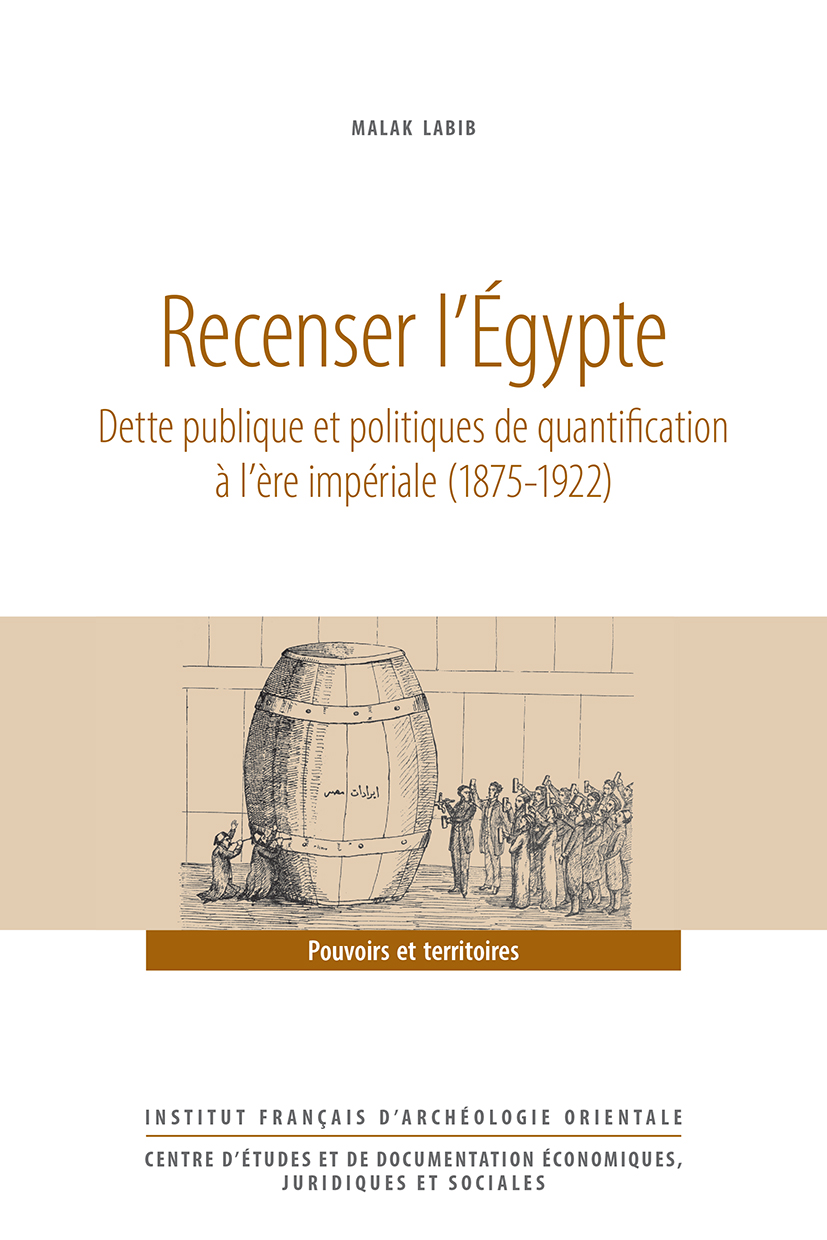
Malak Labib
Recenser l’Égypte
Dette publique et politiques de quantification à l’ère impériale (1875-1922)
Dans la décennie qui précède l’occupation britannique (1882), l’Égypte est placée sous tutelle financière internationale, dans un contexte de crise de la dette. Émissaires, diplomates et banquiers européens mènent des enquêtes visant à recenser ses ressources économiques. Le présent ouvrage prend pour point de départ ces enquêtes afin d'explorer plus largement l’histoire de la statistique et de la quantification en Égypte à l’ère de la première globalisation financière.
Des débats autour du budget à la réforme de l’impôt et à celle des poids et mesures, cet ouvrage s’intéresse aux lieux, aux acteurs et aux modalités de la fabrique du chiffre. Il montre comment, dans un contexte de crise, l’évaluation des ressources publiques devient un enjeu de négociations et de luttes, où s’entrecroisent problèmes techniques et politiques. Il permet d’appréhender sous un jour nouveau l’histoire économique de l’Égypte à l’ère impériale et de placer le cas égyptien dans une histoire transnationale de la quantification et de la statistique.
In the decade preceding the British occupation (1882), Egypt was placed under international financial control, in the context of the debt crisis. European emissaries, diplomats, and bankers conducted surveys with the aim of investigating the country's economic resources. The present study takes these surveys as a starting point for a broader exploration of the history of statistics and quantification in Egypt during the first phase of financial globalization.
From the debates about the budget to the adjustment of taxes and the reform of weights and measures, the book examines the actors, sites and practices of numerical knowledge production. It shows how the evaluation of public resources was a contested terrain where political struggles intersected with technical and scientific debates about measurement procedures.
This study provides new perspectives on the economic history of Egypt during the British colonial period, and aims to situate the Egyptian case within the transnational history of statistics and quantification.
تم وضع مصر تحت رقابة مالية دولية في سياق أزمة الديون خلال العقد السابق للاحتلال البريطاني (١٨٨٢م). وفي تلك الفترة تم ارسال مبعوثين ودبلوماسيين ورجال بنوك أوروبيين ليقوموا بدراسات ترمي إلى إحصاء الموارد المالية للبلاد. يتخذ هذا الكتاب هذه الدراسات الاستقصائية كنقطة انطلاق، بغية استكشاف تاريخ الإحصاء والقياس الكمي في مصر، في عصر أول عولمة مالية. وانطلاقًا من الصراعات حول الميزانية، إلى إصلاح نظام الضرائب، وإصلاح نظام الأوزان والمقاييس، ينصب اهتمام الكتاب على الأماكن والفاعلين والوسائل المستخدمة في عملية صناعة الأرقام. وهو يُظهِر كيف أنه، في سياق الأزمة، أصبح تقييم الموارد العامة موضوع تفاوض وصراع، حيث تقاطعت مصالح ورهانات تقنية وسياسية فيما بينها.
- Malak Labib ( : 261798464)
Malak Labib est membre scientifique à l’Ifao. Elle a obtenu sa thèse à l’université d’Aix-Marseille (IREMAM) en 2015. Ses travaux s’intéressent à l’histoire de la statistique et à celle des savoirs et ingénieries du développement.
- Vous pouvez acquérir ce(s) fichier(s) PDF issu(s) de cet ouvrage en cliquant sur le nom du fichier puis 'Ajouter au panier'.
- You can buy theses PDF files extracted from this book by clicking on the file name then 'Add to cart'.