

Manifestations scientifiques
Abonnez-vous à la … Subscribe to the Mailing list :
ASWAT
Le dimanche 26 avril 2026 à 18h00 (heure du Caire), IFAO 
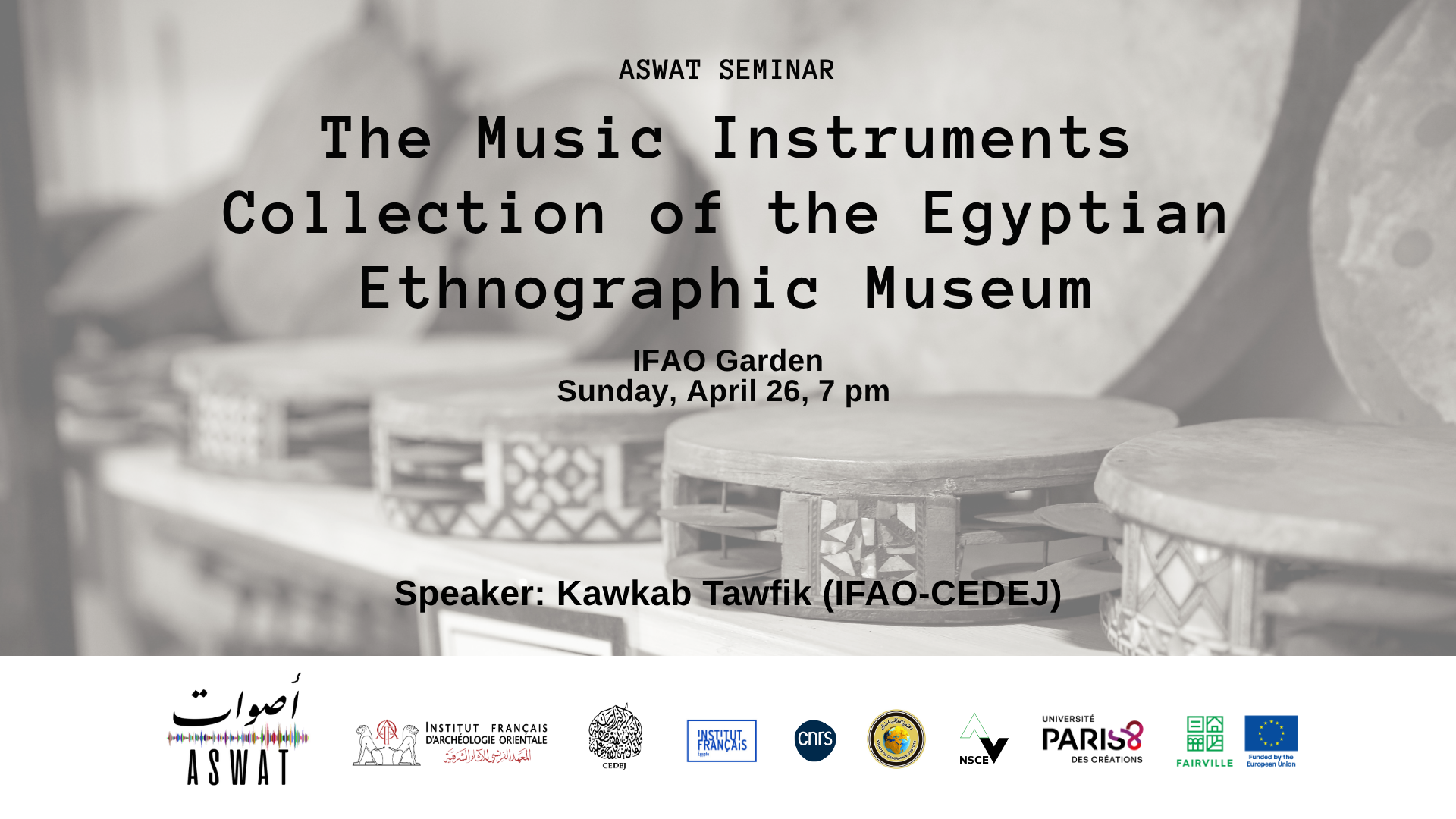
The Music Instruments Collection of the Ethnographic Museum of Cairo
between imperial knowledge production and emerging national identity
Kawkab Tawfik
Partenaire(s) de l’Ifao : CEDEj, IFE, CNRS
Langue : anglais.
A new session of ASWAT (an Ifao - CEDEJ scientific initiative) will take place on 26 April 2026, at the Ifao, and it is entitled "The Music Instruments Collection of the Ethnographic Museum of Cairo, between imperial knowledge production and emerging national identity", it will start with a lecture given by Kawkab Tawfik, which will be followed by taqasim performance of Egyptian flutes.
The event is open to the public in the limit of available places.
Abstract:
The collection of musical instruments within the Ethnographic Museum of the Egyptian Geographical Society can be examined as a lens through which to analyze the intersections of science, colonialism, and nation-building in late nineteenth- and early twentieth-century Egypt. Established within a naturalist and evolutionist epistemological framework, the museum classified objects according to typological and comparative principles derived from European anthropology. Within this system, ṭarab e sha‘bī musical instruments—namely a rich set of nāy, kawala,, arghūl, mizmar, rabābah, riqq, mazhar, doholla, lutes, cymbals, a qānūn, horns, and naqrazān—were categorized alongside other ethnographic materials, yet occupied a distinctive position linking material culture to performance, ritual, and oral tradition.
These instruments were associated with social practices including weddings, religious ceremonies, and itinerant storytelling. As such, they functioned as mediators of collective memory and embodiments of intangible cultural heritage. Their interpretation was shaped by the concept of ethnographic “survivals,” reinforcing narratives of continuity between ancient, Coptic, Islamic, and modern Egyptian traditions. At the same time, their inclusion in both Egyptian and African sections of the museum reflects underlying colonial frameworks, particularly in relation to Sudan. Ultimately, the collection reveals tensions between classification and lived culture, and between imperial knowledge production and emerging national identity.
The presentation will be followed by taqasim performance of Egyptian flutes
ASWAT
Sounds - and music - are able to shape individual and collective identities, define spaces and borders, denote cultures, transmit knowledge and influence style lives.
ASWAT is a series of music meetings and music performances focusing on Egyptian culture(s) of music that seeks to explore a range of musical practices across Egypt, and beyond, through the contribution of academic speakers and music makers, followed by a concert. The meetings will offer the opportunity to deepen some historical, religious, social and musicological aspects that interwoven in, and from, the Egyptian music heritage, addressing creation, performance and reception practice.
Aswat is a joint initiative from CEDEJ, IFAO supported by IFE.
Les sons - et la musique - sont capables de façonner les identités individuelles et collectives, de définir les espaces et les frontières, de dénoter les cultures, de transmettre les connaissances et d'influencer les styles de vies.
ASWAT est une série de rencontres et de spectacles musicaux axés sur la ou les cultures musicales égyptiennes qui vise à explorer un éventail de pratiques musicales à travers l'Égypte, et au-delà, grâce à la contribution de conférenciers universitaires et de musiciens, suivie d'un concert. Les rencontres seront l'occasion d'approfondir certains aspects historiques, religieux, sociaux et musicologiques qui s'entremêlent dans et à partir du patrimoine musical égyptien, en abordant les pratiques de création, d'interprétation et de réception.
ASWAT est une initiative conjointe du CEDEJ et de l'Ifao soutenue par l'IFE.