

Biahmu

| Variantes | Mission franco-égyptienne sur le site des colosses de Biahmu |
| Missions Ifao depuis | 2025 |
BIAHMUOpération de terrain 24121
Responsable(s)
Partenaires
 🔗 Ministère du Tourisme et des Antiquités (MoTA)
Cofinancements
Dates des travaux
décembre - février
Participants en 2026
| | Simon Connor | Chercheur | IFAO |
| | Mohamed Gaber | topographe | IFAO |
| | Valentina Gasperini | archéologue, Céramologue | IFAO |
| | Tomasz Herbich | géophysicien | IAEPAN |
| Eid Rezk Nagy Mertah | Restauration, Boursier doctorant | Ministère du Tourisme et des Antiquités ; Musée égyptien du Caire | |
| Ashraf Sobhy | Chef inspecteur des antiquités pharaoniques et gréco-romaines du Fayoum, Co-directeur de la mission Biahmu | Ministère du Tourisme et des Antiquités | |
| | Hourig Sourouzian | Deutsches Archäologisches Institut |
Co-direction
Simon Connor
Membre scientifique, Institut français d’archéologie orientale (IFAO)
Ashraf Sobhy
Directeur général de l’administration des Antiquités égyptiennes et gréco-romaines du Fayoum, Ministère du Tourisme et des Antiquités (MoTA)
En 2025-2026 ont été menées les deux premières campagnes de terrain de la nouvelle mission égypto-française à Biahmu. Pour cette première saison, la prospection a été réalisée par Simon Connor, Marwa Ragab, Sara Samir, Nora Thabet, Heba Atef, Samia Shawky, Hassan Selim, Mahmoud Mamdouh et Mahmoud Diab.
Valentina Gasperini et Ashraf Sobhy ont assuré la documentation complète du matériel céramique collecté en surface. Les travaux de conservation ont été dirigés par Eid Mertah et Susan Hosny.
Joachim Le Bomin, Mohamed Gaber et Mahmoud Diab ont été responsables de la mise en place des points de contrôle topographiques et de la réalisation de la documentation photogrammétrique du site.
Tomasz Herbich a mené une prospection à l’aide des méthodes de magnétométrie et de résistivité.
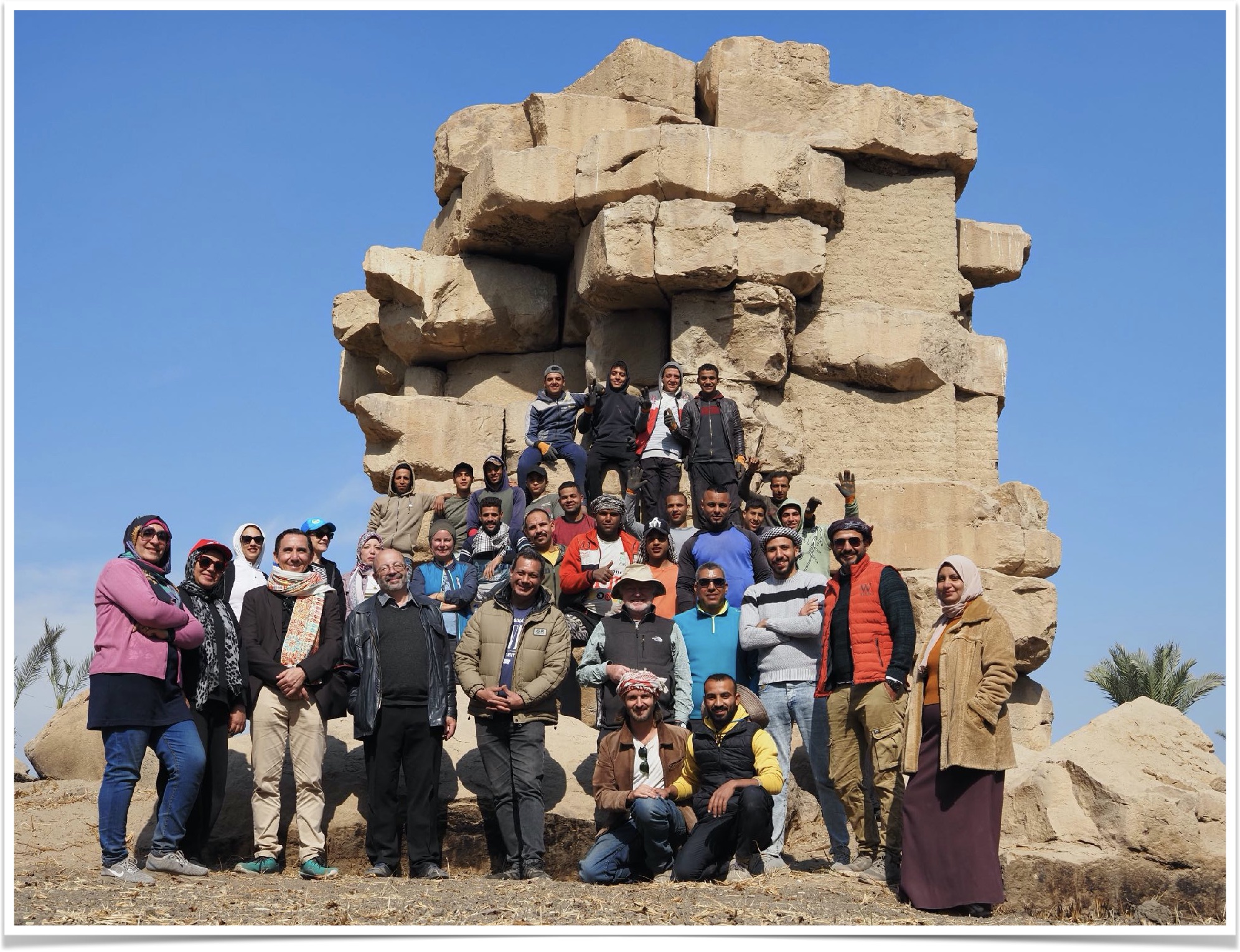
La mission a été appuyée par une main-d’œuvre locale passée de 10 à 30 ouvriers au cours de la saison, tous originaires du village de Biahmu, qui ont contribué de manière significative au nettoyage du site et aux opérations logistiques.
1. Brève présentation du site
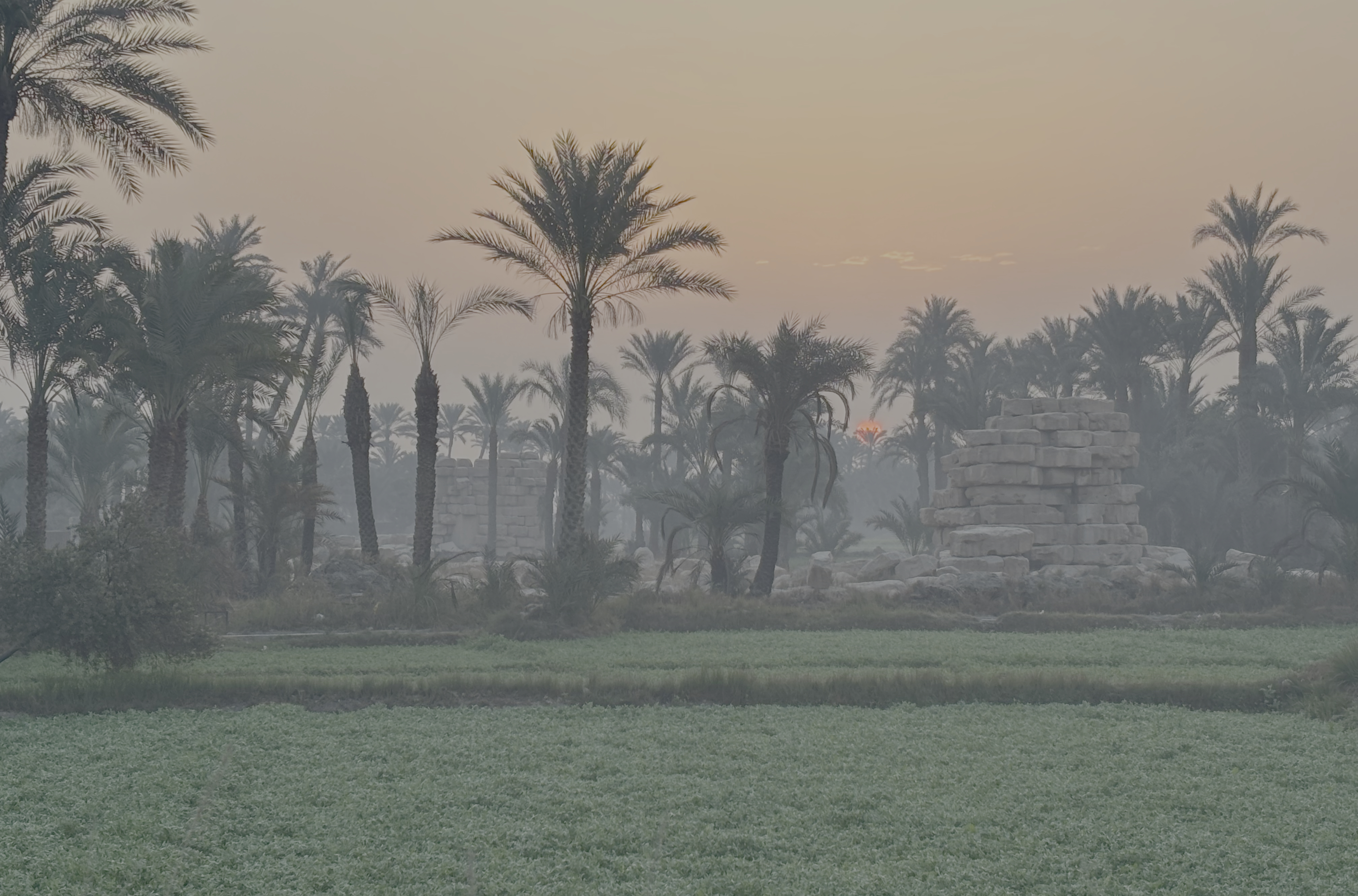
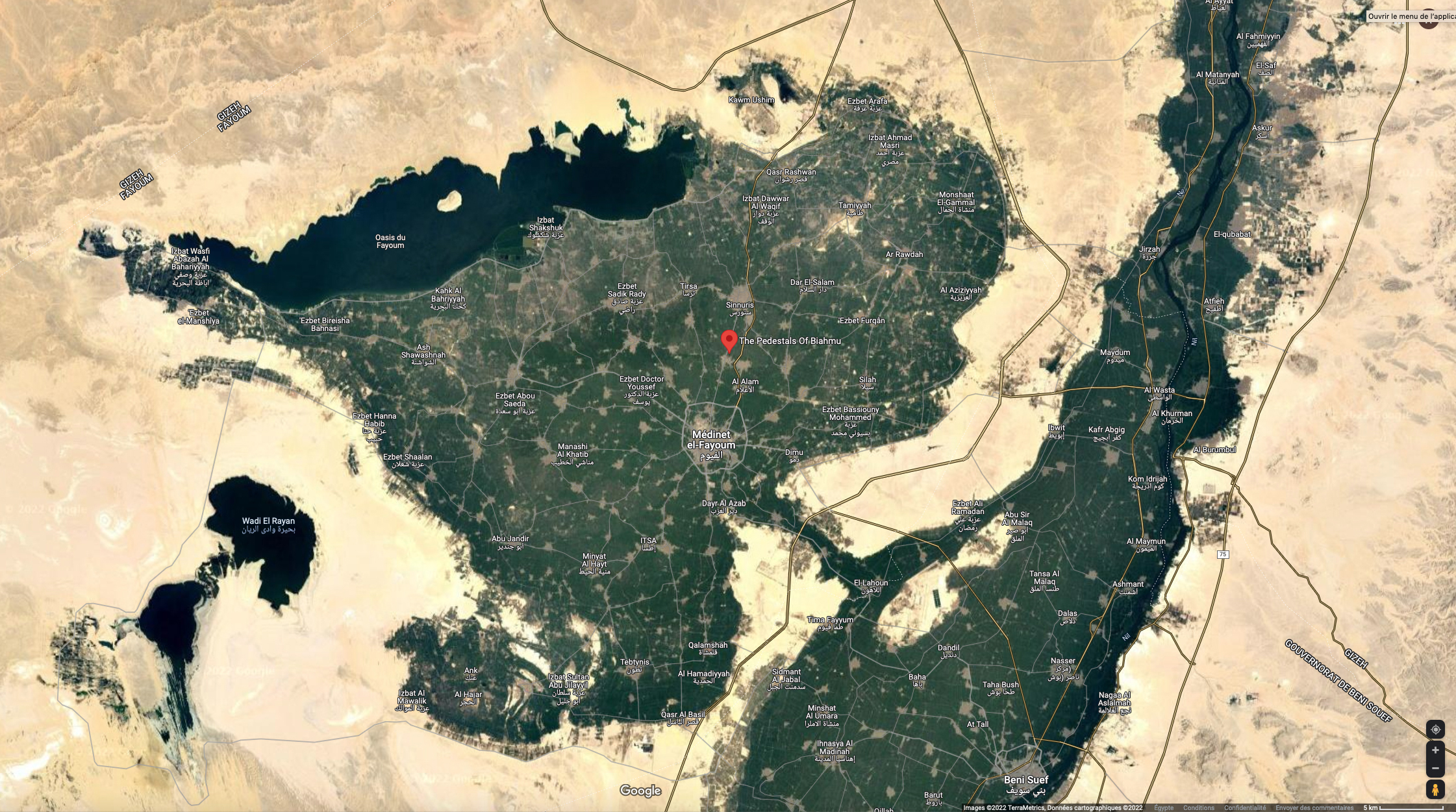
Situé à environ 7 km au nord de Médinet el-Fayoum, le site de Biahmu conserve les vestiges d’un ensemble dont la fonction reste à déterminer. Il fut occupé depuis l’époque d’Amenemhat III, vers 1800 av. J.-C., jusqu’à la période ptolémaïque.
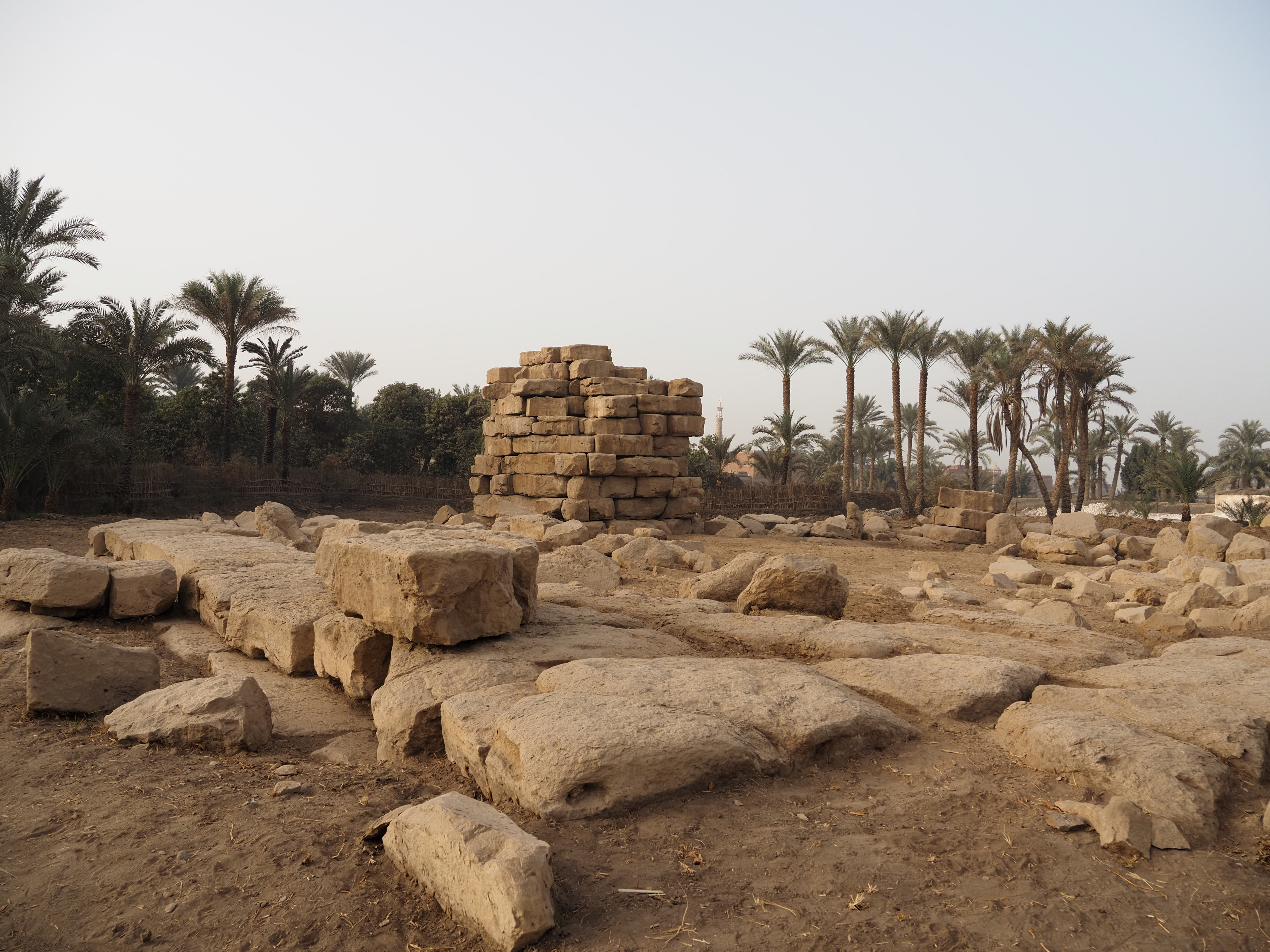
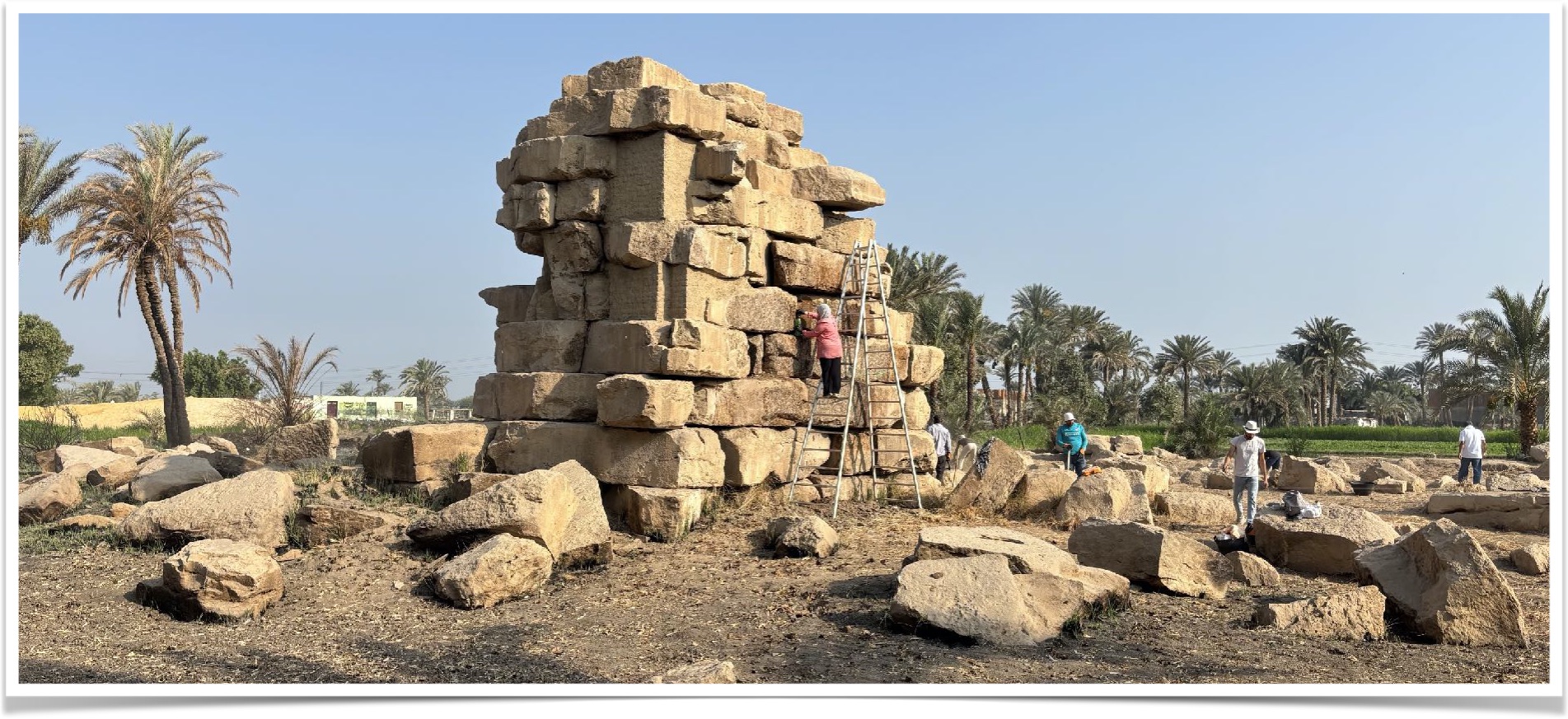
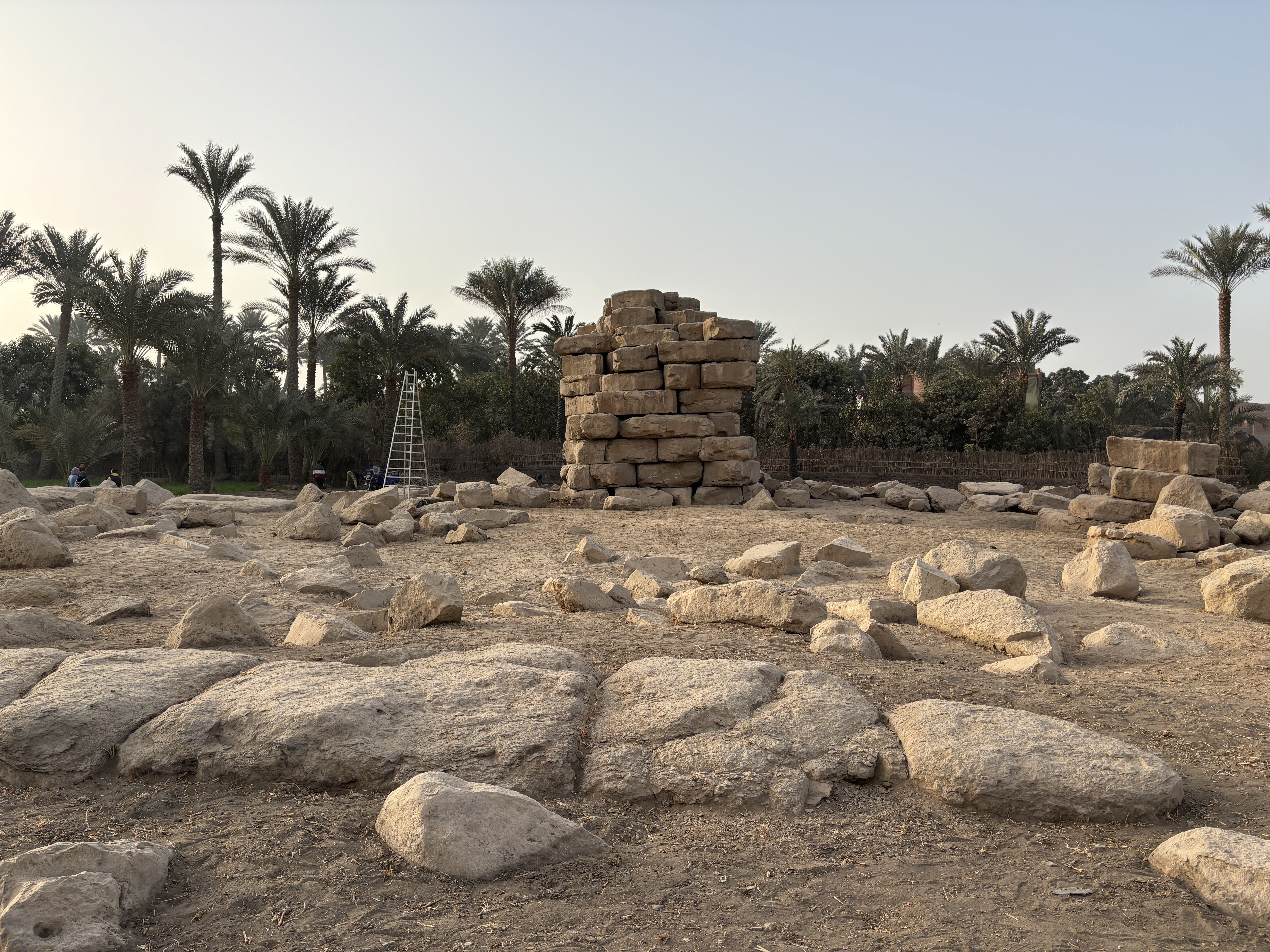
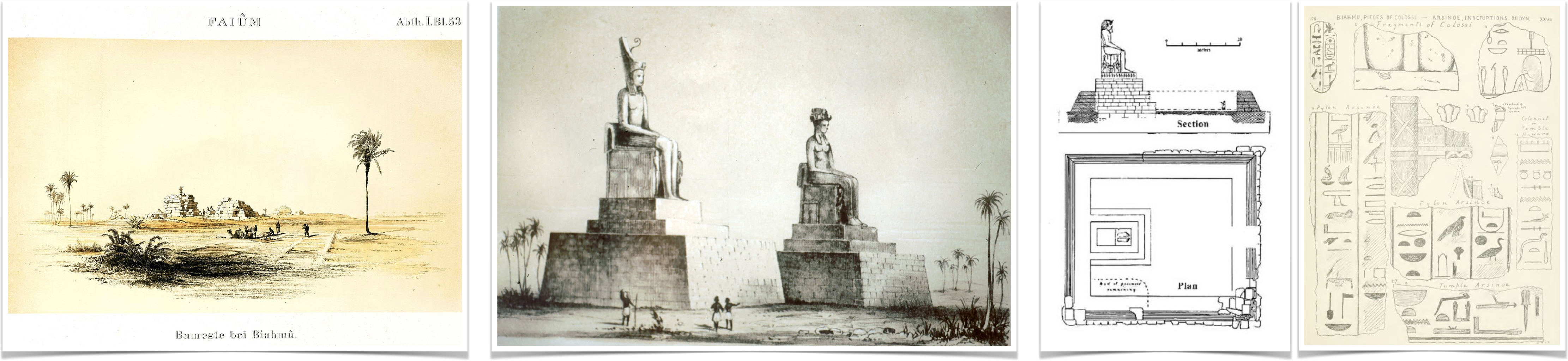
À l’origine, deux statues colossales d’Amenemhat III, hautes d’environ 12 mètres, se dressaient chacune sur un massif podium construit en blocs de calcaire. Dans l’Antiquité, le rivage du lac Qaroun s’étendait beaucoup plus au sud qu’aujourd’hui et pouvait se situer directement en face des statues. Hérodote, Diodore de Sicile et Pline l’Ancien mentionnent ces statues comme étant dressées « sur des pyramides » et « au milieu du lac », ce qui suggère que le site était au moins partiellement entouré d’eau pendant les périodes de crue.
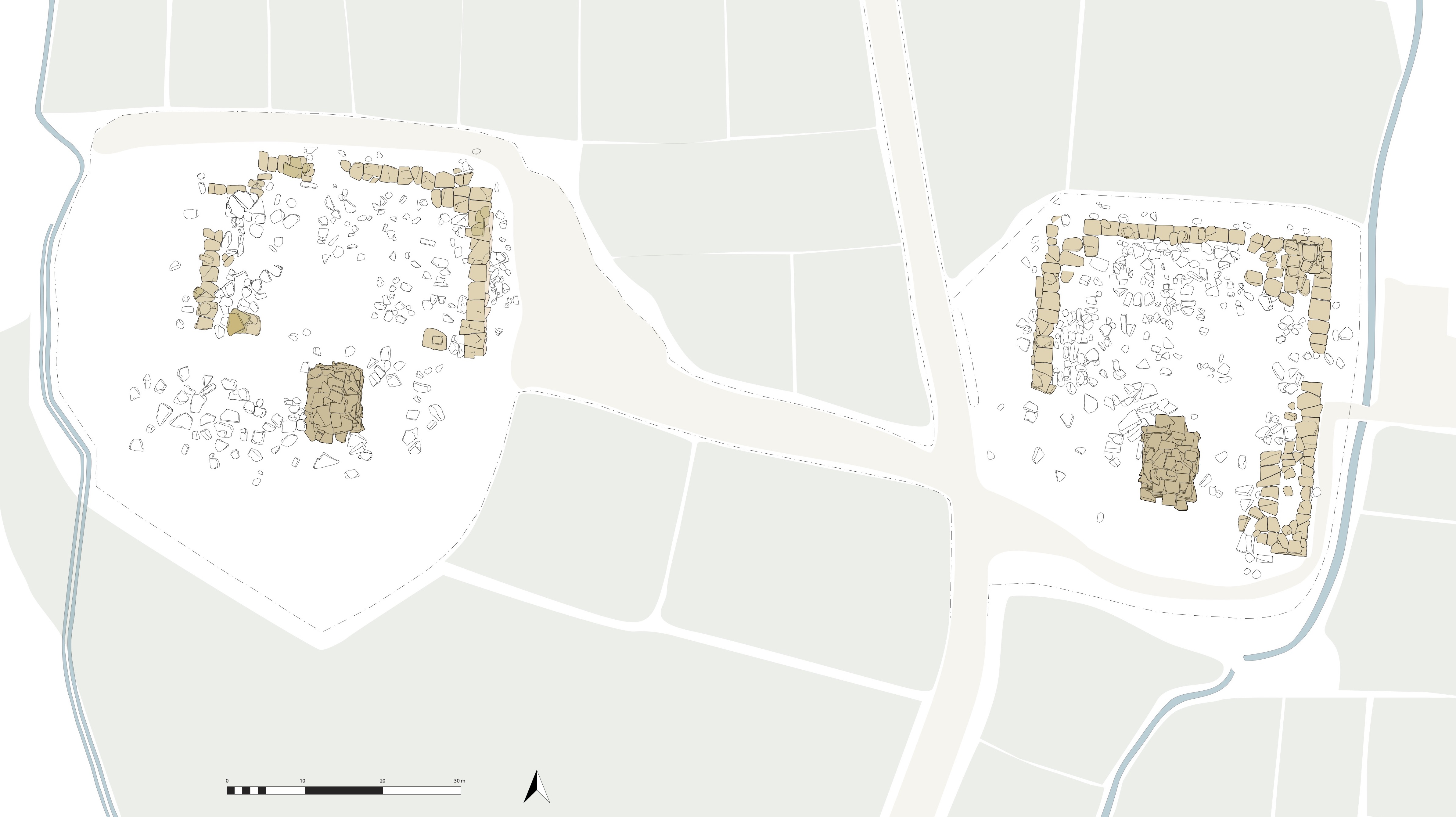
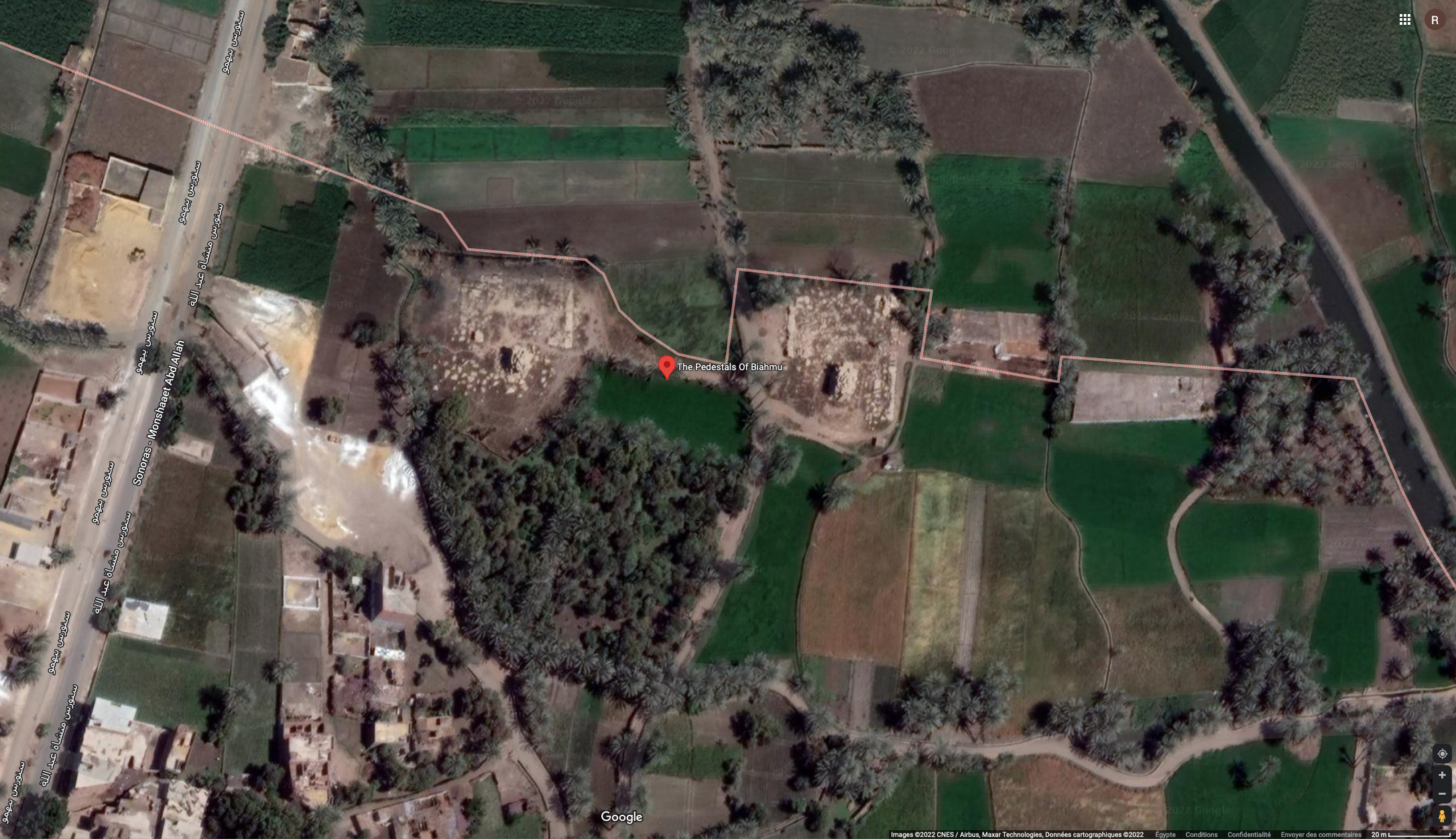
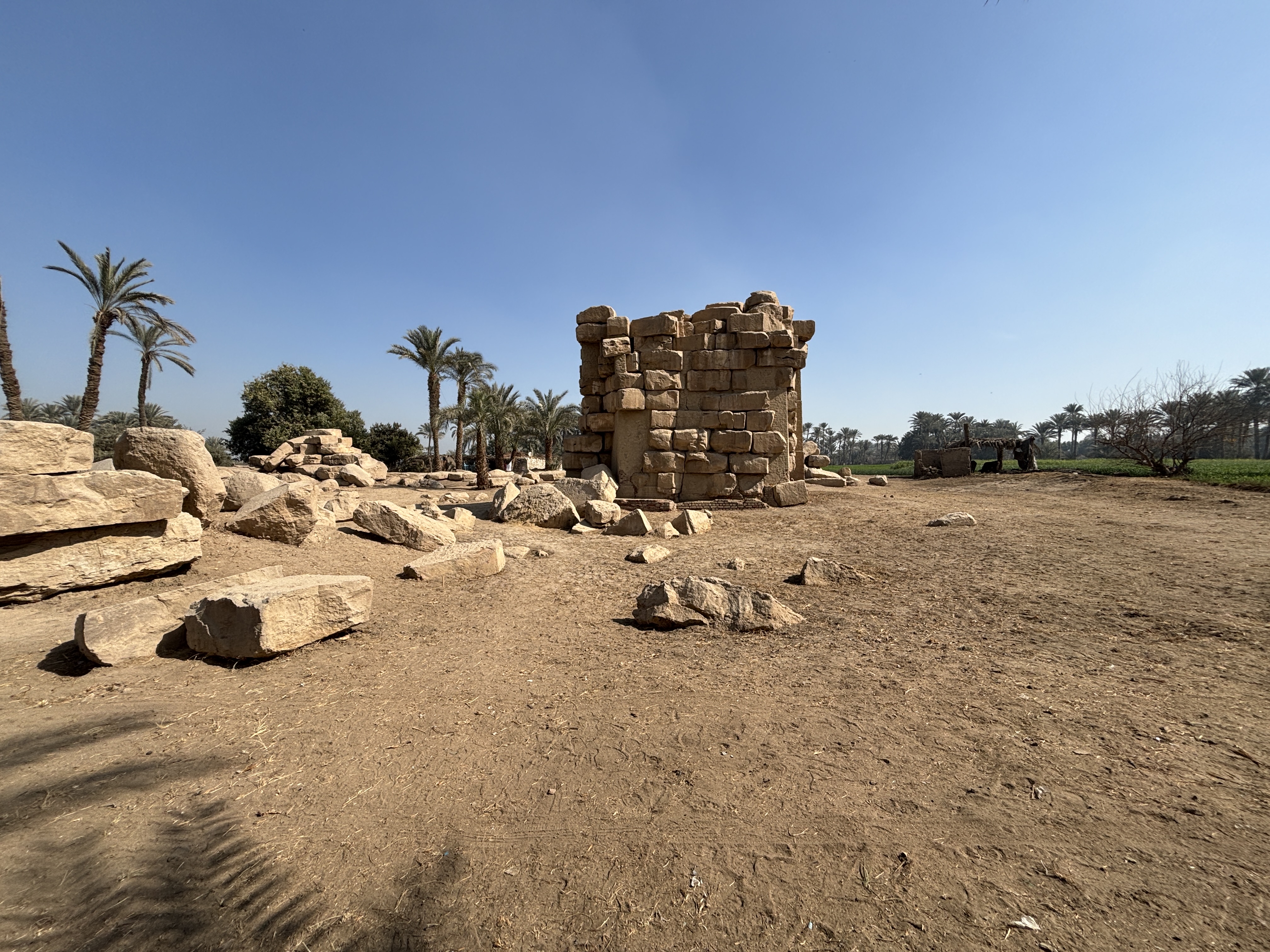
Les deux statues étaient encore debout au XIIIe siècle apr. J.-C., comme l’attestent les sources islamiques médiévales (Osman el-Nabulsi). Elles furent détruites au cours des siècles suivants, mais leurs piédestaux monumentaux subsistent. Chacun est « protégé » au nord par une enceinte en U d’environ 25 m de côté, dont la fonction reste à déterminer - peut-être une voie d'accès au lac Qaroun, dont la berge devait se trouver à peu près à cet endroit au Moyen Empire ?
Lors d’une courte fouille de six jours en 1888, W.M.F. Petrie mit au jour plusieurs dizaines de fragments de statues en quartzite, principalement autour du podium oriental. Quarante-six fragments (dont un nez monumental) furent envoyés à l’Ashmolean Museum d’Oxford, tandis que les plus grandes pièces furent réenfouies à l’ouest du podium oriental.
Sur la base de ces découvertes, Petrie proposa une restitution de deux colosses assis orientés vers le nord, face au lac Qaroun. Il suggéra que les murs formaient deux enceintes carrées autour des piédestaux, avec une porte au centre du mur nord, en direction du lac, et qu’une voie passait entre les deux ensembles. Comme on le verra, les résultats préliminaires de notre prospection invitent à reconsidérer cette restitution.
Les campagnes 2025-2026 avaient trois objectifs principaux :
- Assurer la préservation et l’entretien du site par des opérations de nettoyage et de conservation ;
- Reconstituer, dans la mesure du possible, l’aspect et l’organisation originels du site vers 1800 av. J.-C. ;
- Retracer l’histoire du site et comprendre les transformations qu’il a connues au cours des quatre derniers millénaires.
2. Nettoyage du site
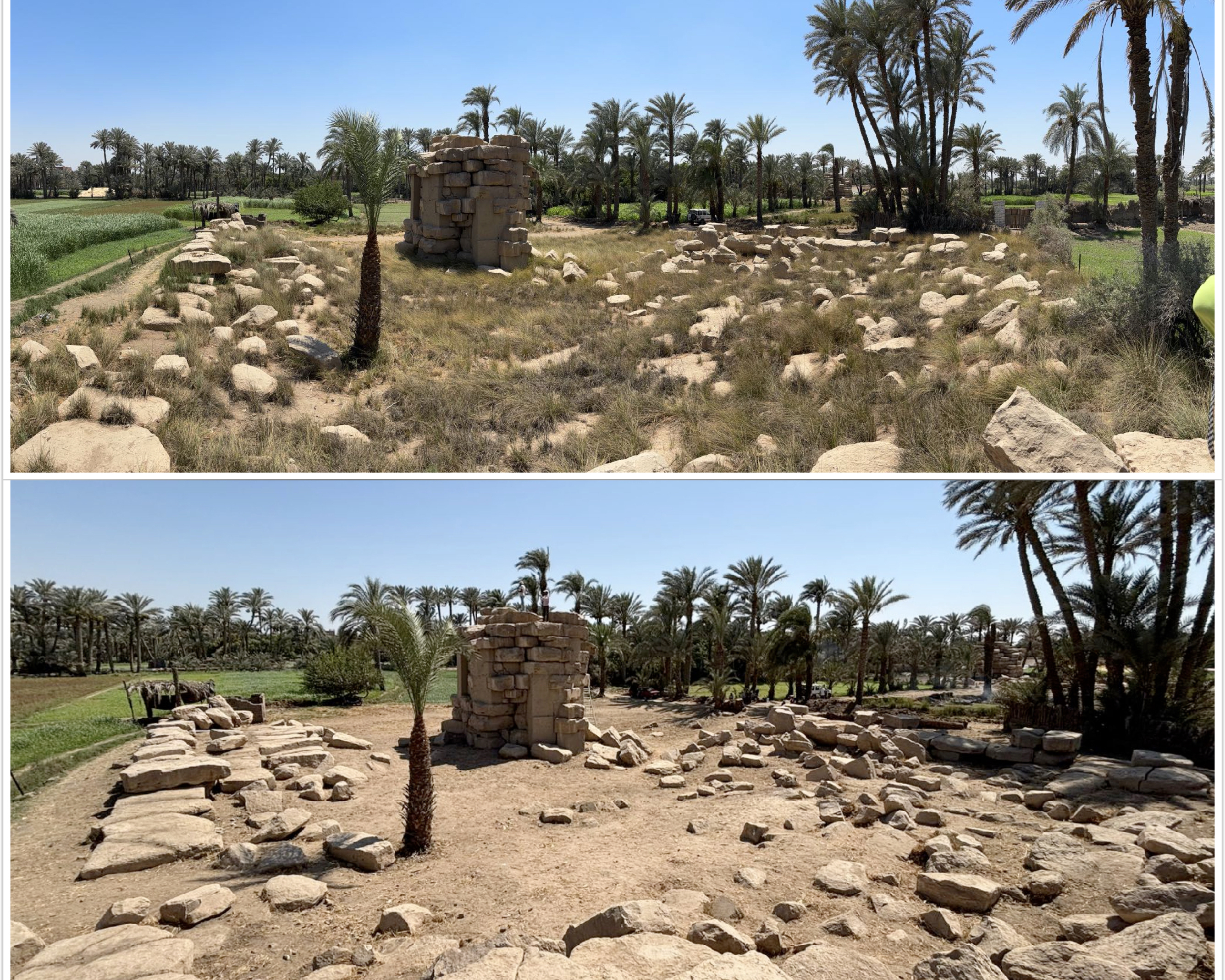
La principale tâche menée lors des campagnes d’été et d’hiver fut le nettoyage des deux zones principales du site, fortement envahies par une végétation haute et encombrées de déchets modernes. Toute la végétation et les détritus ont été soigneusement retirés, en veillant à laisser en place les tessons et fragments de pierre pour leur documentation ultérieure. Après enlèvement de la végétation, les racines ont été retirées lorsque cela était possible, sans creuser, afin de limiter une repousse rapide. Une attention particulière a été portée à l’élimination des plantes nuisibles, notamment l'« herbe à chameaux », très destructeur pour les blocs calcaires.
Ce nettoyage initial a permis de réaliser une étude topographique détaillée ainsi qu’un relevé photogrammétrique complet. Une fois la surface dégagée, il est devenu beaucoup plus facile de distinguer les blocs en place de ceux déplacés au fil des siècles.
3. Prospection pédestre
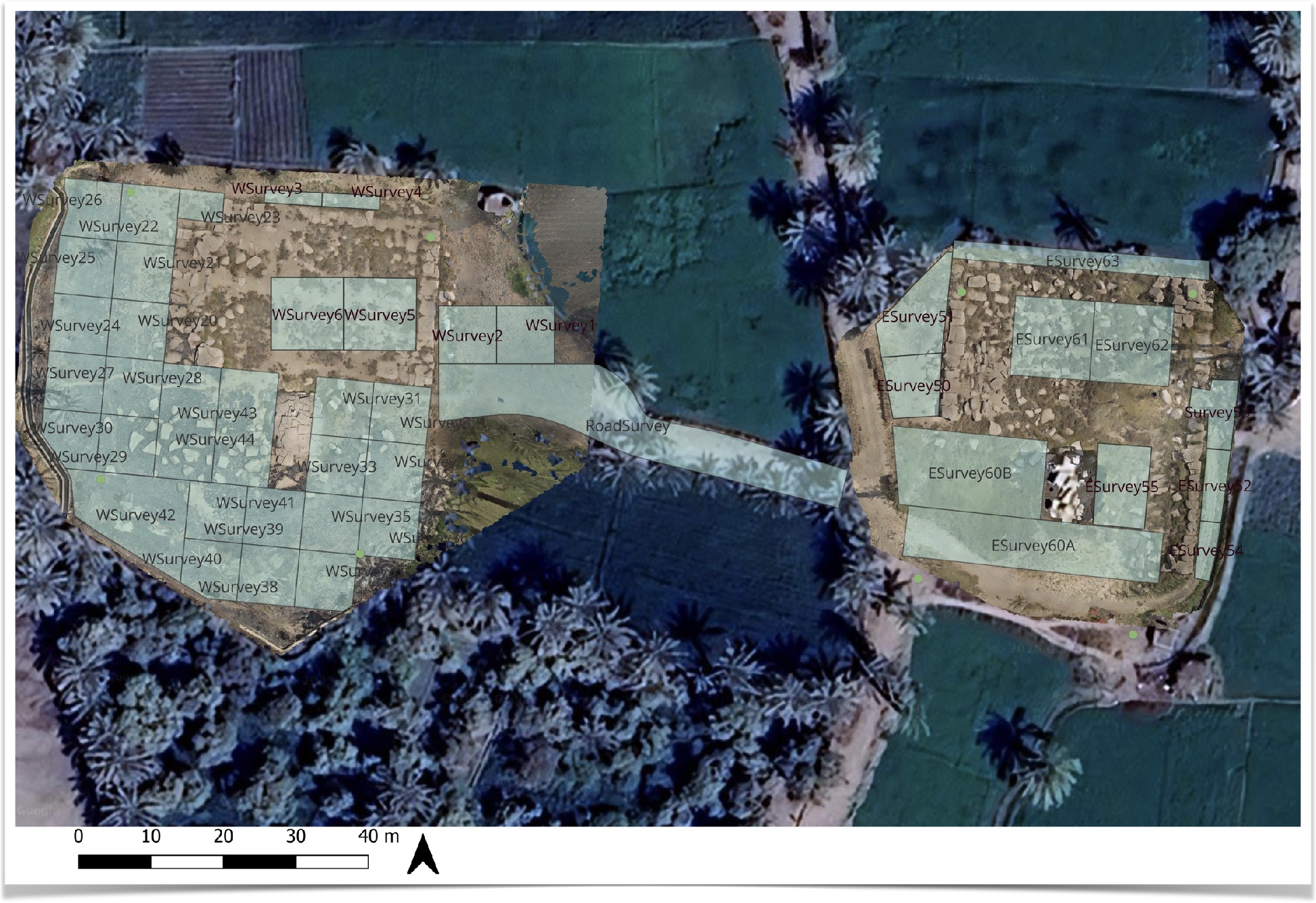
Une prospection pédestre systématique a constitué un élément clé de cette première saison. Après nettoyage, un examen complet du matériel de surface a été entrepris comme étape préalable à toute fouille future.
L’objectif principal était d’évaluer le potentiel archéologique du site par des méthodes non invasives et d’identifier les phases les plus récentes d’occupation. La prospection a couvert l’ensemble du site, à l’intérieur et à l’extérieur des enceintes, ainsi que la zone située entre les deux piédestaux.
Cette prospection a permis de documenter la nature et la distribution spatiale du matériel de surface. Des fragments de calcaire, de quartzite, de granodiorite et de dolérite ont été enregistrés, ainsi qu’une grande quantité de céramique.
Matériel lithique
La majorité des fragments consiste en éclats de calcaire provenant probablement des enceintes et des piédestaux. De nombreux fragments de quartzite, dispersés sur le site, proviennent très probablement de la destruction des colosses. Beaucoup présentent des traces de brûlure, suggérant l’usage du feu dans leur démantèlement.De nombreux marteaux en dolérite, complets ou fragmentaires, ont également été identifiés. Ces outils, utilisés pour travailler la pierre dure, témoignent d’activités de destruction ou d’exploitation du site.
Matériel céramique
Les tessons ont été systématiquement comptabilisés par unité de prospection. Leur étude, menée par Dr Valentina Gasperini, montre que le matériel date presque exclusivement de la période ptolémaïque au début de la période romaine (IIIe–IIe siècles av. J.-C.). L’assemblage est dominé par des récipients de transport et de stockage, suggérant une intégration du site dans des réseaux d’échange régionaux. La proximité du lac pourrait avoir facilité ces circulations. Il est notable que le développement d’un culte d’Amenemhat III dans le Fayoum remonte précisément à cette époque, environ 1500 ans après sa mort. Le lien entre ce culte et les colosses demeure une question ouverte.
4. Conservation / restauration
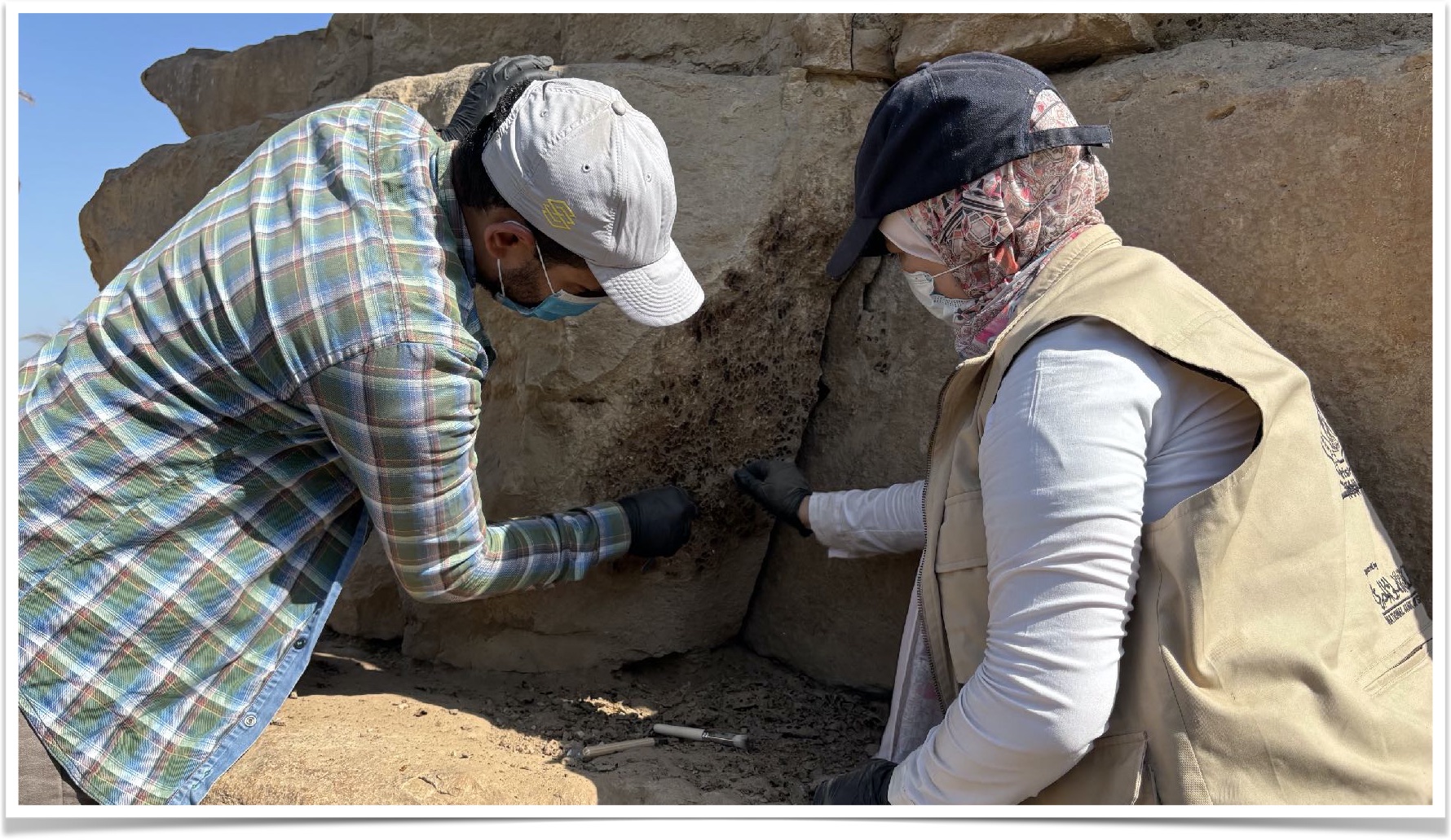
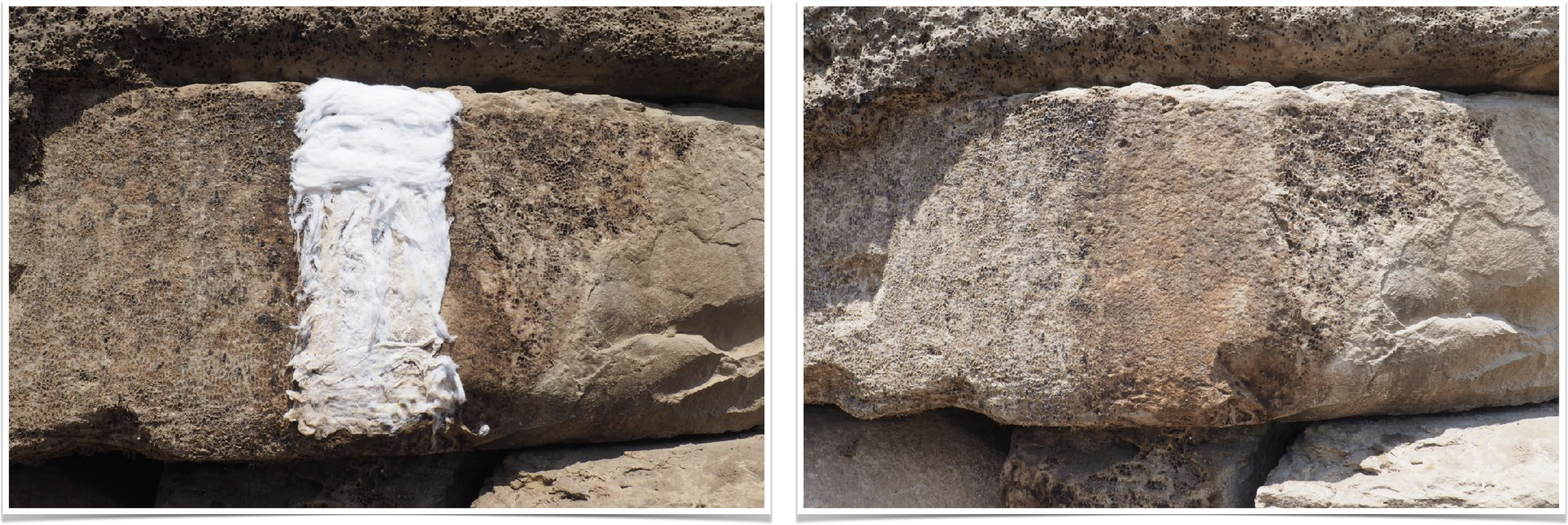
Les restaurateurs ont travaillé durant toute la mission. Cette première saison s’est concentrée sur le podium occidental, le plus dégradé. La première étape a consisté à enlever une croûte très dure laissée par d’anciens nids d’insectes, pouvant atteindre 14 cm d’épaisseur. Le nettoyage a impliqué l’élimination de ces structures et des taches brunes qu’elles avaient laissées. Les travaux ont été menés du haut vers le bas, d’abord pour enlever les nids, puis pour nettoyer les dépôts de terre. Certaines zones se sont révélées plus difficiles, mais les résultats sont encourageants. Les restaurateurs ont veillé à préserver la patine de la pierre, en évitant les outils abrasifs. L’objectif n’était pas de restituer l’aspect d’origine, mais de stabiliser et équilibrer visuellement la surface tout en respectant son intégrité historique.
5. Coopération avec la communauté du Fayoum
La mission a inclus un programme de formation destiné aux inspecteurs du Fayoum et aux étudiants de l’université d’Aïn Shams. Quatre inspecteurs et deux étudiants ont participé aux sessions de 2025 et 2026, portant sur les techniques de prospection, le dessin et l’identification des matériaux. La collaboration avec la communauté locale constitue un axe central du projet. La moitié de l’équipe scientifique est composée d’inspecteurs régionaux, assurant l’intégration des compétences locales. Tous les ouvriers sont originaires de Biahmu, renforçant le lien entre la population et le site. L’un des objectifs majeurs est de créer une relation de confiance et de sensibiliser à la valeur du patrimoine. La mission soutient également l’économie locale en s’approvisionnant exclusivement à Médinet el-Fayoum. Cette approche s’inscrit dans une archéologie responsable, attentive aux enjeux sociaux et économiques.
Perspectives pour les campagnes 2026-2027
Dans la prochaine phase, il est prévu d’intégrer un architecte spécialisé en restauration, Aisam Magdy, afin d’évaluer l’état des structures et de proposer un plan de consolidation et de remontage partiel. Aucune restauration moderne ne sera retirée à ce stade ; l’accent sera mis sur le suivi de leur état.
Interventions proposées
Restauration architecturale
Remontage des blocs calcaires identifiables, afin de stabiliser les vestiges et améliorer leur lisibilité.
Fouilles archéologiques
Un permis de fouille est nécessaire pour :
- Documenter et récupérer les blocs enfouis ;
- Retrouver les fragments enfouis par Petrie et Habachi.
Recherche scientifique
Les fouilles et carottages permettront :
- une analyse hydrologique ;
- une reconstitution du paysage ancien ;
- une meilleure compréhension de la fonction du site.
Problématiques de recherche
- Le site était-il un sanctuaire lacustre ?
- Existait-il une voie ou un canal entre les colosses ?
- Quelle était leur orientation symbolique ?
- Ont-ils joué un rôle dans la divinisation posthume d’Amenemhat III ?
Co-direction
Simon Connor
Scientific member, Institut français d’archéologie orientale (IFAO)
Ashraf Sobhy
General Director of the General Administration of Egyptian and Greco-Roman Antiquities in Fayum, Ministry of Tourism and Antiquities (MoTA)
In 2025-2026, the first two field campaigns of the new Egyptian-French Mission at Biahmu were conducted. For this first season, the survey was carried out by Simon Connor, Marwa Ragab, Sara Samir, Nora Thabet, Heba Atef, Samia Shawky, Hassan Selim, Mahmoud Mamdouh, and Mahmoud Diab.
Valentina Gasperini and Ashraf Sobhy conducted full documentation of surface-collected ceramic material. The conservation work was led by Eid Mertah and Susan Hosny.
Joachim Le Bomin, Mohamed Gaber and Mahmoud Diab were responsible for the establishment of topographical control points and the production of photogrammetric documentation of the site.
Tomasz Herbich conducted a survey, using the methods of magnetometry and resistivity.
The mission was supported by a local workforce that grew from 10 to 30 workmen over the course of the season, all of whom were residents of the village of Biahmu and contributed significantly to site cleaning and logistical operations.
1. Brief presentation of the site
Located approximately 7 km north of Medinet el-Fayum, the site of Biahmu preserves the remains of a site whose function still has to be defined. It was on use from the time of Amenemhat III, around 1800 BC, until at least the Ptolemaic Period. Originally, two colossal statues of Amenemhat III, originally approximately 12 metres high, were standing each on a massive podium built of limestone blocks. In Antiquity, Qarun lake’s shoreline extended much farther south than today, potentially lying directly in front of the statues. Herodotus, Diodorus the Sicilian and Pliny the Elder mention the two statues as standing “on pyramids” and “in the middle of the lake” – which probably means that the site was partly surrounded by water at least during the high flood season.
The two statues were still upright as late as the 13th century AD, as attested by medieval Islamic sources (Osman el-Nabulsi). They were destroyed in the following centuries, but their monumental pedestals remain in place. Each is “protected” to the north by a U-shaped precinct measuring ca. 25 m on each side.
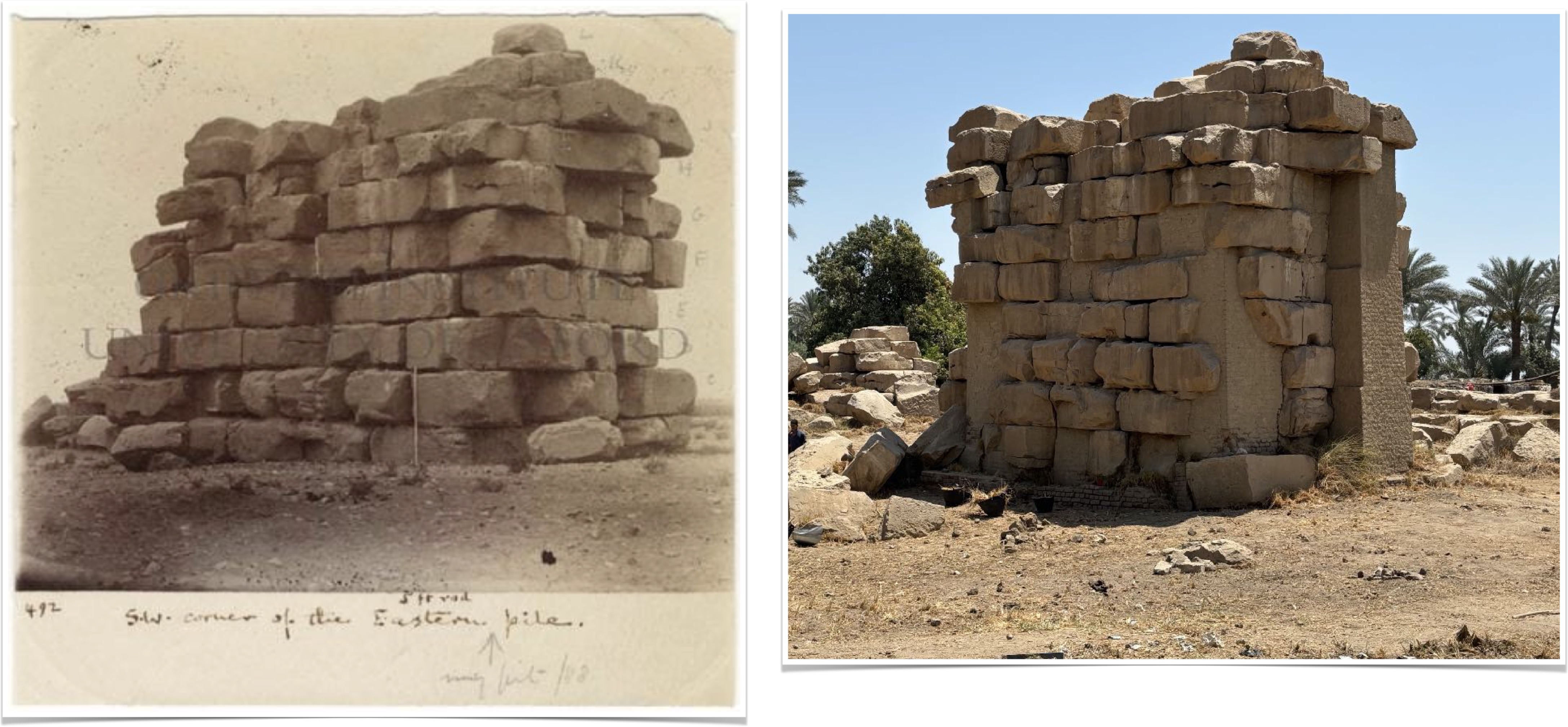
During a brief six-day excavation in 1888, W.M.F. Petrie recovered a few dozen quartzite statue fragments, mostly around the eastern podium. 46 fragments (including a massive nose) were sent to the Ashmolean Museum in Oxford, while the larger pieces were re-buried, according to Petrie, to the west of the eastern podium.
On the basis of these finds, Petrie proposed a reconstruction of two seated colossi oriented northward, facing Lake Qarun. He proposed that the walls formed two square enclosures around the pedestals, with a gate opening in the middle of the northern wall, in the direction of the lake. A road would have passed between the two enclosures. As we will see, the preliminary results of our survey seem to propose an alternative view for this reconstruction.
The 2025-2026 campaigns had three primary objectives:
- To ensure the preservation and maintenance of the site through cleaning and conservation efforts;
- To reconstruct, as far as possible, the original appearance and layout of the site around 1800 BC;
- To trace the subsequent history of the site and understand the transformations it underwent over the past four millennia.
2. Cleaning of the site
The main task undertaken during both summer and winter campaigns of this first year was the cleaning of the two main areas of the archaeological site, which were heavily overgrown with tall grass and littered with modern debris. All vegetation and rubbish were carefully removed, while ensuring that pottery sherds and stone fragments were left in place for subsequent documentation during the survey phase. Once the cleaning of the site and removal of the grass was done, the roots were removed when possible, without digging, in order to prevent a fast regrowing of the grass in the forthcoming months. We carefully removed all threatening vegetation (particularly the “camelthorn,” which is very dangerous for limestone blocks).
This initial cleaning made it possible to carry out a detailed topographical study of the site, as well as a full photogrammetric recording. Once the surface was cleared, it became significantly easier to distinguish which architectural blocks remained in situ and which had been displaced over the course of the past centuries.
3. Pedestrian Survey
A systematic pedestrian survey constituted a key component of this first field season. Following initial cleaning of the site, a comprehensive examination of surface material was undertaken as a necessary preliminary step prior to any future excavation. The primary objective was to assess the archaeological potential of the site through non-invasive methods and to identify the latest phases of activity attested on its surface. The survey covered the entire area of the site, both inside and outside the enclosure walls, as well as the road between the two pedestals.
This pedestrian survey yielded significant results, allowing for the documentation of both the nature and spatial distribution of surface material. Stone fragments of limestone, quartzite, granodiorite, and dolerite were recorded, together with a large quantity of pottery sherds providing important chronological and functional indicators.
- Stone material: The majority of the stone finds consist of limestone chips, most likely originating from the enclosure walls and the pedestals. Numerous quartzite fragments, widely scattered across the site, almost certainly derive from the destruction of the two colossal statues. Many of these fragments exhibit traces of burning, which may indicate that fire played a role in dismantling or destruction of the colossi. In addition, a substantial number of dolerite hammers – both fragmentary and complete – were identified. These dense, hard stone tools, traditionally used for working or breaking hard stones such as quartzite, suggest episodes of intentional destruction or quarrying activity at the site.
- Ceramic material: Pottery sherds, both diagnostic and non-diagnostic, were systematically counted, together with each category of stone fragment, within each designated survey unit. This quantitative and typological dataset provides a basis for identifying the final phases of activity at the site. Detailed documentation, drawing, and typological study of all diagnostic pottery were carried out by Dr. Valentina Gasperini. Her study indicates that the ceramic material recovered from the surface dates almost exclusively to the Ptolemaic to early Roman Period, mainly from the 3rd–2nd centuries BC. The assemblage is dominated by fragments of transport and storage vessel fragments, shedding light on patterns of use and on the integration of the site within regional exchange networks. The vicinity of the lake in Antiquity – possibly extending as far as the limestone enclosure walls – may have played a role in the transport of goods.
It is noteworthy that the development of a cult dedicated to Amenemhat III in the Fayum dates precisely to the Ptolemaic period, some 1,500 years after the king’s death. The relationship between this cult and the presence of the two colossal statues, which must have dominated the surrounding landscape, remains an open question.
4. Conservation / restoration
The work of the restorers took place during the whole duration of the two weeks. For this first season, we focused on the western podium, whose surface was the most affected. The eastern pedestal will be the focus of next season.
The first task was to remove a hardened crust left by abandoned insect nests – up to 14 cm thick and nearly as hard as concrete. Though the nests are no longer active, we found a few dead wasps and dried larvae inside the cavities.
Cleaning the stone from the wasps’ nests involved two main challenges:
- Removing the thick, indurated crust of the clay structures (alveoli) left by the wasps
- Eliminating the dark brown staining left on the stone surface beneath the nests.
During the first week, the conservation team focused on completing the removal of the wasp nests, working from top to bottom, on the whole height of the 6.5 m-high pedestal. Then, the conservators began cleaning the accumulated dirt and soil covering the entire structure, again proceeding from top to bottom to avoid re-contaminating cleaned areas.
Some sections proved easier to clean than others. In some spots, the brown stains were particularly difficult to remove, but overall, the results were promising. The conservators took great care to preserve the stone’s patina, avoiding abrasive tools ad relying wherever possible on softer instruments to remove the remnants of the infestation without causing damage. The goal was not to return the surface to its original appearance from 3,800 years ago – nor would that be desirable. Instead, our aim was to preserve the stone’s natural patina while achieving a visually balanced result and protective result. The target was to restore the surface to the characteristic beige tone patina of the weathered stone, without over-cleaning or compromising its historical integrity.
5. Cooperation with the Fayum’s community
Part of the mission’s roles was to provide a training for young inspectors of the Fayoum taftish as well as for students from Ain Shams university, members of the mission. Four inspectors and two students joined us for this training in June 2025 and in February 2026. In June, we focused on the procedure techniques for surveying a site (pedestrian survey, use of the total station, use of the diary), drawing sketches, as well as the identification of the different stones present on the site (limestone, quartzite, granite, dolerite, indurated limestone). In February, we pursued this formation with pottery drawing and architectural drawing.
A central component of our mission is fostering strong and meaningful engagement with the local community. This collaboration is not only essential to the success of the project but also contributes to the long-term preservation and appreciation of the site.
Half of the scientific team is composed of inspectors and specialists from the Fayoum regional inspectorate. Their active involvement ensures that local expertise and institutional knowledge are fully integrated into the research and conservation processes.
Moreover, all the workmen employed on site are residents of the village of Biahmu. Their daily participation strengthens the connection between the community and the archaeological site, fostering a sense of ownership and pride in their cultural heritage. One of our primary goals is to build a relationship of trust with the local population (including children who visited us regularly and who appear on the photos – however, all employed workmen were adults). Through this partnership, we aim to raise awareness of the historical and cultural significance of the monuments, while demonstrating the value of preserving them for future generations. By working side by side, we hope to empower the community to become active stewards of their own heritage.
In addition to human resources, we have made a conscious effort to support the local economy by sourcing all our tools and supplies from Medinet el-Fayoum. Whether purchased, manufactured, or repaired, all equipment used in the field was obtained locally, as part of our commitment to environmental and economic sustainability. By investing in local skills, resources, and collaboration, the mission aims to contribute not only to archaeological research but also to the broader social and economic fabric of the Fayoum region. We wish to see this as a model of responsible archaeology – one that places as much importance on people as it does on the past.
Plans for the forthcoming seasons (2026-2027)
As part of the next phase of our archaeological mission, we propose to bring on board an architect specialized in the conservation and restoration of ancient stone monuments, Aisam Magdy, who has a long experience working at Kom el-Hettan with Dr. Hourig Sourouzian, with the restoration of various monuments behind the Colossi of Memon. His role will be to assess the condition of the two monumental pedestals and the surrounding limestone walls, and to develop a detailed plan for their consolidation and – where feasible – their partial reassembly. We are currently in advanced discussions for the conservation of the structures. Aisam’s expertise will enable us to produce an accurate assessment of the scope of the restoration work required.
No modern restorations will be removed at this stage; instead, attention will be given to monitoring the condition and evolution of the existing brickwork.
Proposed Interventions
Architectural Restoration: Reassembly of limestone blocks
- Limestone blocks whose original positions can be reliably identified will be reassembled under the supervision of a restoration architect, Aisam Magdy, specialised in Heritage conservation and restoration (with extensive experience at Kom el-Hettan). This intervention aims to stabilize the standing remains, improve legibility of the monument, and reduce ongoing deterioration.
Archaeological Excavation:
An excavation permit would be essential to enable the following key actions:
- Recovery and documentation of fallen blocks: The majority of the limestone blocks, as well as some granite elements, are partially buried and cannot be documented, studied, conserved, or extracted without excavation. For this reason, targeted excavating would be required to expose, record, and safely move the blocks lying within the two courtyards, prior to any potential reintegration into the enclosure walls.
- Investigation of fragments buried by W. Petrie and L. Habachi: Several fragments of the Eastern statue were reburied by Flinders Petrie during his 1890 campaign, as he stated in his report. Unearthing these could provide important information for the reconstruction of the monuments and the site’s historical narrative. Similarly, when L. Habachi surveyed the site in the 1940s, he also reported the discovery of some architectural blocks in granite, but he did not specify what happened to them. The rediscovery of one of these blocks during the present season of cleaning and surveying strongly suggests that others may still be buried in the vicinity and could be recovered through excavation.
- Scientific Research, Contextual Interpretation and Historical Significance: Excavation will also contribute to a more comprehensive understanding of the site’s chronology, function, and long-term transformation, thereby contributing significantly to both academic knowledge and conservation strategy. Excavation and core-drilling operations in various spots of the site will offer crucial environmental and archaeological data. This will be supervised by expert in the study of ancient landscapes Dr Giulia Nicatore (Université Paris-Sorbonne). This will serve multiple purposes: Hydrological Analysis, to determine the current water table level and assess risks of salinization that may threaten the site’s long-term stability; and geoarchaeological Reconstruction, to reconstruct the historical landscape and environmental evolution of the site. This includes determining whether – and until which period – Lake Qarun extended to this location.
Environmental and stratigraphic data will significantly enhance our understanding of the site’s original function:
- Was the site conceived as a lakeside sanctuary? Did it function as an embankment, processional space, or infrastructural feature?
- Was there a road or a canal between the two colossi?
- Were the colossi oriented towards the lake as divine guardians, or toward Medinet el-Fayoum, greeting worshippers approaching from the city?
- Did the colossi play a role in the posthumous deification of King Amenemhat III during the Ptolemaic period?