

Manifestations scientifiques
Abonnez-vous à la … Subscribe to the Mailing list :
ASWAT
Le dimanche 1er novembre 2026 à 18h00 (heure du Caire), IFE 
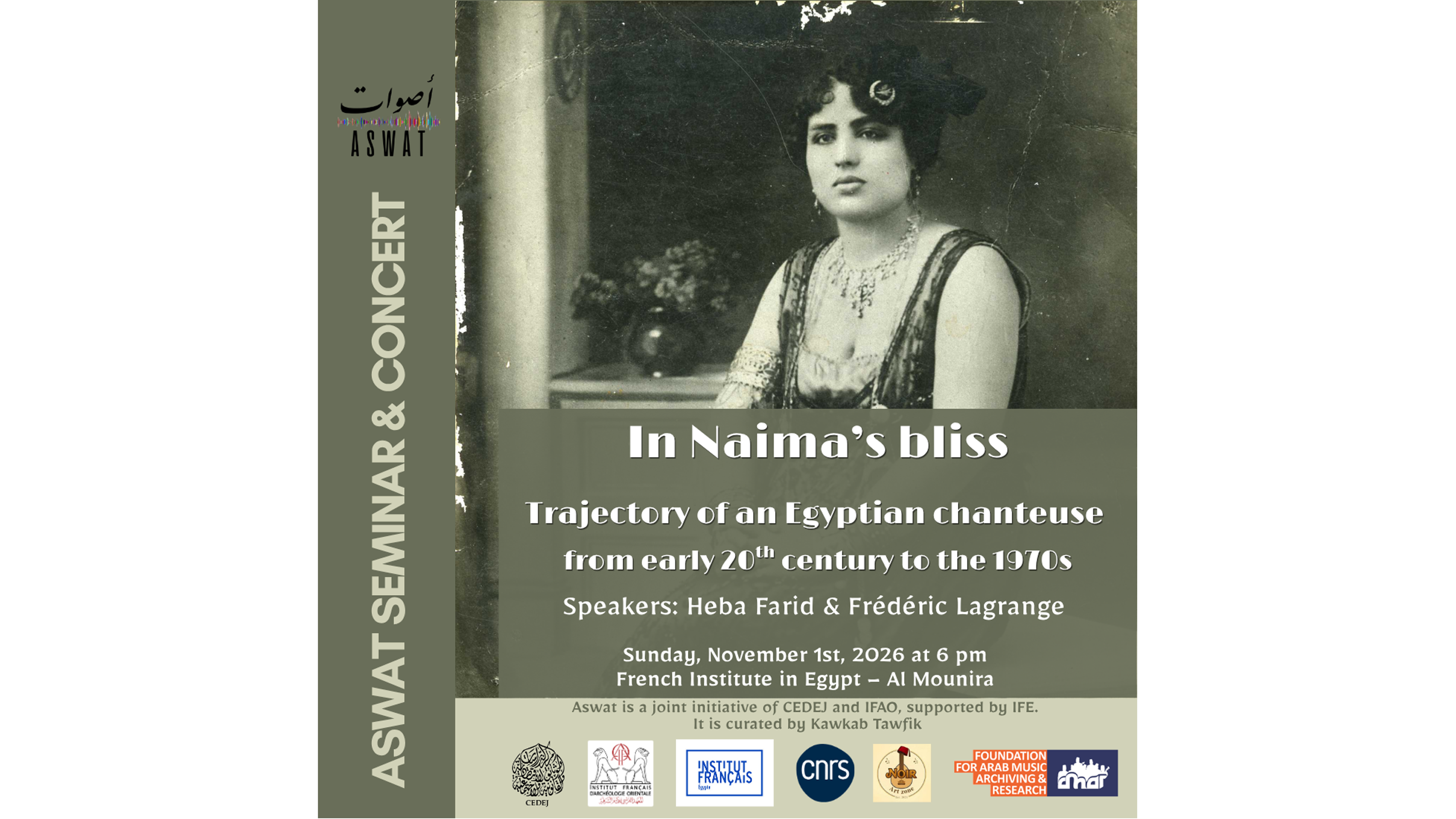
In Naima’s bliss
Trajectory of an Egyptian chanteuse, from early 20th century to the 1970s
Frédéric Lagrange & Heba Farid
Partenaire(s) de l’Ifao : IFE, CEDEJ
Langue : anglais.
Abstract:
The trajectory of Naʿima al-Misriyya (1894-1976), one of the most famous and successful performers in Cairo’s musical scene from World War I to the mid-1930s and a major recording artist for the flourishing disc industry, allows us to interrogate the very notion of “female artist” in 20 century Egypt. The changing economy of the musical milieu, nascent female empowerment, notions of modernity intersecting with class and gender, and a revolution in lyrics blurring the limits of what was deemed
“singable” allowed for Na ʿima’s moment of glory, until new aesthetic and moral discourses slowly erased her memory from the national narrative and the official historiography of music, in spite of her fruitful collaboration with revered male icons of Egyptian music such as Sayyid Darwīsh, Muḥammad al-Qaṣabgī and Zakariyyā Aḥmad.
Heba Farid, the great-granddaughter of the artist, will present the Na’ima al-Misriyya Music Research and Photograph Collection project, while Frédéric Lagrange will situate Na’ima among other female performers of the roaring 20s, such as Munīra al- Mahdiyya, Ratība Aḥmad, Fatḥiyya Aḥmad, Sekīna Ḥasan, Umm Kulthūm, and comment on her art through a selection of recordings by Na ʿima. The talk will be followed by a concert by Firqat al-Afandiyya & Noir Art Zone.
Aswat is a joint initiative from CEDEJ, IFAO supported by IFE. It is curated by Kawkab Tawfik.
Speakers:
Heba Farid is an interdisciplinary artist, researcher, educator, and curator in photography, working between contemporary practices, historical and archival research, institutional leadership, and scholarly contributions focused on photography in Egypt. She is the creator of The Na ʿima al-Misriyya Music Research and Photograph Collection (2003–2026), a curated archive documenting the life and legacy of the pioneering 20th-century Egyptian chanteuse, supported by the Endangered Archives Programme of the British Library and housed at the Rare Books and Special Collections Library of the American University in Cairo. An upcoming book and exhibition are supported by the Canada Council for the Arts. In Cairo, Farid co-founded TINTERA (2019), a gallery dedicated to photography and
the Contemporary Image Collective (CiC, 2004), was coordinator of the photographic heritage program of CULTNAT (Bibliotheca Alexandrina, 2008-2026) and taught photography in the Visual Arts program at the American University in Cairo (2013-2021). She served on competition juries for World Press Photo (2024) and the AFAC Arab Documentary Photography Program (2025) and her writings appear in The Journal of the Arab Council for Social Sciences, Gendering the Arab archive (2025), in DUST: Egypt’s Forgotten Architecture (AUC Press, 2022), and in PhotoResearcher, Journal of the European Society for the History of Photography, The City and the Territory: Imagining Cairo and Egypt (2017).
Frédéric Lagrange is a Professor of Arabic studies at Sorbonne Université, Paris and presently director of CEDEJ in Cairo. His academic fields of interest include history of music practice in early 20 century Egypt, record companies, lyrics, and gender and class dynamics in the artistic and intellectual milieux. He is a translator of classical and contemporary Arabic literature into French. His latest translation is Rasha Azab’s Qalb māliḥ (Salty heart) to be published March 2027. He has been reissuing 78rpm recordings on Egyptian and Levantine performers since the late 1990s, collaborating with Club du Disque Arabe, Institut du Monde Arabe and presently AMAR Foundation (Beirut), for whom he worked on CDs and booklets
presenting the works of Yūsuf al-Manyalāwī, ʿAbd al-Ḥayy Ḥilmī, Salāma Ḥigāzī, and ʿAwālim of Egypt and Bilād al-Shām. The latest issue is a complete collection of Egyptian singer Ṣāliḥ ʿAbd al-Ḥayy’s shellac records, to be released in November 2026. He co-authored a monograph on Shaykh Yūsuf al-Manyalawī (d. 1911) and wrote numerous articles on Egyptian cultural productions, from the late 19 century to the present.
-----------------------------------
في نعيم نعيمة
مسيرة مغنية مصرية من اوائل القرن العشرين إلى السبعينيات
المتحدثان
هبة فريد و فريدريك لاجرانچ
إنّ مسيرة نعيمة المصرية (1894-1976)، إحدى أشهر وأنجح الفنانات في المشهد الموسيقي بالقاهرة منذ الحرب العالمية الأولى حتى منتصف الثلاثينيات، وإحدى كبرى نجمات صناعة الأسطوانات المزدهرة آنذاك، تتيح لنا مساءلة مفهوم «الفنانة» ذاته في مصر القرن العشرين. فقد سمحت عوامل عدة، منها تغيّر اقتصاد الوسط الموسيقي، وبدايات تمكين المرأة، وتقاطع مفاهيم الحداثة مع الطبقة والنوع الاجتماعي، وثورة في كلمات الأغاني وسّعت حدود ما كان يُعدّ «قابلاً للغناء»، أن تبلغ نعيمة لحظة مجدها، إلى أن محَتْ تدريجيًا خطاباتٌ جمالية وأخلاقية جديدة ذكراها من السردية الوطنية ومن التاريخ الرسمي للموسيقى، وذلك رغم تعاونها المثمر مع رموز مبجَّلة للموسيقى المصرية أمثال سيد درويش ومحمد القصبجي وزكريا أحمد.
ستعرض هبة فريد، حفيدة الفنانة من الجيل الثالث، مشروع «أرشيف نعيمة المصرية للأبحاث الموسيقية والصور الفوتوغرافية»، فيما سيضع فريدريك لاجرانچ الست نعيمة في سياق مغنيات أخريات من «العشرينيات الصاخبة»، مثل منيرة المهدية ورتيبة أحمد وفتحية أحمد وسكينة حسن وأم كلثوم، كما سسيعلّق على فنّها من خلال مختارات من تسجيلاتها. وسيعقب المحاضرة حفل موسيقي تحييه فرقة الأفندية التابعة لـ Noir Art Zone.
هبة فريد فنانة وباحثة وقيّمة معارض متعددة التخصصات في مجال التصوير الفوتوغرافي، تعمل عند تقاطع الممارسات الفنية المعاصرة والبحث التاريخي والأرشيفي والإدارة المؤسسية والإسهامات الأكاديمية المعنية بالتصوير الفوتوغرافي في مصر. هي صاحبة مشروع «أرشيف نعيمة المصرية للأبحاث الموسيقية والصور الفوتوغرافية» (2003–2026)، وهو أرشيف منتقى يوثّق حياة وإرث المطربة المصرية الرائدة في القرن العشرين، بدعم من برنامج المحفوظات المهددة بالخطر التابع للمكتبة البريطانية، ويُحفظ في مكتبة الكتب النادرة والمجموعات الخاصة بالجامعة الأمريكية بالقاهرة. كما أن مجلس كندا للفنون سيدعم لاحقا كتابا ومعرضا مخصصَيْن للمشروع.
فريدريك لاجرانچ أستاذ الدراسات العربية في جامعة السوربون بباريس، والمدير الحالي لمركز الدراسات القانونية والإجتماعية - سيداچ بالقاهرة. تشمل اهتماماته البحثية تاريخ الممارسة الموسيقية في مصر في مطلع القرن العشرين، وشركات التسجيل، والكلمات الغنائية، وديناميات النوع الاجتماعي والطبقة في الأوساط الفنية والفكرية. وهو مترجم للأدب العربي الكلاسيكي والمعاصر إلى الفرنسية. وأحدث ترجماته رواية رشا عزب «قلب مالح»، المقرر صدورها في مارس 2027.
يعمل منذ أواخر التسعينيات على إعادة إصدار تسجيلات أسطوانات الـ78 لفة لمؤدّين مصريين وشاميين، بالتعاون مع «نادي الأسطوانة العربية» ومعهد العالم العربي، وحالياً مع مؤسسة آمار (لبنان)، التي أعدّ لها أقراصًا مدمجة وكتيّبات تقدّم أعمال يوسف المنيلاوي وعبد الحي حلمي وسلامة حجازي والعوالم في مصر وبلاد الشام. وآخر إصداراته مجموعة كاملة لتسجيلات المطرب المصري صالح عبد الحي على أسطوانات 78 لفة ، المقرر طرحها في نوفمبر 2026.
شارك في تأليف دراسة مفردة عن الشيخ يوسف المنيلاوي (ت. 1911)، وكتب مقالات عديدة عن الإنتاج الثقافي المصري من أواخر القرن التاسع عشر حتى اليوم.
ASWAT
Sounds - and music - are able to shape individual and collective identities, define spaces and borders, denote cultures, transmit knowledge and influence style lives.
ASWAT is a series of music meetings and music performances focusing on Egyptian culture(s) of music that seeks to explore a range of musical practices across Egypt, and beyond, through the contribution of academic speakers and music makers, followed by a concert. The meetings will offer the opportunity to deepen some historical, religious, social and musicological aspects that interwoven in, and from, the Egyptian music heritage, addressing creation, performance and reception practice.
Aswat is a joint initiative from CEDEJ, IFAO supported by IFE.
Les sons - et la musique - sont capables de façonner les identités individuelles et collectives, de définir les espaces et les frontières, de dénoter les cultures, de transmettre les connaissances et d'influencer les styles de vies.
ASWAT est une série de rencontres et de spectacles musicaux axés sur la ou les cultures musicales égyptiennes qui vise à explorer un éventail de pratiques musicales à travers l'Égypte, et au-delà, grâce à la contribution de conférenciers universitaires et de musiciens, suivie d'un concert. Les rencontres seront l'occasion d'approfondir certains aspects historiques, religieux, sociaux et musicologiques qui s'entremêlent dans et à partir du patrimoine musical égyptien, en abordant les pratiques de création, d'interprétation et de réception.
ASWAT est une initiative conjointe du CEDEJ et de l'Ifao soutenue par l'IFE.