Une image, un commentaire…
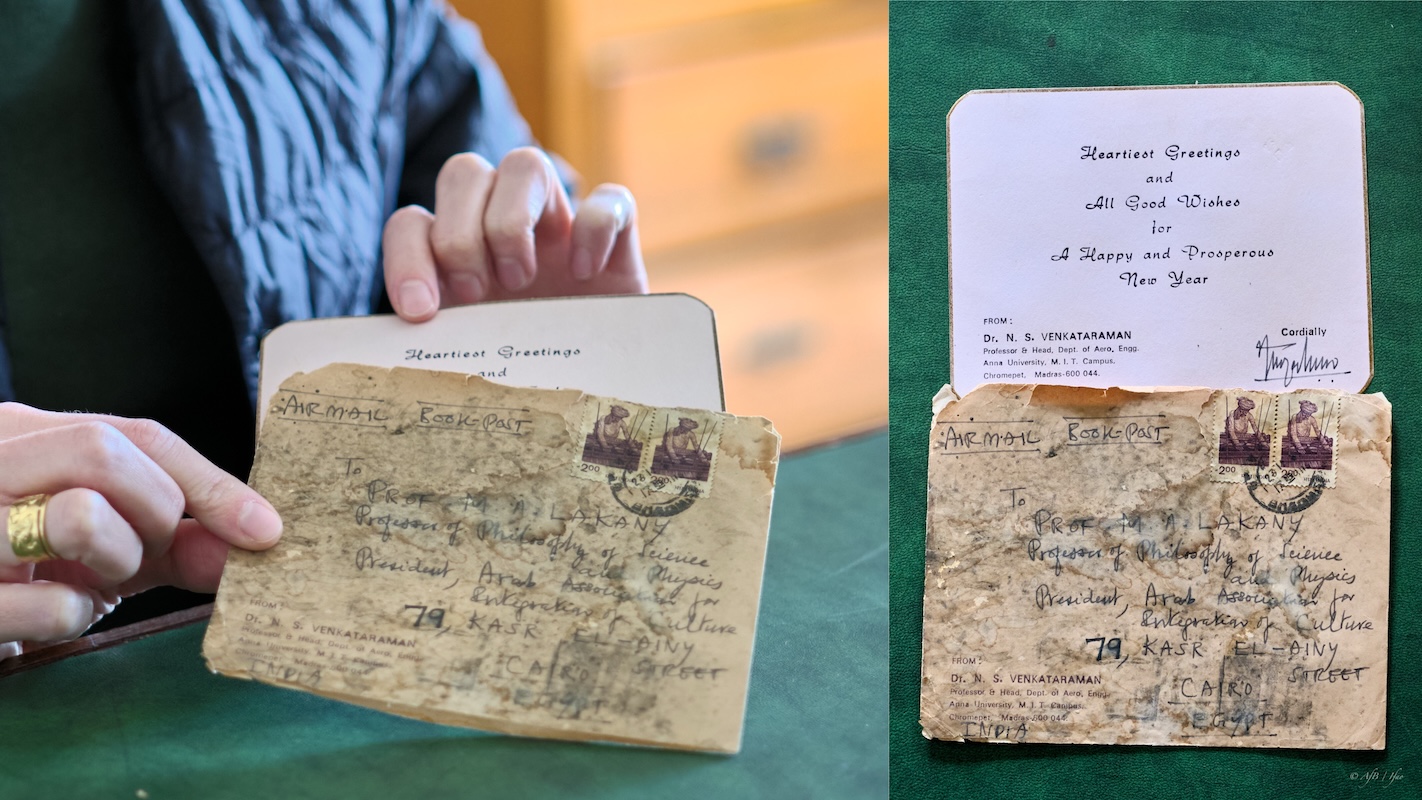
Meilleurs vœux des ingénieurs de Madras pour l’année 1988 ! - تحيات طيبة من مهندسي مدراس لعام ١٩٨٨!
Encore une matinée à arpenter les avenues du marché aux antiquités qui s’étale chaque samedi au pied du cinéma al-Diyānā, dans le centre-ville du Caire. Parmi les tables de nuit au marbre ébréché, les vieux appareils photos entassés, les cuivres rutilants et la vaisselle à l’effigie des rois d’Égypte, se glissent des liasses de journaux illustrés, des revues scientifiques, des timbres, des photos de famille, des cartes postales et parfois même des archives étatiques. Il faut s’armer de patience ; les jours là-bas sont comme les saisons agricoles, parfois bons, parfois mauvais. Ce 13 décembre, alors que je feuilletais distraitement un paquet d’enveloppes, mon regard s’arrêta sur celle-ci : quinze centimètres par dix, portant deux timbres indiens, elle contient une carte de vœux qu’adresse un certain Dr. N. S. Venkataraman au professeur M. A. Lakany (al-Laqānī), président de l’Association arabe pour l’intégration culturelle, dont les locaux se trouvaient en face du syndicat des médecins sur Qaṣr al-ʿAynī.
Comme le tampon de la poste égyptienne l’indique, ce courrier est parvenu le 2 janvier 1988 à Lakany, qu’il me faut encore identifier, et dévoile la relation, très certainement d’ordre académique, qu’il entretenait avec son expéditeur, N. S. Venkataraman, professeur à la Anna University à Chennai (Madras), capitale du Tamil Nadu. À l’origine, le Madras Institute of Technology (MIT) est créé en 1949 par un grand industriel tamoul, Chinnaswami Rajam (1882-1955), qui en fait un établissement de formation technique de renom, où sont enseignées l’ingénierie aéronautique, automobile, électronique et l’ingénierie en instrumentation. En 1978, le MIT fusionne avec trois autres institutions pour former la Anna University : Venkataraman prend la tête du nouveau Département d’ingénierie aéronautique en 1980, avant d’être nommé doyen de l’université, fonction qu’il exerce entre 1989 et 1993.
Mais que cache cette politesse convenue ? La relation entre Venkataraman et Lakany date-elle des essais de coopération aéronautique menés par les deux pays dans les années 1960, ou d’un programme d’assistance technique chapeauté par une agence onusienne ? Sur quel projet ont-ils travaillé ensemble ? Qu’ont-ils chacun pensé du pays de l’autre ? Si j’écrivais au professeur Venkataraman, aujourd’hui à la retraite, pour qu’il m’en dise davantage ? Cette archive, apparemment insignifiante, contribue à nourrir l’histoire connectée des sociétés égyptienne et indienne en plein développement, projet que je mène à l’Ifao. Elle éclaire tout autant la difficile quête d’archives à laquelle l’historien contemporain est confronté, que les dynamiques historiques mêmes que j’étudie. Des bienfaits de la flânerie historienne.
Best wishes from the Madras engineers for 1988!
Another morning spent wandering the avenues of the antiques market that sprawls every Saturday at the foot of the al-Diyānā cinema, in downtown Cairo. Amid bedside tables with chipped marble, stacks of old cameras, gleaming copperware, and crockery bearing the likenesses of Egypt’s kings, slip bundles of illustrated newspapers, scientific journals, stamps, family photos, postcards, and occasionally even state archives. Patience is essential; days there are like farming seasons—sometimes bountiful, sometimes barren. On this 13 December, as I idly leafed through a batch of envelopes, my eye caught this one: fifteen by ten centimetres, bearing two Indian stamps, it holds a greeting card from a certain Dr N. S. Venkataraman to Professor M. A. Lakany (al-Laqānī), president of the Arab Association for Integration of Culture, whose offices stood opposite the doctors’ syndicate on Qaṣr al-ʿAynī street.
As the Egyptian postmark indicates, this letter reached Lakany—who I still need to identify—on 2 January 1988, and reveals the relationship, most certainly academic in nature, that he maintained with its sender, N. S. Venkataraman, professor at Anna University in Chennai (Madras), capital of Tamil Nadu. Originally, the Madras Institute of Technology (MIT) was founded in 1949 by a prominent Tamil industrialist, Chinnaswami Rajam (1882–1955), who turned it into a renowned technical training institution, teaching aeronautical, automotive, and electronic engineering, as well as instrumentation engineering. In 1978, the MIT merged with three other institutions to form Anna University: Venkataraman took charge of the new Department of Aeronautical Engineering in 1980, before being appointed dean of the university, a post he held from 1989 to 1993.
But what lies behind this formal courtesy? Does the connection between Venkataraman and Lakany date back to the aeronautical cooperation trials between the two countries in the 1960s, or to a technical assistance programme overseen by a UN agency? On which project did they collaborate? What did each think of the other’s country? Should I write to Professor Venkataraman, now retired, to learn more? This seemingly trivial archive helps feed the connected history of developing Egyptian and Indian societies—a project I pursue at the Ifao. It sheds light as much on the historian’s arduous quest for archives today as on the very historical dynamics I study. The rewards of the historian’s ramble.
تحيات طيبة من مهندسي مدراس لعام ١٩٨٨!
صباح آخر أقضيه في التجوّل بين أزقّة سوق التحف الذي يُقام كل يوم سبت أمام سينما ديانا، في وسط البلد بالقاهرة. بين طاولات الرخام المكسورة الحواف، وأكوام الآلات الفوتوغرافية القديمة، والمشغولات النحاسية اللامعة، وأطقم المائدة المزيّنة بصور ملوك مصر، تتسلل أحزمة من الصحف المصورة، والمجلات العلمية، والطوابع، وصور العائلات، وبطاقات البريد، وأحيانًا حتى أوراق من أرشيف الدولة. لابدّ من التحلّي بالصبر؛ فالأيّام هناك تشبه المواسم الزراعية: تارةً خصبة، وتارةً قاحلة. في ذلك اليوم الموافق الثالث عشر من ديسمبر، وبينما كنت أتصفّح بشكلٍ عابر كومة من الأظرف، استوقف بصري هذا الظرف تحديدًا: بعرض خمسة عشر سم وطول عشرة سم، يحمل طابعين هنديين، ويحتوي على بطاقة تهنئة من شخص يُدعى الدكتور ن. س. فينكاتارامان إلى الأستاذ م. أ. اللقاني، رئيس الجمعية العربية للاندماج الثقافي، التي كان مقرّها يقع مقابل نقابة الأطبّاء في شارع قصر العيني.
كما يشير ختم البريد المصري، وصل هذا البريد إلى اللقاني — الذي لا يزال يتعيّن عليّ التعرف عليه — في اليوم الثاني من يناير ١٩٨٨. وتكشف الرسالة عن علاقة أكاديمية بالتأكيد، كانت تربط بينه وبين مُرسِلها ن. س. فينكاتارامان، الأستاذ في جامعة آنا بمدينة تشيناي (مدراس)، عاصمة تاميل نادو. في الأصل، أُسِّس معهد مدراس للتكنولوجيا (MIT) عام ١٩٤٩ على يد رجل صناعة تاميلي بارز هو تشيناسوامي راجام (١٨٨٢-١٩٥٥)، الذي جعله مؤسسة مرموقة في مجال التعليم التقني تُدَرَّس فيها هندسة الطيران والسيارات والإلكترونيات وهندسة أجهزة القياس. في عام ١٩٧٨، اندمج المعهد مع ثلاث مؤسسات أخرى لتشكيل جامعة آنا: فتولى فينكاتارامان رئاسة قسم هندسة الطيران الجديد عام ١٩٨٠، قبل أن يُعيَّن عميدًا للجامعة، وهو المنصب الذي شغله بين عامي ١٩٨٩ و١٩٩٣.
لكن ماذا تخفي هذه المجاملة الرسمية؟ هل تعود علاقة فينكاتارامان باللقاني إلى محاولات التعاون في المجال الجوي بين البلدين في ستينيات القرن العشرين؟ أم إلى برنامجٍ للمساعدة التقنية كانت تشرف عليه إحدى وكالات الأمم المتحدة؟ على أيّ مشروعٍ عملا معًا؟ ما رأي كل منهما في بلد الآخر؟ ماذا لو كتبتُ إلى الأستاذ فينكاتارامان، وقد أحيل اليوم إلى التقاعد، ليفيدني بمزيدٍ من التفاصيل؟ إنّ هذه الوثيقة، التي تبدو للوهلة الأولى عديمة الأهمية، تسهم في إثراء تاريخٍ متشابك للمجتمعين المصري والهندي في مرحلةٍ من التحوّل والنموّ، وهو المشروع الذي أعمل عليه في المعهد الفرنسي للآثار الشرقية. كما تُلقي الضوء، في آنٍ واحد، على صعوبة البحث عن الأرشيفات التي يواجهها المؤرّخ المعاصر، وعلى الديناميات التاريخية ذاتها التي أدرسها، لكنها بالتأكيد مكافأة من مكافآت تجوال المؤرخ.
Antoinette Ferrand, 26 janvier 2026
Images précédentes: