Une image, un commentaire…
Les bœufs cessent le travail !
L’une des conséquences de la domestication animale est l’utilisation de certaines espèces au travail – chasse, transport, agriculture, etc. Le thème de la paire de bovins tirant l’araire lors des semailles apparaît ainsi dans les tombes privées pharaoniques dès l’Ancien Empire.
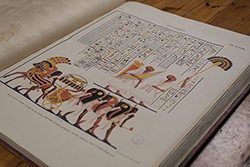
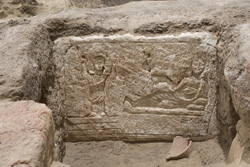
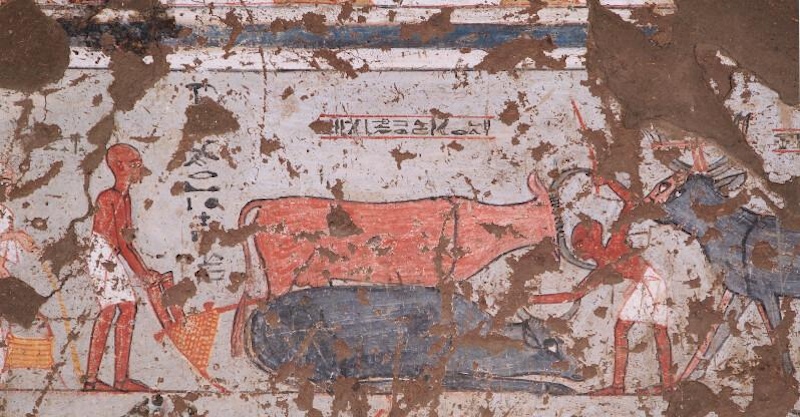
Cette scène provient de la tombe thébaine TT 16, celle du prêtre Panéhésy, qui vécut sous le règne de Ramsès II (XIIIe siècle av. J.-C.). Construite selon une logique symétrique, elle montre deux paires de bovins se faisant face et tirant l’araire.
Le caractère unique de cette scène tient dans la position des bovins de l’attelage de gauche : l’un est couché sur le sol ; l’autre détourne la tête vers le fond de la scène ! Un bouvier saisit chacun des bêtes par une corne, dans un effort de faire se lever la première, et d’immobiliser ou replacer dans l’axe la seconde. On ignore pour quelle raison l’artiste a imaginé que ces animaux auraient cessé d’obéir : maladresse du conducteur de l’araire ? mauvais traitements et usage excessif de la badine ?
Cette scène, en plus de nuancer le caractère idéalisé qui domine en général dans ces scènes dites « de la vie quotidienne », soulève la question de l’agentivité (agency) prêtée par les Égyptiens à leurs bêtes : dans quelle mesure les animaux étaient, selon eux, capables d’influencer une situation (et, de façon plus globale, leur histoire) par leurs prises d’initiative ?
Source : archives de l'Ifao : nu_2005_02471 ; © Ifao. Accessible sur le site https://archimage.ifao.egnet.net/.
NÉCROPOLE THÉBAINE, Dra Abou el-Naga, Secteur(s) Chapelle (TT_16 (Panehesy)), TT_16 (Panehesy). © Ifao / Gout, Jean-François, 2005
الثيران تتوقف عن العمل!
من بين نتائج تدجين الحيوانات استخدام بعض الأنواع في الأعمال — مثل الصيد، والنقل، والزراعة، وما إلى ذلك. وهكذا يظهر موضوع الزوج من الثيران اللذين يجران المحراث أثناء البذر في المقابر المصرية القديمة الخاصة منذ عصر الدولة القديمة.
تعود هذه المشهد إلى المقبرة الطيبية TT 16، وهي مقبرة الكاهن بانحيسي، الذي عاش في عهد رمسيس الثاني (القرن الثالث عشر قبل الميلاد). وقد شُيدت المقبرة وفقًا لمنطق التناظر، وتُظهر زوجين من الأبقار يقفان وجهًا لوجه ويجران المحراث.
يكمن الطابع الفريد لهذا المشهد في وضعية الثيران في العربة اليسرى: أحدهما مستلقي على الأرض؛ والآخر يحول رأسه نحو نهاية المشهد! ويقوم راعي الثيران بإمساك كل من الحيوانين من قرنه، في محاولة لإجبار الأول على النهوض، وتثبيت الثاني أو إعادة وضعه في محوره. ولا يُعرف السبب الذي دفع الفنان إلى تصور أن هذه الحيوانات قد توقفت عن الطاعة: هل كان ذلك بسبب عدم براعة سائق العربة؟ أم بسبب سوء المعاملة والاستخدام المفرط للعصا؟
هذه المشهد، بالإضافة إلى أنه يضفي بعض الاعتيادية على الطابع المثالي الذي يهيمن عمومًا على ما يُسمى بـ«مشاهد الحياة اليومية»، يطرح مسألة «القدرة على الفعل» التي نسبها المصريون إلى حيواناتهم: إلى أي مدى كانت الحيوانات، في رأيهم، قادرة على التأثير في موقف ما (وبشكل أعم، في تاريخها) من خلال مبادراتها؟
المصدر: أرشيف معهد الدراسات الفرنسية في الشرق الأدنى (Ifao): nu_2005_02471؛ © Ifao. متاح على الموقع https://archimage.ifao.egnet.net/.
The oxen have stopped working!
One of the consequences of animal domestication is the use of certain species for labour – hunting, transport, agriculture, etc. The motif of a pair of oxen pulling a plough during sowing thus appears in private ancient Egyptian tombs as early as the Old Kingdom.
This scene comes from the Theban tomb TT 16, that of the priest Panhesy, who lived during the reign of Ramses II (13th century BC). Constructed according to a symmetrical layout, it shows two pairs of oxen facing each other and pulling the plough.
What makes this scene unique is the position of the oxen in the left-hand team: one is lying on the ground; the other has turned its head towards the background of the scene! An ox-herder is grasping each animal by a horn, in an attempt to get the first one to stand up and to restrain or realign the second. It is unclear why the artist imagined that these animals would have stopped obeying: was it the cart driver’s clumsiness? Or perhaps mistreatment and excessive use of the whip?
This scene, as well as tempering the idealised nature that generally prevails in these so-called ‘scenes of daily life’, raises the question of the agency attributed by the Egyptians to their animals: to what extent did the Egyptians believe the animals were capable of influencing a situation (and, more broadly, their history) through their own initiative?
Source: Ifao archives: nu_2005_02471; © Ifao. Available at https://archimage.ifao.egnet.net/.
Images précédentes: